
Recommended Game Story · Shin Megami Tensei V: Vengeance Part 12
Chapters in this story
Creation Ending 3 · Destroying the Throne
Spoiler Notice: This series covers the Canon of Creation and Canon of Vengeance of Shin Megami Tensei V: Vengeance, including all six major endings. The two paths and their respective endings are distinct alternatives. This is not a transcription of the original game's dialogue or a novelization, but an original commentary and critique that interprets character choices and emotions based on key events. Unstated inner thoughts are distinguished as interpretations, and illustrations are AI reconstructions based on public materials.
In the Canon of Creation of Shin Megami Tensei V, the ending where the Throne is destroyed follows a trajectory fundamentally different from the existing options of conforming to the divine order or becoming a new god to reshape it. This is not merely a matter of victory or defeat, but a declaration that humanity will sever the massive shackles of divine rule forever. Through this path, intertwined with the complex relationship between Yakumo and Nuwa, we contemplate the weight of choosing a world without gods and the responsibility humanity must bear upon those ruins.
Chapter 1 · Refusing the Right to Become a God
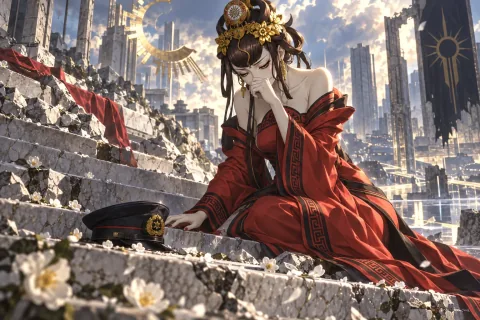
The ending that destroys the Throne offers the most radical answer to the question "What is a god?", a topic the Shin Megami Tensei series has long explored. As the Nahobino, the protagonist stands at the pinnacle where they could seize the power of a god, but instead of using that power to become a new god or replace the existing one, they choose to destroy the Throne itself. This is the result of realizing that the divine order does not save humanity but rather acts as shackles that limit human potential. The act of destroying the Throne does not simply mean a change in power; it is a powerful expression of will to invalidate the very structure where a being called "god" reigns over human life.
On the path of destroying the Throne, Yakumo is killed by the attacks of Abdiel and Dazai, leaving Nuwa behind. The fact that someone who strongly advocated for human self-reliance could not complete their purpose does not immediately refute that argument, nor does it automatically make it correct. Following Nuwa's reaction, one can read that her faith in humanity and her attachment to the individual, Yakumo, were relationships difficult to separate. Even after he disappears, the problem of choice remains before the protagonist.
Nuwa is a divine being who was with the human Yakumo from the beginning. Therefore, explaining that her interest in humanity only arose at the moment of his death would erase their prior companionship. When understanding Nuwa after her loss, one must remember that there was already an accumulated relationship. It is not the case that in the general Throne-destruction path, she simply hands over her power to the protagonist to fuse. Another possibility of creation presented when conditions are met is a separate branch for the next playthrough.
The moment the protagonist destroys the Throne, the sky of Da'at collapses, and the divine hierarchy crumbles. While this scene is visually destructive, narratively, it signals the prelude to liberation. What remains in the place where divine power has vanished is only human will and the future they will create for themselves. This may be frightening for humans who were comfortable under divine protection, but it is also the beginning of true freedom, where they can forge their own destiny without relying on the decisions of others. The destruction of the Throne does not mean the absence of gods, but a declaration that humans will stand as subjects, not as agents of gods.
Through this ending, the player realizes how heavy the responsibility of using divine power is. Choosing to destroy the Throne is one of the most difficult paths in the game, showing how much courage it takes to reject divine power. This goes beyond mere systemic difficulty; it is an ethical decision to abandon the comfort provided by the divine order and choose an uncertain future. Through the protagonist's hands, the player destroys the Throne of God, facing both the hardships and the hope that humanity must endure in a world where divine rule has vanished.
The ending of destroying the Throne is like a coming-of-age ceremony where humanity becomes independent from gods. On the ruins where the divine order has disappeared, humans must no longer ask for the will of gods, but must ask for each other's will to live. Nuwa helping the protagonist by inheriting Yakumo's will suggests that even divine power gains value only when it serves human will. This ending does not end with the destruction of the Throne, but concludes by asking us how humanity will build a new order upon its fragments.
Chapter 2 · What Freedom in the Ruins Demands
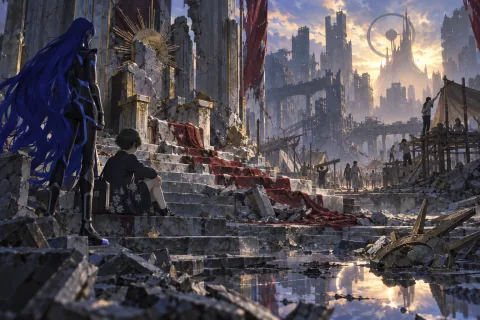
The world immediately after destroying the Throne is not peaceful. The disappearance of the divine order does not automatically mean that the existing threats of Da'at and demons vanish. While there is a belief in the possibility of humans joining forces to survive, safety is not guaranteed, and this general branch is clearly distinguished from the path of creating a new world through the final battle with Lucifer. Surviving in the ruins becomes a matter of human will, not divine grace, and forces one to face the fact that constant effort and solidarity are required to maintain freedom.
The act of destroying the Throne is a rejection of the logic of domination, but it is also an act of taking on the responsibility of survival. Unlike the past, where safety was guaranteed by relying on the logic of the strong, humans must now build safety with their own power. This is different from the survival logic of the strong that ignores the weak. True freedom includes not only rejecting the domination of others but also the responsibility of preparing the conditions to protect and live with each other as members of a community. The sight of humans joining forces to live in the world after the destruction of the Throne shows the possibility that humans can unite without divine rule.
In this ending, human freedom is not the freedom of an isolated individual, but freedom that aims to live by relying on each other within a community. In a world where the divine order has disappeared, humans are reborn not as tools following the will of gods, but as subjects who respect each other's lives. This is well revealed in the way humans help each other and live in the barren land of Da'at. They do not wait for divine miracles, but build shelters and find food with their own hands. This appearance proves that humans are beings who can sufficiently sustain life without the help of gods.
The Throne-destruction ending has a different texture from the grand world-recreation like the final battle with Lucifer. It does not focus on establishing a new god or completely redesigning the world, but on removing the existing oppressive structure and preparing a foundation where humans can live on their own. This is a method that places human life itself at the center, rather than fitting human life to the plans of gods. This ending paradoxically shows how much of an oppression the divine order was to humans, emphasizing that the absence of gods is actually an opportunity for humanity.
Through this ending, the player must look at the ruins where the Throne of God has disappeared and find hope within them. A world where safety is not guaranteed is anxious, but it is also a space of possibility where anything can happen. As the protagonist, the player watches this world and witnesses the process of humans rising with their own power. This is a much more difficult and arduous path than saving the world by borrowing the power of gods, but it is a choice that is all the more valuable. Through this ending, the player feels the weight of true freedom and continues to think about human potential even after the game ends.
The ending of destroying the Throne declares that the age of gods has passed and the age of humanity has arrived. In the place where the divine order has disappeared, humans will establish their own laws and morals, and live by protecting each other. This ending may not be a perfect happy ending, but it is the most human ending where humans can decide their own destiny. Humans standing on the ruins after destroying the Throne are now ready to step out of the shadow of gods and write a new history under their own sun. Instead of asking about the existence of gods, this ending asks us how we should live as humans.
Scope of Materials and Interpretation
As of October 16, 2026 (Bangkok), official work and character introductions have been cross-referenced with the ending, character, and quest materials below. Official introductions were checked only for the scope of disclosure, and fan wikis and guides are distinguished as separate materials. This is a text for an overview of major events and original critique, not a reenactment of all dialogue or gameplay scenes, nor an official novel. Optional quests and developments by version/path are not combined into facts common to all playthroughs.
Megami Tensei Wiki — Path-specific actions of Yakumo and Nuwa
Megami Tensei Wiki — Comparison of the world and events of Shin Megami Tensei V
PowerPyx — Six endings and additional branch conditions for the Canon of Creation
comments 0