
Recommended Game Story · Shin Megami Tensei V: Vengeance Part 23
Chapters in this story
Vengeance Ending 2 · Starting Anew from Chaos
Spoiler Notice: This series covers the Canon of Creation and Canon of Vengeance in Shin Megami Tensei V: Vengeance, including all six major endings. The two paths and their respective endings are distinct alternatives. This is not a transcription of the original game's dialogue or a novelization, but an original commentary and critique that interprets character choices and emotions based on key events. Unstated inner thoughts are distinguished as interpretations, and illustrations are AI reconstructions based on public materials.
The Chaos path in the Canon of Vengeance of Shin Megami Tensei V: Vengeance delves into the contradictions inherent in the existing order of creation, cracking the rigid worldview constructed by the agents of God. This path, taken with Yoko, is more than just overthrowing the existing system; it is an attempt to dismantle the foundation of every value system defined by gods and demons. We examine the departure of Tao and the fictional nature of the human trials symbolized by Mastema, and explore the true meaning of the world after destruction that Yoko dreams of. Before the throne reached after traversing the desolate lands of Da'at, the ending chosen by the protagonist and Yoko is a lonely struggle to break the existing cycle and a desperate struggle for a new birth. We critically illuminate the journey of those who move toward the freedom of chaos, for which they must take responsibility themselves, rather than the peace forced by God's order.
Chapter 1 · Questioning the Structure of the Throne with Yoko
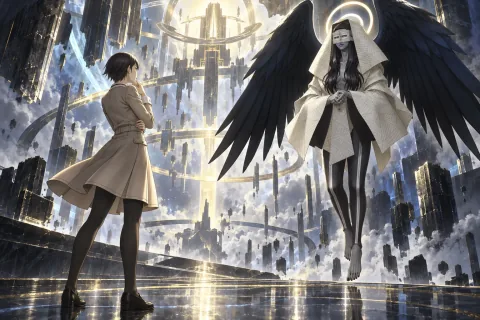
In the Chaos path with Yoko, Tao leaves, and Mastema steals Tiamat to block the protagonist. Mastema is a being who acts under the pretext of testing humans and judging the results according to God's will; after defeating Tiamat, one must fight Mastema himself. The final battle with Lucifer follows, and by defeating him, one attempts to escape the existing cycle. His actions are a stark example of how God's authority standardizes and suppresses human life.
Mastema asserts the authority to test human faith in the name of God. When Yoko and the protagonist reject his plans, he even uses Tiamat's power to block their path. In this behavior, one can read an attitude of trying to confine humans within a framework he has permitted, rather than respecting their choices. However, one must distinguish between criticizing Mastema's exercise of power within the work and judging all faith or religious people in reality in the same way.
Yoko is the character who resists this logic of Mastema most strongly. She rejects the value system that God's order imposes on humans and seeks to uncover the roots of the world with her own power. The reason Yoko's purpose cannot be dismissed as mere expression of anger or personal revenge is that what she aims for lies in the liberation of existence beyond the overthrow of the existing system. She rejects the fate of having to live according to God's will and seeks to lay the foundation for humans to determine their own destiny. This represents the most fundamental desire of humans who refuse to live as passive beings under God's order.
In the process of defeating Tiamat and directly confronting Mastema, the protagonist experiences the crumbling of the solid walls built by God's order. The emotion felt during this process is closer to a complex state where emptiness and liberation are mixed, rather than a sense of victory. The moment one confirms how fragile the world kept by God's agents actually was, the player witnesses the collapse of existing values. This is the narrative catharsis provided by the game, and at the same time, a point that foreshadows the loneliness of humans who must face a world where God's order has disappeared.
The final battle with Mastema demands a critical reflection on how God's authority intervenes in human life. The human trial he claims is, in fact, not a process of growing humans, but merely a shackle that makes them submit to God's control. Breaking this shackle with Yoko is an act of denying all norms and moral standards set by God's agents. This is not criticizing religious beliefs in reality, but taking issue with the structure itself that suppresses human freedom in the name of God. Through this process, the player ponders what true freedom is and what must be sacrificed to obtain it.
Ultimately, the Chaos path with Yoko is an attempt to completely deny the world ruled by God's order and rewrite it from its roots. By defeating Mastema, the protagonist and Yoko move toward a new possibility where there are no agents of God, or where God's authority no longer dictates human destiny. This is a challenge to change the fundamental structure of the world, which is on a different level from maintaining the existing order or replacing it with another. The chaos faced at the end of this journey implies that it will not only mean destruction, but will become fertile soil for a new creation.
Chapter 2 · A New Possibility Left in a Single Universe
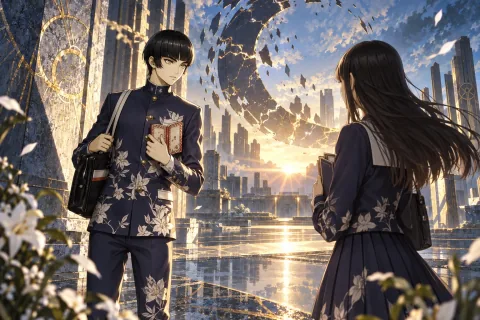
The ending chosen by the protagonist and Yoko contains the will to erase the existing world from its roots and start again from primordial chaos. This is fundamentally different from the general Neutral ending of the Canon of Creation, which merely destroys the throne and leaves ruins. If the Neutral ending of the Canon of Creation stops at destroying the existing order system, this ending with Yoko is an attempt to tear down the foundation of order itself and create something from nothing. It can be called a radical choice to break the cycle of the world and build a fundamental restart involving both humans and demons.
What this ending implies is that the replacement of order and the replacement of the foundation that gives birth to order are completely different. If the existing order defined life according to God's will, the new beginning chosen with Yoko opens up the possibility for oneself to define one's own life. Of course, this does not guarantee a utopia. Rather, a world without God's protection and control may contain greater chaos and danger. However, the will to pioneer one's own destiny even while taking that risk is the core of this ending, and this is read as a process of restoring the subjectivity of existence.
In the epilogue, the new meeting between the protagonist and Yoko turns the gaze back to a small relationship after a decision of cosmic scale. It cannot be confirmed from this short scene alone that all demons have disappeared or that there are no threats in the future. What the two tried to change and what kind of life they will create in the future are questions on different levels. Even amidst the anticipation of a new start, the weight of the choice to erase the world that already existed for that start remains.
The freedom promised by this ending is never given for free. It is obtained at the cost of erasing the existing world and abandoning all the legacies left by God's order. Through this process, the player realizes the weight of freedom. Between a life settled under God's protection and freedom in chaos for which one must take responsibility, what choice will one make? The game asks this question, showing that the journey with Yoko was not merely a destructive act, but a necessary rite of passage to be reborn as a subject in the true sense.
A conclusion that says it guaranteed eternal freedom by erasing all multiple worlds is an oversimplification of the meaning of this ending. Rather, this ending is significant in that it broke the cycle of loops forced by God's order and returned the right to choose. Whatever the result of that choice, it is a share that one must bear oneself. What Yoko and the protagonist showed is not the construction of a perfect world, but the possibility itself that the world can be restarted by one's own power. This is a powerful message that awakens the potential that was suppressed under God's order.
Ultimately, the Chaos ending with Yoko is the strongest denial of the world ruled by God's order, and at the same time, the deepest affirmation of life. The sight of them tearing down the solid walls built by God's agents and starting over on the ruins, even if they look lonely, is more subjective than any mythical hero. Through this journey, the player witnesses the dignity of pioneering life with one's own will, not God's authority.
Scope of Data and Interpretation
As of October 16, 2026 (Bangkok), official work and character introductions were cross-referenced with the ending, character, and quest data below. Official introductions were checked only for the scope of disclosure, and fan wikis and walkthroughs are classified as separate materials. This is a text for an overview of major events and original critique, not a reenactment of all dialogue/play scenes or an official novel. Choice quests and developments by version/path are not combined into facts common to all playthroughs.
Megami Tensei Wiki — Yoko's background and path-specific choice comparison
Megami Tensei Wiki — Background of Tiamat and the Creation system
PowerPyx — Six endings and additional branching conditions for the Canon of Creation
comments 0