
Recommended Game Story · Shin Megami Tensei V: Vengeance Part 11
Chapters in this story
Creation Ending 2 · A Tokyo of Myriad Gods
Spoiler Notice: This series covers the Canon of Creation and Canon of Vengeance of Shin Megami Tensei V: Vengeance, including all six major endings. The two paths and each ending are distinct alternatives. This is not a transcription of the original game's dialogue or a novelization, but an original commentary and critique that reads the characters' choices and emotions based on major events. Unstated inner thoughts are distinguished as interpretation, and illustrations are AI reconstructions referencing public materials.
The creation in Shin Megami Tensei V is a philosophical decision that asks what values should be prioritized over the ruins of a destroyed Tokyo. The path of creation led by Yuzuru and Tsukuyomi aims for a polytheistic world where gods and humans coexist, each maintaining their own faith. This is a process of rejecting the order of a monotheistic god and building a world where fragmented mythologies have their respective domains respected. We critically examine the sense of responsibility Yuzuru carries and the significance of the polytheistic world he chooses. We analyze the ethical cost of a Tokyo where myriad gods coexist—whether it is a peaceful paradise or an unstable compromise harboring the seeds of conflict.
Chapter 1 · Recreating the City One Sought to Protect
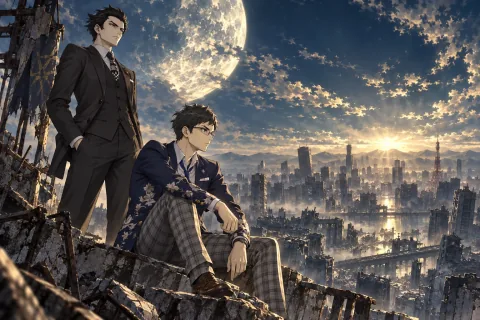
The choice to save Tokyo and recreate the world is close to the polytheistic future envisioned by Yuzuru and Tsukuyomi. The protagonist confronts other candidates and proceeds to a new creation after facing Lucifer. In this path, the protagonist does not fuse anew with Tsukuyomi. The union of Yuzuru and Tsukuyomi is a separate candidacy, and the protagonist's companion remains Aogami. One must distinguish between having similar goals and becoming the same entity.
Interpreting Yuzuru's motivation solely as a personal dimension of protecting his sister, Miyazu, is reductive. In a situation where the community of Tokyo is collapsing, he carries out a public responsibility to preserve the minimum social unit capable of maintaining human dignity and daily life. While other creation candidates attempt to completely reorganize the world to impose their own ideals, Yuzuru seeks to make the roots of the society he belongs to the foundation of the world. This takes the form of conservative yet realistic reform.
Yuzuru constantly struggles between his identity as a Nahobino and his self-awareness as a human. Even while wielding the power of a god by merging with Tsukuyomi, he tries not to let go of his identity as a citizen of Tokyo. This attitude contrasts with other candidates who wish to reshape the world to their own tastes. He seeks to perpetuate the image of the Tokyo he loved by borrowing the power of a god, which can be evaluated as an autonomous attempt to rebuild the human world, refusing to remain a tool of the gods.
Whether Yuzuru's choice has the legitimacy to represent the entire world must be critically examined. The restoration of one nation and the equality of all beings are separate propositions. The peace of Tokyo that Yuzuru sought to protect can become an exclusive barrier to beings from other dimensions. The choice to accept the sacrifice of others to protect what one loves reveals the fundamental violence inherent in the act of creation. The stronger the will to protect, the more that will becomes a barrier facing outward.
The polytheistic world Yuzuru aims for is liberating in that it rejects the rule of a monotheistic god, but it leaves room for the interests of the gods to collide. The fact that gods coexist with their own domains means that the points of conflict are pluralized. Yuzuru takes on the role of a mediator to adjust these conflicts, but it is uncertain whether human wisdom can forever control the desires of the gods. This creation is not a perfect solution, but a product of compromise that defers conflict to the next generation.
Chapter 2 · The Conflict Inherent in Diversity
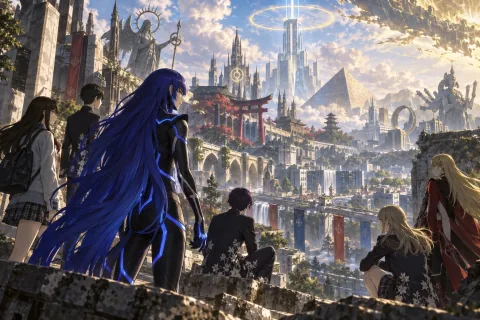
Creating a Tokyo where myriad gods coexist means a world of complex, intertwined interests, not a world dominated by a single set of values. While it may superficially appear to be a society that respects diversity, in reality, it is an environment where conflict can occur at any time. The world Yuzuru created is not a static state of peace, but one predicated on dynamic tension. The fact that beings with different faiths and values live together in one space requires constant dialogue and compromise.
In this ending, diversity is both an object of praise and a task to be overcome. The sight of different gods claiming their own domains and coexisting is like a microcosm of a democratic society, but the absence of an absolute norm to bind them together is a fatal weakness. Yuzuru is destined to constantly strive to manage this diversity, and his rule will be a tightrope walk, maintaining a precarious balance amidst the power struggles of the gods. The conflict inherent in diversity is an unavoidable fate.
Dreaming of a world without war is an age-old human wish, but Yuzuru's creation shows a state where war has not disappeared, but a balance of power has been formed that can suppress it. This suggests that peace is not an eternal promise, but a state that requires constant vigilance and effort. Acknowledging diversity means accepting the existence of the other, but it also means having to endure the pain that arises when the other's difference conflicts with one's own values.
The implication of this ending lies in the value of the freedom to choose and the absence of institutions to support that freedom. Yuzuru granted the gods their own domains, but there are no concrete laws or institutions to mediate conflicts between those domains. This is reminiscent of international relations or social conflicts in the real world, making one think about how ideal diversity can be corrupted in reality. This ending coldly shows that freedom is a fine line away from indulgence, and diversity is two sides of the same coin as division.
Yuzuru's creation is an attempt to replace a mythical narrative with a human political narrative. The process of ending the era ruled by gods and having humans establish their own order by borrowing the power of gods can be read as a humanistic victory. However, the price of that victory is harsh, and Yuzuru is placed in the position of an administrator who must forever watch the gods' eyes to protect Tokyo. His choice is less of a heroic narrative and more of a desperate struggle to hold onto a world that is perishing.
Scope of Materials and Interpretation
As of October 16, 2026 (Bangkok), official work and character introductions have been cross-referenced with the ending, character, and quest materials below. Official introductions were only checked for the scope of disclosure, and fan wikis and walkthroughs are distinguished as separate materials. This is a text for an overview of major events and original critique, not a reenactment of all dialogue or gameplay scenes, nor an official novel. Choice quests and developments by version/path are not consolidated into facts common to all playthroughs.
Megami Tensei Wiki — Comparison of the World and Events of Shin Megami Tensei V
PowerPyx — Six Endings and Additional Branching Conditions for the Canon of Creation
comments 0