
Recommended Game Story · Shin Megami Tensei V: Vengeance Part 16
Chapters in this story
Vengeance Route · Suspicion and Rescue in Shinjuku
Spoiler Notice: This series covers the Canon of Creation and Canon of Vengeance of Shin Megami Tensei V: Vengeance, including all six major endings. The two paths and their respective endings are distinct alternatives. This is not a transcription of the original game's dialogue or a novelization, but an original commentary and critique that reads into the choices and emotions of the characters based on major events. Unstated inner thoughts are distinguished as interpretations, and illustrations are AI reconstructions based on public materials.
The mid-game of the Shin Megami Tensei V: Vengeance route deviates from the familiar trajectory of the Canon of Creation, showcasing a complex entanglement of interests between humans, demons, and angels on the new stage of Shinjuku. The appearance of the enigmatic being known as Mastema poses dual questions of salvation and ruin to the player, accelerating the psychological isolation experienced by the protagonist's party and the rifts between companions. This installment covers the rescue operation unfolding within the ruins of Shinjuku and the clash of beliefs hidden behind it.
Chapter 1 · The Angel Named Savior
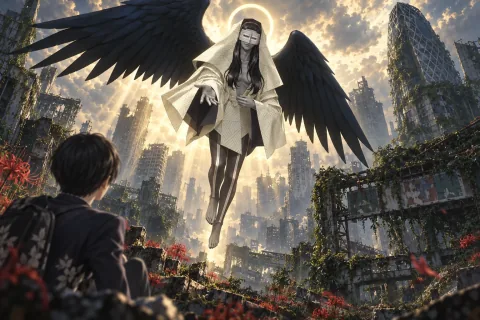
The mid-game of the Vengeance route unfolds primarily in Shinjuku rather than the Chiyoda Demon King's Castle. The angel Mastema appears, making contact with the protagonist's party under the pretext of pursuing the Qadistu. He presents himself as a helper with the stated goal of testing human faith, but his words and actions harbor independent intentions distinct from the order of Bethel. The player is placed in a situation where they must constantly judge whether the information he provides is a genuine helping hand or a means to achieve his own ends.
The members of the Qadistu—Naamah, Aysheth, Agrath, and Lilith—are beings who harvest Magatsuhi from human suffering. While they justify their vengeance based on the history of oppression they endured in the past, the indiscriminate violence they currently perpetrate in Shinjuku sacrifices innocent humans, regardless of their stated cause. The game presents their past narratives while refusing to defend the legitimacy of their current violence, maintaining a complex structure of conflict.
The proposition put forth by Mastema—that he is testing human faith—reveals him to be an observer and an architect. He is not merely tracking demons; he is observing and orchestrating the process to see what choices humans make in extreme situations. While his logic appears on the surface to be about upholding order, the intentions hidden beneath are distinctly different from Bethel's methods of control, providing the player with a persistent sense of uncertain tension.
The history of oppression claimed by the Qadistu may be a clear truth from their perspective, but it cannot serve as an absolution for the violence currently directed at innocent humans. At this point, the game cleverly twists the dichotomy of good and evil. Between the screams of demons crying for vengeance and the cold smile of the angel standing in their way, the player is left to ponder whose side to take, or whether this conflict itself is merely a game of chess played by greater powers.
The existence of Mastema is also a device that clearly exposes the limitations of the organization known as Bethel. If Bethel values order and control, Mastema chooses to exploit the cracks in that order to shake the fragile faith of humans. He instrumentalizes humans under the guise of saving them, showing a cold-bloodedness that accepts even the tragedies occurring in that process as part of his plan. These multi-layered aspects of the character are key elements that make the narrative of the Vengeance route more three-dimensional.
The journey into the depths of Shinjuku is less a process of finding the truth and more a process of walking into a deeper labyrinth. The player must combine the fragments of information he provides and judge whether he is truly a savior or another form of predator. The distrust and suspicion felt during this process heighten the game's immersion, providing a unique experience where the player feels as though their own beliefs are being tested.
Chapter 2 · Yuzuru Searching for Miyazu and the Wavering Dazai
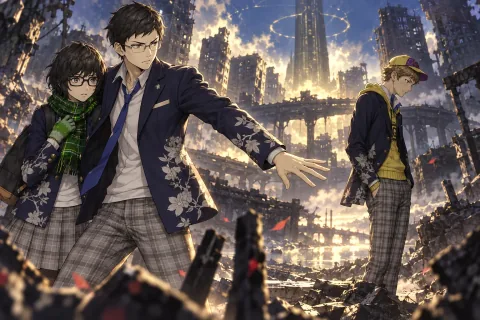
In the Shinjuku of the Vengeance route, the rescue of Miyazu leads to conflict with Yuzuru and Hayataro, serving as a catalyst that dramatically changes the inner selves of both Yuzuru and Dazai. Yuzuru's desperation to rescue Miyazu becomes a powerful motivation that dominates his actions, and his obsession with protecting his companion sometimes leads to pushing those around him. This will intertwine with Bethel's power structure, serving as an indicator of how deeply he is buried in the organization's logic.
Dazai experiences an identity crisis amidst the sense of helplessness he feels. He attempts to prove his own worth by relying on powerful beings or authoritative systems, but reality is far from the justice he expected. In contrast to the determination Yuzuru shows in the process of rescuing Miyazu, Dazai suffers from the fact that he can do nothing, and he gradually becomes more vulnerable to the temptation of authority.
Yuzuru's sense of responsibility is a double-edged sword that isolates him. He tries to faithfully follow Bethel's orders to protect Miyazu, but the sacrifices and compromises that occur in the process slowly eat away at his inner self. The protective instinct he displays stems from human warmth, but the way it gradually turns coercive and exclusionary evokes pity from the player. He finds himself in a paradoxical situation where the more he tries to save his companion, the further he drifts from his companions.
The helplessness Dazai feels does not come simply from a lack of power, but is closer to a mental panic stemming from the collapse of the values he believed in. Without a clear goal like Yuzuru, he struggles to find meaning in his existence while being swept up by the situation. This unstable psychology of Dazai acts as foreshadowing for the choices he will make later, and through his wavering gaze, the player witnesses how easily humans can lose their way in the realm of the gods.
Their relationship is depicted even more tragically in conjunction with the spatial background of the ruins of Shinjuku. The collapsed buildings and desolate streets visually represent the psychological disconnection they experience. When Yuzuru runs toward Miyazu, the image of Dazai left behind symbolically shows how the two people's values are diverging. They started toward the same goal, but the pain and choices they experience in the process are leading them in different directions.
The player watches the conflict between these two characters and, beyond simply solving the event, contemplates their inner growth. Yuzuru's obsession and Dazai's helplessness well illustrate the human weakness and the weight of the choices that follow, which the Vengeance route deals with. Watching how their relationship meets catastrophe or faces a new phase is one of the important narrative experiences that permeate the Vengeance route, making the player think again about the weight of the characters' choices.
Scope of Materials and Interpretation
As of October 16, 2026 (Bangkok), official work and character introductions have been cross-referenced with the ending, character, and quest data below. Official introductions were verified only for public scope, and fan wikis and walkthroughs are treated as separate materials. This is a text for an overview of major events and original critique, not a reenactment of all dialogue or gameplay scenes, nor an official novel. Optional quests and developments by version/route are not consolidated as facts common to all playthroughs.
SEGA·ATLUS Official Story & Character Introduction
comments 0