
Recommended Game Story · Shin Megami Tensei V: Vengeance Part 13
Chapters in this story
Creation Ending 4 · A World for Humanity Alone
Spoiler Notice: This series covers the Canon of Creation and Canon of Vengeance in Shin Megami Tensei V: Vengeance, including the six major endings. Both paths and their respective endings are distinct alternatives. This is not a transcript of game dialogue or a novelization, but an original commentary and critique that reads the characters' choices and emotions based on key events. Unstated inner thoughts are distinguished as interpretations, and illustrations are AI reconstructions based on public materials.
The World for Humanity Alone is an additional branch distinct from the standard Destroy the Throne ending in the Canon of Creation. While the player initially chooses the intent to destroy the throne, accepting the new possibility presented by Nuwa when specific conditions are met leads to the actual use of the power of creation. Understanding this distinction reveals the paradox between the goal of eliminating divine and demonic intervention and the means used to achieve it. For those who remember the non-human companions they fought alongside, the return to a familiar daily life may not feel like a simple reward.
Chapter 1 · Can You Erase the Lives You Have Witnessed?
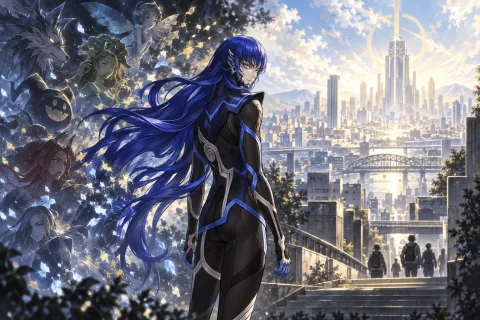
This additional branch is not a path that opens by chance from the rubble after destroying the throne. It occurs when Nuwa presents a different possibility to the protagonist who has set their intent to destroy the throne; choosing this leads to creating a world for humanity alone through the act of creation. If the necessary side quests have not been completed, this option is not presented. The starting point for reading this ending is the tension between the means and the end: a person who sought to reject divine power uses that very power to create a world without gods.
The ethical cost of this choice is directly linked to the solitude the protagonist must bear. Eradicating the possibilities of other species for the sake of human prosperity is no different from trapping oneself within the narrow framework of anthropocentrism. The demons encountered in the game were not mere enemies, but individuals with their own beliefs and desires. Excluding them to create a world solely for humans may be the most stark manifestation of human arrogance. The player is left to ask themselves whether the human species they wish to protect is truly worth such a sacrifice.
This additional possibility opens only when conditions are met, such as completing the continuous quests that include the choice to spare Khonsu, the story related to Fionn, and defeating Shiva. The structure where one must build more relationships with demons to choose a world without them creates a strange paradox. The final confrontation with Lucifer cannot be explained simply as removing an enemy who guards the existing order. This is because Lucifer himself seeks to escape the cycle of creation and proposes a decisive battle for the protagonist to obtain his Knowledge.
Friendship with demons is a factor that makes this choice even more painful. Although the protagonist gained power beyond human limits while with Aogami, using that power to create a world only for humans is tantamount to denying a part of their own identity. Can humanity truly be whole in a world where the demons who were their companions have vanished? While this ending appears to show humanity becoming independent from gods, it inherently carries the risk of causing humanity to isolate itself.
In the process of moving toward this ending, the player must reconcile the narratives of countless demons. For a player who has come to understand the wishes and sorrows of beings like Khonsu or Fionn through continuous quests, this ending can become a choice that erases their existence. Yet, paradoxically, because the world is built upon their sacrifices, humanity may need to feel an even stronger sense of responsibility. This choice is not a simple victory, but a heavy declaration that humanity has decided to shoulder its own destiny.
Chapter 2 · The Empty Space Left in the Returned Daily Life
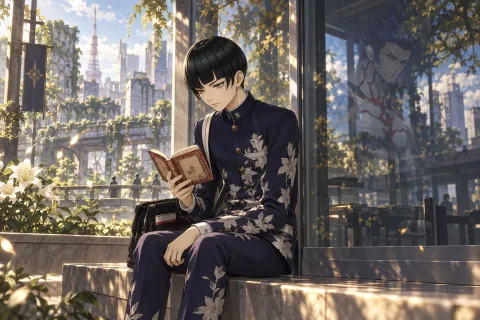
The protagonist's appearance upon returning to daily life in Tokyo after the creation is complete seems peaceful, but a deep sense of loss lies beneath the surface. In a world where the intervention of demons and gods has vanished, Tokyo has returned to being a space for ordinary students. However, Aogami is no longer by the protagonist's side. The time spent as a Nahobino, the conversations shared while traversing the rough lands of Da'at, and the bonds formed have now become mere afterimages in the protagonist's memory. This ordinary daily life paradoxically proves the magnitude of what they have lost.
Unlike the endings of the Canon of Vengeance, this Canon of Creation ending feels more like the weight of the loss paid as a price rather than a sense of achievement for completing a world for humanity. The protagonist excluded gods and demons by their own hand, but what they gained as a result is an isolated human world. Daily life as a student is peaceful, but that peace feels like a landscape seen through a glass wall. The transcendental experiences the protagonist underwent have now become secrets that cannot be shared with anyone, and they must return to the narrow framework of an ordinary human life.
It is crucial not to romanticize this ending. While many attempt to interpret this ending as a human-centric utopia, the game does not hide the emotional void the protagonist experiences during the process. The journey with Aogami was more than a simple partnership; it was a process of the protagonist growing into a being beyond humanity. That the journey has ended does not mean the protagonist's growth has stopped, but that they have chosen a life as a human once again. However, the solitude brought by that choice leaves a deep lingering impression on the player.
The judgment to erase other existences for the sake of humanity is an ethically complex issue. Watching this ending, the player is left to ponder whether they truly have the right to sacrifice the lives of other beings for a world solely for humanity. The game does not provide a correct answer. It merely induces the player to evaluate the value of this choice themselves by showing how empty the daily life to which the protagonist has returned is. Readers who have learned about the relationship between humans and demons will intuitively know that this ending is not simply a happy ending.
The sight of the protagonist returning to being a student and living a daily life makes the massive events they experienced feel like a dream. But that dream has changed reality. In a world without the order of gods or the chaos of demons, humanity must now pioneer its own future with its own strength. This ending gave humanity freedom, but at the same time, it burdened them with the responsibility to sustain that freedom. The protagonist's empty space might symbolize the weight of the responsibility they must bear.
Scope of Materials and Interpretation
As of October 16, 2026 (Bangkok), official work and character introductions have been cross-referenced with the ending, character, and quest materials below. Official introductions were checked only for the scope of disclosure, and fan wikis and walkthroughs are categorized as separate materials. This is a text for an overview of key events and original critique, not a reenactment of all dialogue or gameplay scenes, nor an official novel. Choice quests and developments by version/path are not consolidated into facts common to all playthroughs.
PowerPyx — Six Endings and Additional Branch Conditions for the Canon of Creation
Megami Tensei Wiki — Comparison of the World and Events of Shin Megami Tensei V
comments 0