
Operator Recommended Game Story · Warhammer 40,000 Part 23
Chapters in this story
- Spoiler and the scope of this episode
- Table of Contents for this episode
- 1. A Different Faith Echoing in the Heart of the Empire
- 2. The Key Offered by Horus
- 3. When the Vaults of Moravec Opened
- 4. The Death of Innocence
- 5. Those Seeking a Different Path
- 6. The Defense of Magma City
- 7. A War Where the Shape of Machines Changes
- 8. The Expedition to Recover War Materiel
- 9. Two Fabricator-Generals and Divided Hunters
- 10. 007.M31: Resistance Continuing from the Underground
- 11. 013.M31: Signals Aimed at Terra
- 12. Remaining Knowledge and Vanished Possibilities
- Reading names and concepts together
- Previously published connection episodes
- Official materials and verification scope
Spoiler and the scope of this episode
This episode covers the schism of the Mechanicum that occurred on Mars during the Horus Heresy. The events begin with the preparations for betrayal around the time of Isstvan and continue through to the resistance at the end of the war. Since the Martian Civil War was not a single day's battle, this text is organized to distinguish between the flows of 005.M31, 007.M31, and 013.M31. This narrative commentary is written based on the scope confirmed through the public sample of 'Mechanicum', official history introductions, and the 2024 Martian Civil War campaign commentary. It is not a translation of the novel's original text or dialogue; the atmosphere of the scenes and the illustrations are reconstructions. It does not claim to have verified the entire development of the novel dealing with the secrets of Mars or every individual battle.
Table of Contents for this episode
- A Different Faith Echoing in the Heart of the Empire / 2. The Key Offered by Horus / 3. When the Vaults of Moravec Opened / 4. The Death of Innocence / 5. Those Seeking a Different Path / 6. The Defense of Magma City / 7. A War Where the Shape of Machines Changes / 8. The Expedition to Recover War Materiel / 9. Two Fabricator-Generals and Divided Hunters / 10. 007.M31: Resistance Continuing from the Underground / 11. 013.M31: Signals Aimed at Terra / 12. Remaining Knowledge and Vanished Possibilities
1. A Different Faith Echoing in the Heart of the Empire
Warships departing from Terra to the galaxy passed through the hands of Mars. From the armor of the Legions and the weapons of soldiers to massive walking war machines and the technology to maintain them, the victories of the Great Crusade were not forged on the battlefield alone. There were factories fueling the fires from behind so that the Emperor's armies could depart for the next planet. The priests of the Red Planet controlled those fires, and their power was more than just production output.
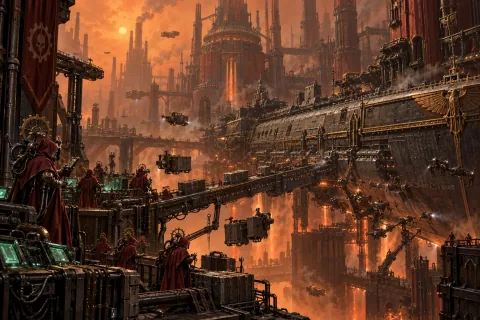
Mars was not a planet completely transformed by the ways of Terra. The Empire led by the Emperor and the Mechanicum, which served the Machine God, combined based on each other's needs. The tech-priests, possessing technology and industry, sought to preserve their own faith and governing structure, and the Empire needed their factories. The strength of the alliance lay in the fact that two different powers made a single war possible. However, that difference did not disappear on its own as time passed.
The power of each Forge World was complex. Official history introductions describe factory planets that maintained strong independence and a semi-feudal hierarchy woven with mysterious disciplines. It was not a simple organization where all tech-priests moved with the same thought at the command of one person. There were powers that possessed their own production facilities, knowledge, followers, and armies. To understand the Martian Civil War, one should not visualize them in the same shape as the command structure of a single Legion.
Technology and experiments forbidden by the Emperor were also at the center of the conflict. What knowledge could be opened and what should be kept closed? Who could set those boundaries? Among the tech-priests who had fought alongside the Empire, there were those who suspected that their independence was maintained only as long as it was convenient for the Emperor. Horus entered through that gap. The proposal of betrayal reached not only planets far from Terra but also the closest industrial worlds that supported Terra.
2. The Key Offered by Horus
Horus did not see Mars as just a factory that could be destroyed. It was important to turn its production capacity and weaponry to his side in the coming war. Once the loyalists and traitors were divided, weapons made in the same Empire would be turned against each other. Along with which side had stronger soldiers, which side could continue to arm those soldiers would determine the direction of the war.
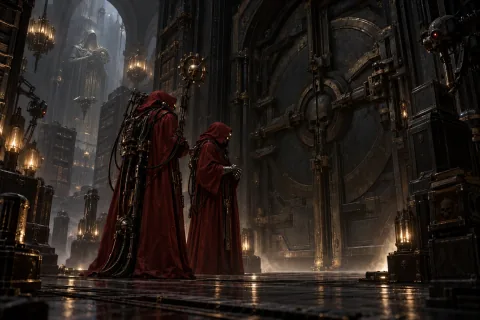
His envoy, Regulus, visited Kelbor-Hal, the Fabricator-General of Mars. Official Dark Mechanicum history introductions link this meeting to the preparations before the betrayal was fully revealed. The proposal Regulus brought included a way to open the Vaults of Moravec, which the Emperor had personally sealed. It was forbidden knowledge that had been closed under the restrictions of Terra. To the tech-priests, it was a temptation that could not be calculated in land or gold alone.
The official record that Iron Hands loyal to Horus accompanied this delegation is particularly sharp when read alongside the previous chapter. The tragedy suffered by Ferrus Manus and the loyalist X Legion at Isstvan and the claim that every member of the Iron Hands always made the same choice are different things. This record speaks of the accompaniment of a specific delegation. It does not expand that to mean the entire Legion turned to Horus. The division of the Imperium was also a war where one could not know an individual's loyalty solely by the name of their organization.
Kelbor-Hal's choice was not the choice of all of Mars. There were high-ranking priests under the Fabricator-General who refused to follow Horus, and the intertwined power structure was not easily bound in one direction. For the traitors, along with opening the vaults, the task of eliminating opponents remained. For Mars to fall entirely into the hands of Horus, they had to break the factories and armies of their dissenting peers.
3. When the Vaults of Moravec Opened
The place where the seals were broken was not just a library that safely stored lost knowledge. Official introductions describe these vaults as places where a sinister intelligence, not belonging to the material world, whispered secrets in the darkness of ancient data repositories. While the war outside was revealed through ships and Legions, the first lethal attack on Mars chose a quieter passage.
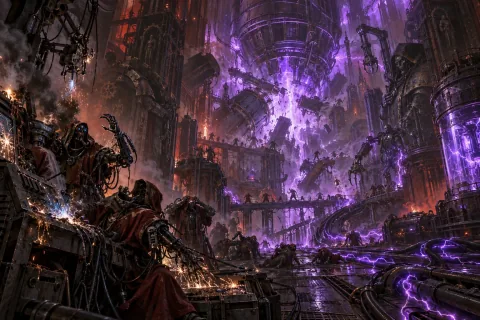
When Kelbor-Hal opened the vault, scrapcode spread. While the name sounds like fragments of corrupted data, in this event, it was a contamination attacking technological civilization itself. Systems that had penetrated power regulators, defensive shields, thermal safety devices, and life support systems collapsed in a chain reaction. Before the outer walls were broken by guns and artillery, the factories were made unable to protect themselves from within.
The scale of that attack came from the connections of the machines. The relationships that kept Mars moving became the conduits for disaster. The failure of one facility led to anomalies in other devices, and the systems that were supposed to ensure safety could no longer guarantee it. Even the conviction that a priest could understand and command machines was shaken. The markings that distinguished the people to be protected from the enemies to be eliminated in war provided no protection in front of the circuits that maintained life.
This cannot be called a simple success of knowledge liberation. Instead of gaining forbidden possibilities, the problem of whether one could control how those possibilities moved was revealed. The division of Mars began with a difference of opinion, but after the opening of the vaults, the disaster actually killed people. The choices of the priests did not just change the future of their own laboratories. It changed the conditions of countless people working and living on the Red Planet all at once.
4. The Death of Innocence
Millions died in the disaster later called the 'Death of Innocence.' Official explanations point to the meltdown of reactors and the cascading failure of critical systems as the cause. Even those who had not yet encountered enemy walking machines face-to-face could not survive. Even without weapons and armies from the start, mass death could begin simply by turning off the facilities that sustained life.
Some military systems were protected for longer, gaining time to sever external connections. Therefore, the damage from the disaster varied by facility, and not every facility on Mars was destroyed simultaneously in the same way. Isolating salvageable circuits and seizing maintained armaments led to subsequent battles. Because the conditions of defense and damage differed for each factory, resisting forces remained even after the disaster. The initial attack was overwhelming, but it did not eliminate every possibility on that day.
However, those who stood with Kelbor-Hal did not safely gain only new knowledge. The same official introduction explains that their minds were twisted in a more cruel and belligerent direction. It was a corruption that brought destruction to opponents and alteration to followers. Along with the question 'Who is the enemy?', the question 'What do you become after gaining the knowledge?' remains.
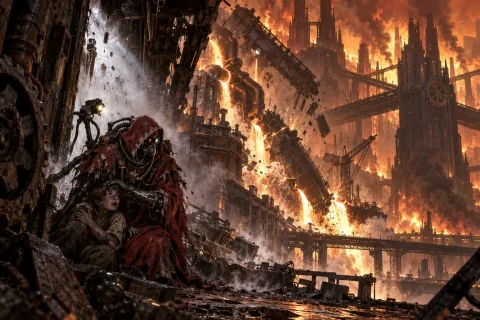
The illustration for this scene does not represent the exact final moments of a named individual. It shows the structure of the disaster through industrial facilities with no end in sight, tech-priests in crisis, and the workers beside them. The nameless people of Mars are easily erased as numbers on the strategic maps of war. But one must recall their lives to see how far the confrontation between the Emperor and Horus, priests and Legions, had descended. The civil war of the same Empire tore apart even the people of the same factory.
5. Those Seeking a Different Path
There were those on Mars who made different choices. There was the choice of high-ranking priests who already possessed their own factories and armies not to submit to Horus, the choice of which Fabricator-General the soldiers would follow, and the choice to think differently about the relationship between prohibition and research. The authority of the Fabricator-General was great, but the entire technological civilization could not be compressed into one person's inner world. This complexity makes the Martian Civil War deeper than a simple numerical comparison of loyalists and traitors.
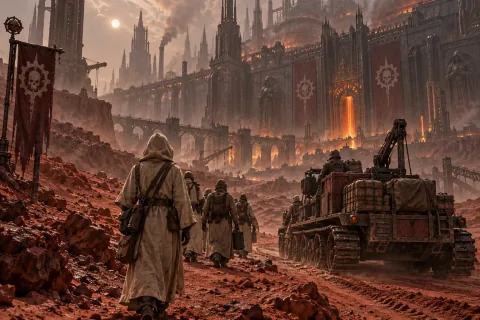
Dalia Cythera, a scribe of Terra who appears in the official 'Mechanicum' public sample, also allows us to see this world through a different lens. She was not a superhuman warrior cutting down enemies on the battlefield. Her work improving the interior of machines was treated as a technical sin, leading to her imprisonment, and she encounters protectors who take her to Mars before she can be executed. The figure they serve is Koriel Zeth of Magma City. The sample shows the start of Dalia's journey there.
Even in this short departure, the tension of the Mechanicum is contained. There is a discipline that views the talent to change machines as a danger, and there is another power that seeks out people precisely because of that talent. Just because organizations with the same faith name exist on one planet does not mean they treat knowledge and possibilities the same way. When war begins, such differences do not remain as safe debates. It connects to who can research and who can survive.
The long thread of the novel concerning Dalia, Zeth, and the Noctis Labyrinth corresponds to the hidden history of Mars. This public sample's departure alone does not fill in the entire conclusion. It is a connection that must be verified further in a separate character/setting episode. What we will follow in this main text is the war where the factories, faith, and loyalty systems of Mars collapse. Beside that war, the door to another story that must be seen through people who are not warriors is also opening.
6. The Defense of Magma City
Magma City was a large-scale factory that withstood a significant portion of the initial scrapcode attack. A new noosphere defense network protected its systems. When countless facilities on the same planet collapsed, different defenses produced different results. That survival did not mean they had escaped the war. The surviving factory became a target that the traitors had to seize.
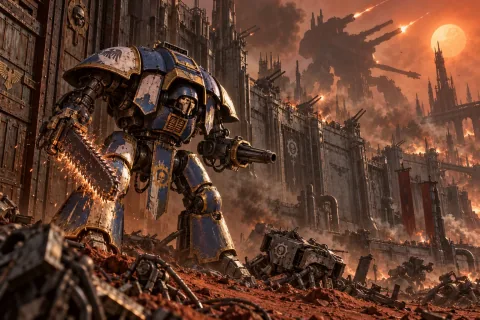
Official history records that this city called upon the Knight House Taranis and the Legio Tempestus to defend it. There were Knight machines much larger than humans, Titans, and soldiers and automated weapons fighting around them. The city is not a space where industry and war are separated. Between the walls, doors, and production equipment of the massive facility, battles are fought to protect the foundation of production with the weapons produced there.
When one actually views the Magma City reconstructed by the official exhibition, the scale is clear. Beyond the gray and bronze industrial walls, cylindrical facilities, pipes, and massive cranes rise. On the red ground, walking machines, automated weapons, and much smaller infantry are together. The large doors make one think of the mechanisms that move their weight. This is the appearance of a factory where the daily lives of residents once existed, now turned into a fortress of war. The exhibition does not claim that its detailed placement represents the exact coordinates of every historical moment.
An endless attack surged before the defenders. The 2024 official campaign introduction describes this battle through the defense of multiple sectors and the overwhelming scale of the attack, explaining the large pyramid-shaped defense guns. However, the rule of redeploying destroyed units in the tabletop game is a mechanism to represent the pressure of the attack. It does not change that into an event where every soldier actually died and was resurrected. The volume and scale that the surviving city had to endure are the core of the story.
7. A War Where the Shape of Machines Changes
In the factories of the Dark Mechanicum, weapons using previously forbidden technology poured out. Weapons named Stalkers reveal long mechanical legs, weapons, and the shapes of twisted technology. Unlike the war where Astartes point bolters at other Astartes, the Martian Civil War sent the problem of what to combine with machines and what intelligence to make them move with onto the battlefield.
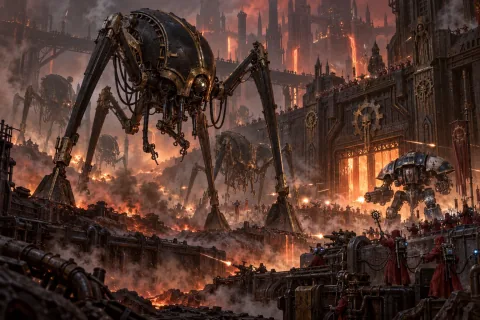
The official introduction of Magma City cites the Sibilans Taghma as an early example. It was a combat organization that utilized the operation of Tech-priests alongside the ominous noosphere control network of the Scintillax Stalker. After Kelbor-Hal confirmed its results, the same combination followed elsewhere. The change that began in the first vault of betrayal did not remain with the choice of a single priest but spread as a new method of warfare.
The Noosphere is easy to understand in this battle if you read it as a connection where various systems exchange information and commands. The defensive network that allowed Magma City to withstand the initial attack is connected to this concept, and the attacker's weapon control network is also connected to this concept. The power of the same connection can be used for protection, domination, and destruction respectively. It was a war where one could not determine which side was safe by the name of the technology itself.
Magma City eventually becomes one of the major factories that collapse. This illustration expresses the pressure of the defensive battle based on the industrial structure confirmed in the official battlefield exhibition, the blue and white loyalist walking machines, and the steel and bronze-colored Stalkers. It is not a scene replacing the final firing of a specifically named Titan or a specific sword strike from the novel. The fact that the factory survived does not mean the lives belonging to that factory were ultimately saved, which remains as a heavy lingering impression.
8. The Expedition to Recover War Materiel
The news that Mars' production facilities were falling into enemy hands was a desperate problem for Terra as well. To protect the Emperor, they had to recover even the war materiel that had already been produced. The official 2024 Martian Civil War campaign commentary connects the development of 005.M31 to the battles of Mondus Gamma and Mondus Oculum. It is a scene where the civil war of the factory planet meshes with the defense of Terra.
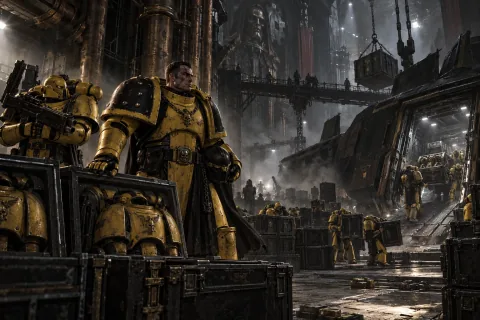
Sigismund and Camba Diaz of the Imperial Fists set out on a mission to secure precious new Astartes power armor stock. Armor might seem like an object that does not tell a story in itself. However, in war, it determines whether a soldier can survive the next battle. If the premise that the factory will continue to be a friendly supplier collapses, the armor already in the warehouse becomes future power that is difficult to replace.
This expedition is not explained as a victory that immediately reclaimed all of Mars. One must distinguish between the purpose of an operation to secure supplies and the control of the planet. Recovering munitions is about enabling the loyalists to continue fighting, not that it rescued every resister in the remaining Forge Worlds. The war of those left on Mars continued even after that.
To a reader who has gone through the horrors of Isstvan, this connection shows another form of loss. The people the Legion lost and the production base the Empire is losing are two sides of the same civil war. Rogal Dorn's defense could not be completed just by placing warriors on the walls. The armor those warriors would wear, the weapons they would move, and the reliable communication and logistics were also included in the war.
9. Two Fabricator-Generals and Divided Hunters
As Mars split, the loyalty that had followed the name of the Fabricator General also divided. There were forces following Kelbor-Hal and forces following the exiled loyalist Fabricator General, Zagreus Kane. The official Skitarii history introduction explains the orders that joined both sides. A single high position could not substitute for the choices of all its members.
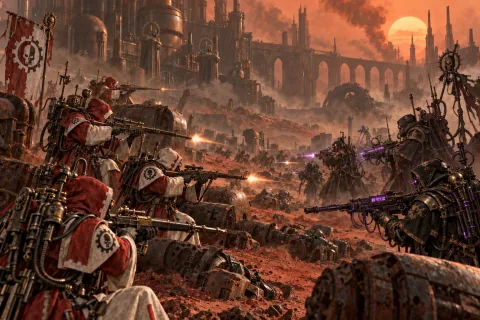
The classical Skitarii of the Heresy era cannot be compressed into the same appearance and operation as all Skitarii of the 41st Millennium. The 2026 official introduction explains that they were the elite hands of the Fabricator-General and hunters who sought dangerous ancient technology. The process of the Corpus Skitarii, which replaces the body significantly, and the process of injecting the combat experience of previous wearers as data are also introduced. Hunters who had the same colleagues and the same technology came to fight under the names of different masters.
Their role does not end with the defense line of one city. The mission to seek lost technology continues throughout the galaxy, and which side recovers it changes the power balance afterward. The army on expedition, the factories of Mars, the orders seeking artifacts, and the power of the Fabricator-General are connected. However, it does not say that all Skitarii battles took place in specific defensive battles on Mars. The division of the Mechanicum moved even outside the planet.
On the other hand, there were also judges of the Mechanicum who tracked forbidden technology. The official Arcuitor Magisterium introduction explains very old high-ranking priests, extensive modifications, and the rigidity of faith and discipline. The question of the civil war was not only who was in command. Which technology was viewed as a sin and who judged that sin was also a problem that divided the forces. One cannot make all loyalist priests gentle researchers or all technical differences into a simple picture of good and evil.
10. 007.M31: Resistance Continuing from the Underground
Even after losing the major factories of Mars, the loyalist resistance did not end. The 2024 official campaign commentary describes Mars in 007.M31 as a period of desperate resistance forces driven underground. There were people continuing guerrilla warfare instead of large-scale frontal battles in places where they had ceded control to the enemy. The fact that they were defeated on the surface of the planet is different from the fact that everyone submitted.
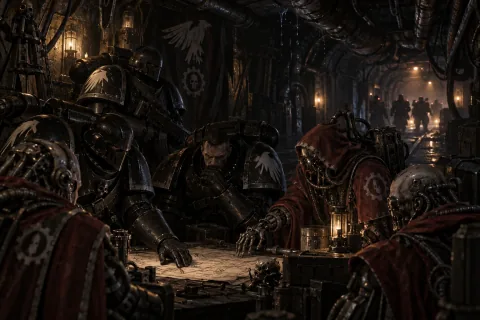
Malcador moved to plan for their aid. During this period, Corax and the decapitation strike force of the Raven Guard XIX Legion, who had briefly returned to the Sol System, were deployed in the Perditus infiltration operation. It is a connection showing that even though the Legion suffered massive damage at Isstvan, the war of Corax and those who remained was not over. The warriors left behind their dead comrades still fought on other battlefields.
I do not fabricate entire troop movements or every casualty of the battle that I have not confirmed just by the name of the operation. The connection confirmed in the official commentary is the flow of the resistance's persistence, Malcador's support plan, and the fact that Corax and his Legion attacked the traitors. If you close the division of Mars with the disaster and Magma City, this long resistance disappears. Therefore, this main text moves the time forward to follow even that continuation.
The term 'underground resistance' also has the paradox of an industrial planet. Priests and soldiers who once moved a massive organization now hide and fight against the enemy that dominates that organization. They must endure without having both production capacity and connection networks. The meaning of that war cannot be calculated only by the scale of taking land once. Even in a world where the enemy seems to have everything, there was a will of opposition that remained until the end.
11. 013.M31: Signals Aimed at Terra
Even at the end of the war, the threat of Mars did not become a thing of the past. In 013.M31, covered by the official campaign commentary, as Horus's vanguard approached, a situation emerged where scrapcode transmissions confusing detection devices attacked Terra. Now, the dangerous connection went beyond the factories of Mars toward the Emperor's defensive lines. The war that initially targeted reactors and life support systems now targeted the senses of the Sol System's defense.
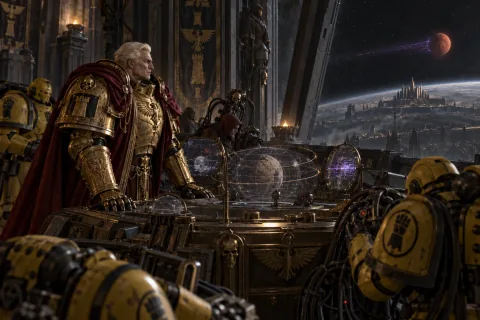
Dorn initiates two coordinated operations. One is the attack on Mars by the Blood Angels 94th Company led by Aster Crohne, with Legio Cybernetica forces joining this Martian assault force to reinforce its strength. The other is a mission by a Custodian unit to seek out an ancient evil in the far-off Oort Cloud. It is important that both operations were placed within the same response. The problem of the factory world near Terra and the problem of the darkness outside the solar system entered the defense plan simultaneously.
The story at this time is later than the earlier point of this series. I do not unfold all the scenes of the Siege of Terra here in advance to combine them into an event at one point in time. You should read it as a connection showing that the Martian Civil War itself continued from the beginning to the end of the war. When the later main text deals with Horus's advance and the defense of Terra, the conflict of Scrapcode and production bases seen in this episode will have meaning again.
Mars was geographically close to Terra. However, the premise that a nearby world was a certain ally collapsed. The place that made the facilities and technology to protect the Emperor became the place that could shake that defense. This relationship makes the Martian Civil War a long-lasting strategic wound. Everything from signals outside the gunfire to factories, storage, and safety devices was a battlefield of the galactic civil war.
12. Remaining Knowledge and Vanished Possibilities
The division of Mars leaves behind the stories of those who gained technology and those who lost it. The traitors opened the forbidden vaults and created new weapons. The loyalists isolated the surviving systems, protected the factories, recovered necessary materiel, and continued the resistance. On either side, people, knowledge, and industrial facilities did not return to their previous forms. Even if the names and rituals of the machines were the same, the relationships where they trusted each other were severed.
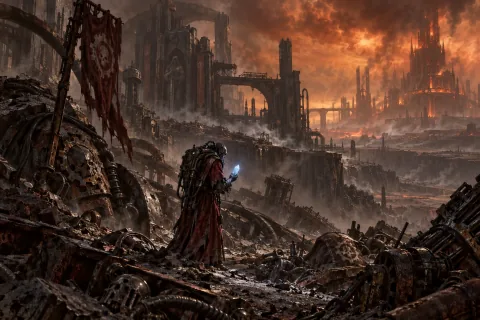
We do not conclude that the Mechanicum of this period and the Adeptus Mechanicus of the later Imperium are the same institution at the same point in time. Through the war, the positions of institutions and power also change. Furthermore, just because the name Dark Mechanicum was created does not mean all traitor Forge Worlds possess exactly the same goals and weapons. Within them, there are also different priests, technologies, contracts, and factions. These are changes that must be followed in the later character and faction sections.
What remains after reading is the question of how far one key to the vault opened the door. The proposal that put forward the freedom of research first collapsed the lives of the people in the factories, and the new knowledge changed even the minds of the people who made the tools. There is a gap between the choice not to follow the Emperor's restrictions and the result of being consumed by the war Horus wants. The guarantee that the possibility gained is freedom collapses in this world.
The battlefield of the next main text is Calth. The preparations for betrayal, piled up in different ways, explode at another gathering place of the loyalists. If you remember the meaning of the communication, production capacity, and untrustworthy colleagues seen on Mars and move on, that horror will not look like a war separated from the rest. The Horus Heresy was not a sword swung once by one traitor, but a process in which countless relationships that kept the Empire alive and moving were severed from within.
Reading names and concepts together
Mechanicum: The technology and faith system of Mars during the Great Crusade and Heresy. It distinguishes the institutional point of view from the later Adeptus Mechanicus.
Fabricator-General: The highest position of tech-priest power on Mars. After the division, Kelbor-Hal and the loyalist Zagreus Kane each become the center of different factions.
Regulus: Horus's Mechanicum envoy. The person who delivered the proposal leading to forbidden knowledge to Kelbor-Hal.
Vaults of Moravec: The place of forbidden knowledge that the Emperor had sealed. It is connected to the opening and the Scrapcode disaster.
Scrap-code: A corruption that infiltrates and destroys various systems and twists followers in this civil war. It does not explain all ordinary data corruption as the same phenomenon as this disaster.
Death of Innocence: The name of the disaster that brought about the collapse of Mars' systems and mass death.
Noosphere: A domain/network that shares information and connects systems. It is used in different ways in the defense of Magma City and the control of traitor weapons.
Magma City: A massive factory that was militarily attacked after withstanding a significant portion of the initial attack. Knight House Taranis and Legio Tempestus are connected to its defense.
Sibilans Taghma: An early combat organization that combined the control networks of Tech-priests and Scintillax Stalkers, appearing in the official campaign introduction.
Dalia Cythera / Koriel Zeth: Characters who confirmed the connection between a scribe of Terra and the power that brings her to Mars in the official novel public sample. This sample alone does not explain all the conclusions of the novel.
Perditum Incursion: The attack by Corax and the Raven Guard connected to the underground loyalist resistance in 007.M31.
Aster Crohne: Commander of the 94th Company of the Blood Angels deployed to the attack on Mars in 013.M31. Do not mix with other battles during the Siege of Terra.
Previously published connection episodes
Warhammer 40,000 Part 11 — Alliance of Terra and Mars, Industrial Base of the Great Crusade: /en/community/tm-warhammer40000-saga-part011-20261008
Warhammer 40,000 Part 18 — The Massacre of Isstvan III and Loyalty within the Legions: /en/community/tm-warhammer40000-saga-part018-20261008
Warhammer 40,000 Part 22 — The Betrayal of Isstvan V and the Loss of Loyalist Legions: /en/community/tm-warhammer40000-saga-part022-20261008
Official materials and verification scope
Verification date: October 8, 2026 (UTC). It was written based on settings and events confirmed in the official public materials below. The public samples and setting introductions only verified the relevant public scope, and it does not indicate that the entire book was read. The illustrations are AI reconstructions, not official images.
Dark Mechanicum Lore — renegade tech-magi and the Martian schism
The Martian Civil War — official author account of the supplement
The Skitarii — elite hunters of the Mechanicum
Arcuitor Magisterium — judging tech-heresy
The Battle for Magma City — official Warhammer World exhibition
Magma City — Legions Imperialis campaign introduction
Mechanicum — Black Library public sample (Dalia’s departure)
Liber Mechanicum: Forces of the Omnissiah — official introduction
comments 1
화성의 내전은 단순히 기계들의 싸움이 아니라 믿음과 지식의 경계가 무너지는 과정이라 더 안타깝게 느껴지네요. 켈보르할이 열어버린 그 금고가 결국 돌이킬 수 없는 강을 건너게 만든 것 같아요. 다음 칼스 이야기도 기대하겠습니다! ⚙️