
Operator Recommended Game Story: Warhammer 40,000 Part 15
Chapters in this story
- The Mournival and Samus: Shadows Remaining Beside Victory
- Chapter 1: The War Continued Even When the Father's Seat Was Empty
- Chapter 2: The Four Who Formed the Same Circle
- Chapter 3: When Loyalty and Judgment Do Not Have the Same Meaning
- Chapter 4: Names Left in the Records of Conquered Worlds
- Chapter 5: Names That Will Change from White Armor
- Chapter 6: Paths to Leave Behind Before Reaching Davin
- Terminology and Character Guide
- Further Reading
- Official Materials and Verification Scope
The Mournival and Samus: Shadows Remaining Beside Victory
Spoiler Notice: This article covers the interpersonal relationships of the Mournival surrounding Horus after the Emperor withdrew from the front lines, the threat of Samus recorded since the Great Crusade, and the fractures within the Legion leading up to the civil war. Returning from the previous episode that looked back at the past of Monarchia, we return to the latter half of the Great Crusade. This is a narrative commentary based on the scope confirmed by official character introductions, setting documents, and publisher synopses; it does not replicate the battles or dialogue of the entire novel, nor does it add unverified scenes as official facts.
Chapter 1: The War Continued Even When the Father's Seat Was Empty
The cheers received at Ullanor had ended. The Emperor had returned to Terra, and Horus was left with a fleet that kept moving and a Great Crusade that had not yet concluded. The victories won on the battlefield and the responsibilities newly assumed were not of the same magnitude. Now, he had to lead not only the next assault of his own Legion but also the expeditions of his brothers and the advance of the Imperium.
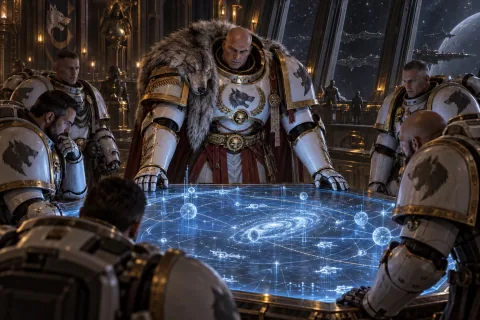
Horus's power did not lie solely in his massive physique and weapons. Official Legion introductions convey that he was a being exceptional at persuading others and forging relationships with his brothers. He had spent a long time with the Emperor, was deeply loyal to the sons of his Legion, and influenced other Primarchs as well. Such relationships became a path for transmitting orders rapidly.
However, even the person who ascended to the highest position did not make every judgment alone. Beside Horus were his closest warriors. They were those who had traversed the same front lines and those who had achieved his victories together. The advice they shared did not merely change the lines drawn on operational maps. How the Legion understood and followed its commander was also forged within those close relationships.
Whenever the doors of the fleet opened and new routes were set, another world awaited Horus's next judgment. The Imperium advanced toward countless stars, but those stars were not places that all shared the same past. The work left behind after a great victory could not be a simple matter of relocating worlds according to a single formula.
Chapter 2: The Four Who Formed the Same Circle
The name of that close circle is the Mournival. Official introductions of Aximand explain this as a gathering of four warriors who were Horus's personal advisors and companions. Ezekyle Abaddon, Horus Aximand, Tarik Torgaddon, and Garviel Loken. The names that would later walk different paths were, at this time, beside the same commander.
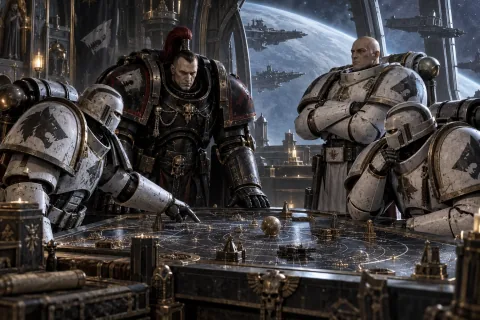
Aximand was called 'Little Horus.' This was due to his shared name and exceptionally similar face. In official introductions, he is depicted as a skilled commander who cares for his soldiers, and even after entering the path of betrayal later, he is not portrayed as someone who simply accepted that choice comfortably. If read as a villain without any conflict from the beginning, the weight he carries is lost.
Abaddon, too, is not explained in this era solely by his appearance as the future leader of the Black Legion. He is a son of Horus and a warrior with an important position within the Legion. One must remember whom he followed and with whom he fought to understand why that name later becomes a threat to others in the same Legion.
Loken and Torgaddon were the other two in this circle. In official aftermaths, the massacre at Isstvan III separates their paths from those of Abaddon and Aximand. However, if we attach labels to them starting from the conclusion, the time they spent together vanishes. The fact that colleagues who were still on the same side were passing through the same dangers existed first.
The new illustration refers to the appearance of Horus and the Luna Wolves before their fall, as seen on the official Horus Rising cover. The white armor, golden decorations, gray wolf pelts, and the equipment of the warriors nearby have been adapted to this era. The ship's command center and the meeting in front of the hologram are new compositions intended to show interpersonal relationships. The drawing is not a restoration of the placement and remarks of a specific meeting in the novel.
Chapter 3: When Loyalty and Judgment Do Not Have the Same Meaning
The voices of close people hold great power. Advice from a trusted colleague can reach deeper than orders from afar. Horus kept those who understood and followed him by his side. That trust became the foundation connecting many victories of the Great Crusade, but believing and having identical judgments were different matters.
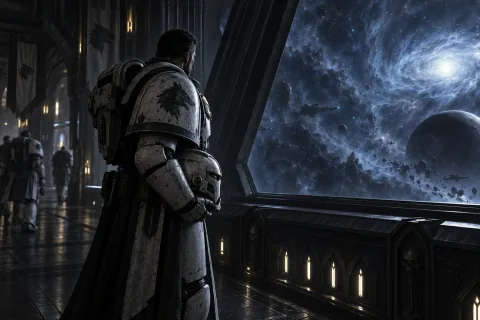
The introduction to False Gods released by the publisher conveys that Loken questioned the secret methods spreading among the brothers of the Legion. This is a connection that must be read alongside the influence of the warrior lodges seen in the previous episode. Just because a soldier of the same Legion questions his colleague does not mean he has already left the Legion. It could be an attitude of wanting to know what the community to which he belongs is doing.
The Mournival is not a civilian administrative body governing Terra, nor is it a new council replacing the Emperor. They are Horus's close Legion warriors. If one remembers this difference, the scale of the conflict becomes visible. Judgment regarding the institutions of the Imperium and the loyalty forged beside a commander were different relationships, and the civil war eventually causes those relationships to collide with one another.
Moving away from someone who once stood together is different from fighting a strange enemy. Those who remembered the same battlefield and the same commander could reach different conclusions. The reason these four are important is not just their combat ability. It is because their relationship shows that the great division of the Imperium occurs even among the closest colleagues.
Chapter 4: Names Left in the Records of Conquered Worlds
The Great Crusade conquered worlds and struck down enemies on the battlefield. However, some dangers did not end with the record that the enemy army had collapsed. Official Samus settings convey that the name remained in the legends and history of Sixty-Three Nineteen for a long time. Malicious whispers fostered distrust and fear, and the daemon could inhabit a soul that was not guarded.
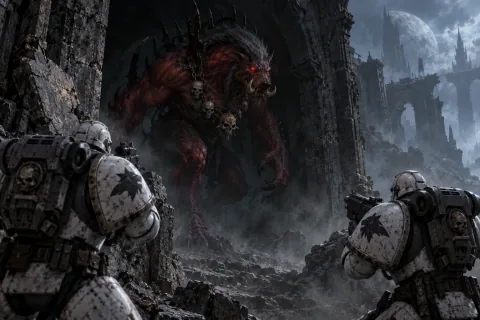
The terror of Samus is not explained merely by the image of a strange monster running from the front. Official documents convey that the entity turns the host against their colleagues, causing them to attack people they had been with just moments before. For a warrior who needs to know where the enemy is, the situation where the closest colleague becomes a threat shakes the very meaning of the front line.
The released settings connect Samus to one side of the enemies defeated during the Great Crusade in the Imperium's early encounters. Here, the certainty that conquest is the end of the problem is lost. Even if one can seize a city and crush the military forces, there is no guarantee that one has fully understood the forces acting upon that world. This is why the whispers in the records cannot be explained by the same standards as military victory.
The Samus illustration refers to the red body, long neck, beast-like snout, wingless physique, and the metal blades and skull chains on its back confirmed in official models. The ruins and the wary warriors are a symbolic new scene showing the terror of the whispers. The drawing does not conclude the exact terrain of a specific novel or which character became the host at which moment.
This is a connection that there was already a different kind of danger before the great war began. The secrets grown in the ruins of Monarchia and the old whispers of the battlefield are not the same event. However, both make it impossible to view the fight the Legions will face in the future as a mere matter of troops and firepower.
Chapter 5: Names That Will Change from White Armor
Horus's warriors originally fought under the name Luna Wolves. Official introductions convey that the Legion changed to the Sons of Horus following the name change proposed by the Emperor and the advice of Sanguinius. The white armor and wolf emblem lead to sea-green and the Eye of Horus. The history of the battlefield remained in words and colors as well.
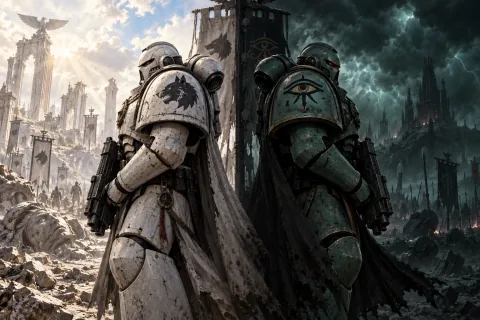
If one views this change as evidence that all soldiers fell at the same time from the beginning, the loyalists who follow cannot be explained. Among the soldiers bearing the Legion's new name, there were those who kept their loyalty to the Emperor. Just because they wore armor of the same color did not mean they made the same choice until the end. If this point is missed when reading the later massacre, the positions of those who were killed become blurred.
The relationship of the Mournival also harbors the same problem. The heart that follows Horus and the heart that follows every decision Horus will make in the future could diverge at any moment. Official character introductions convey the later future where Aximand and Abaddon remain on the side of betrayal, while Torgaddon and Loken are classified as loyalists and attacked at Isstvan III. Loken's death is an explanation of how it was perceived at that point, and his subsequent survival and return are handled separately in the later era section.
For readers who know this ending in advance, the days when they stood together are necessary. People who had no relationship do not lose a relationship. What would be severed at Isstvan was not just the number of the Legion, but the time when they trusted each other's strength and formed the same circle.
Chapter 6: Paths to Leave Behind Before Reaching Davin
The publisher's official introduction connects the situation where Horus sinks deeper and relies on advisors after the catastrophe at Interex to the expedition to reconquer the moon of Davin. If one removes where the Legion passed to reach that place, Davin looks like a trap that appeared suddenly. Therefore, in the next episode, the encounter with Murder and Interex and the events where other paths are closing are arranged separately.
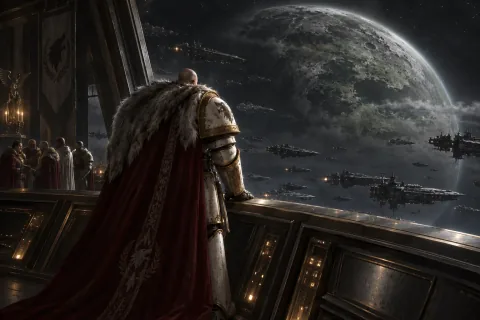
After that, Horus's wound on Davin and the ritual of the Serpent Lodge follow. Erebus from the previous episode is an important person in that connection. However, the fact that he exists cannot make every close warrior the same accomplice. One must distinguish who knew what and what choices were made so that the betrayal and loyalty of the civil war remain as individual stories.
The fleet moves toward the next world. Beside Horus, the same faces still remain, and the honor of the expedition remains. However, among them, the meaning of questions begins to change, and the identity of the dangers faced on the battlefield also begins to change. The trust that allowed the Great Crusade to continue after the Emperor withdrew will be tested in the tragedy to come.
Terminology and Character Guide
Mournival: A gathering of four Legion warriors who were Horus's personal advisors and companions. It is a different relationship from the administrative council of Terra.
Ezekyle Abaddon, Horus Aximand: Two warriors of the Mournival. Aximand's nickname 'Little Horus' came from his exceptionally similar appearance. The facial scar from Dwell in the later era is not attached to Aximand at this time.
Garviel Loken, Tarik Torgaddon: Two other companions of the same Mournival. Read by distinguishing the relationship they had together at the present from the fact that they were attacked as loyalists at Isstvan III later.
Samus, 63-19: The name of the daemon and the record name of the world that are connected in official settings. Whispers and attacking colleagues through a host were confirmed in the released settings. This does not mean that all novel details of the initial encounter have been verified.
Luna Wolves, Sons of Horus: The name change of the 16th Legion. The white and sea-green armor are appearances that distinguish the era and the renaming. Do not mix them with the later Black Legion as names for the same period.
Horus Rising, False Gods: The first two books of the Heresy novels. They are not treated as separate continuities because they were republished with new covers, and the released synopses and model materials do not substitute for evidence of having read the entire novel.
Further Reading
Previous Episode: Read about the destruction of Monarchia and the long preparation for betrayal by Lorgar and the Word Bearers. That episode was a branch looking back at the past of the Great Crusade.
Story to Continue in the Next Episode: The encounter and severance at Murder and Interex. Afterward, it leads to the wound on Davin, the division of the Mournival and the Legion, and the massacre at Isstvan III. Materials outside the public scope of the novel necessary to verify events will be left in the research list to be continuously cross-referenced.
The full published table of contents and the previous and next episodes can be found in the series guide below. Episodes not yet posted are not displayed like the published links.
Official Materials and Verification Scope
Verification Date: October 8, 2026 (UTC). Written based on settings and events confirmed in the official public materials below. Public samples and setting introductions only verified that public scope and do not indicate that the entire book has been read. The illustrations are AI reconstructions, not official images.
Heresy Thursday: Little Horus Aximand
Experience the Greatest Hits of the Horus Heresy Saga in a New Curated Series
Legacies of the Age of Darkness: Daemons of the Ruinstorm — Samus
The Horus Heresy Legacies: Daemons — Samus, September 2025
The Bound Daemons of the Ruinstorm Herald a Packed Year for the Horus Heresy
False Gods — Games Workshop publisher synopsis, 2014 edition
Legions of the Horus Heresy — The Sons of Horus Are the Real First Legion
comments 0