
Operator Recommended Game Story · Warhammer 40,000 Part 11
Chapters in this story
- The Red Light of Mars · The Heart of the Empire Heading to the Stars
- Chapter 1 · A World Where Those Who Guard Machines Gained Power
- Chapter 2 · A Different Faith Within One Empire
- Chapter 3 · Factories Expanded Toward the Galaxy
- Chapter 4 · Whose Commands Do Automated Weapons Follow?
- Chapter 5 · There Were Ordinary Humans on the Path to the Stars
- Chapter 6 · The Emperor Who Trusted the Alliance While Being Wary of It
- Chapter 7 · The Martian Rift That Has Not Yet Burst
- Chapter 8 · The Starting Line Created by the Red Planet
- Organization and Terminology Guide
- Official Materials and Confirmation Scope
Spoiler Notice: This installment covers the process of establishing the logistics and expeditionary systems of the Great Crusade, following the unification of Terra and the alliance with the Mechanicum of Mars. References to the later Adeptus Mechanicus and records of the Heresy are distinguished and used only to the extent necessary to understand the aforementioned alliance. The Mechanicum of the 30th Millennium and the later Adeptus Mechanicus, as well as the Great Crusade and the Martian Civil War, are not events of the same timeframe. This is a novel-style commentary written independently based on officially released lore, not a translation of a novel's original text.
The Red Light of Mars · The Heart of the Empire Heading to the Stars
Gaining Terra did not mean gaining the galaxy. The Emperor's soldiers had survived the wars of Earth, and the Primarchs were living their own lives on scattered homeworlds. Now, another wall stood before the plan to connect the severed worlds of humanity. The Legions were powerful, but armor did not complete itself. Someone had to build the warships, the facilities to repair them, and the ammunition to endure the next war on distant planets.
Beyond the skies of Terra lay the Red Planet. Power there was concentrated not in a monarch shouting on the battlefield, but in priests who handled machines. An industrial civilization operating with a new faith, different disciplines, and a different language than the Emperor's new order. The Great Crusade was not an expedition that began after erasing these differences. It was an expedition that set out with an alliance containing those differences at its heart.
Chapter 1 · A World Where Those Who Guard Machines Gained Power
The devices left behind after the collapse of humanity's Age of Technology were not mere objects. Whether one could keep them running determined life and death. As seen in the chapter covering the previous era, colonies were severed, and fully recovering lost knowledge was difficult. Mars is a world that shows how the history of that loss and the preservation of technology solidified into immense power.
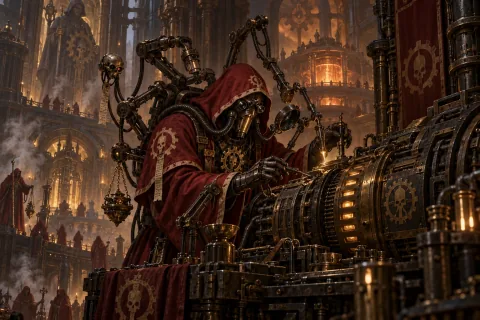
Official Mechanicus introductions convey how the priests of Mars would later produce the Empire's weapons and armor. The act of repairing machines is surrounded by rituals, incense, oils, and dogma. Since this is a later explanation, one cannot conclude that every detailed norm was identical from the time of the Great Crusade. However, it serves as a starting point for understanding a culture where knowledge of handling machines and religious authority are intertwined.
For a Tech-Priest, their own body is also a realm that can be changed and expanded. Augmented flesh and senses, increased manipulation appendages, and modifications that blur the boundary between human and machine are not merely for decoration. They are choices that reveal the ability to perform production and command, and what kind of being one wishes to become. Therefore, to see the rulers of Mars, one must first set aside the face one expects of a human king.
This civilization did not possess merely a factory. Official introductions of the Great Crusade and the Heresy explain that the Mechanicum was a power that possessed its own war forces and a unique command structure. Just because they were technicians supplying others' armor did not mean they lacked the ability or will to fight themselves. Mars, placed before the Emperor, was not a repair crew entering occupied territory, but a massive political power with the potential for both cooperation and conflict.
Chapter 2 · A Different Faith Within One Empire
When understanding the union of the Emperor and the Mechanicum, the first thing to look at is the necessity of the alliance. No matter how strong the Legions were, they needed an industrial base to maintain that strength. The production capacity of Mars became the core of the expedition. Conversely, the expedition reaching out into the galaxy opened the way to access lost knowledge and machines. What each side had and lacked interlocked, moving the new Empire forward.
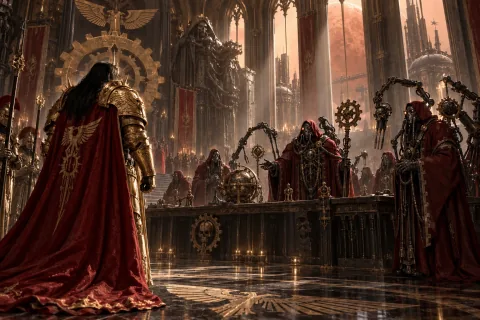
Official public records clarify that the union of the Mechanicum and the Emperor was connected by a treaty, and that the Mechanicus continued its own rituals and creeds. If one depicts them as a force absorbed in the same way as other institutions of the Empire, the tension of this alliance disappears. The Emperor needed weapons, and the priests of Mars sought to protect the power and faith they had preserved. Even after the relationship was established, the two goals did not become one.
The term Omnissiah is an important name for reading this world. However, if one overlaps the later Imperial State Church's explanation of reconciling the Machine God and the God-Emperor with the dogma of the early Great Crusade, one confuses the eras. The core of this period is the fact that the Mechanicum openly worshipped its own god, and that this did not naturally align with the Imperial Truth. In the midst of an order intended to eliminate belief, an industrial alliance with its own faith remained.
This installment does not fill in with imagination the exact year of the treaty's signing or the dialogue on the scene, which could not be confirmed in public materials. To know the scene where the Emperor repaired a specific weapon by hand or the hearts of all the figures present at the negotiation table, more confirmation from the relevant official primary sources is needed. The facts confirmed in this text are the political and military structure of that union. That structure alone reveals how great a compromise was made at the start of the expedition.
Chapter 3 · Factories Expanded Toward the Galaxy
A Forge World is not just a city with many factories, but a world where the entire planet is connected to a production system and technological power. In expedition records, the distant Forge Worlds of Mars appear as the axes that sustain the war. To understand the victories the Primarchs and Legions achieved in the battles of a single planet, one must also look at the paths of production and supply that made those victories possible. Behind the names of the soldiers lie the labor and devices of planets the soldiers would never meet.
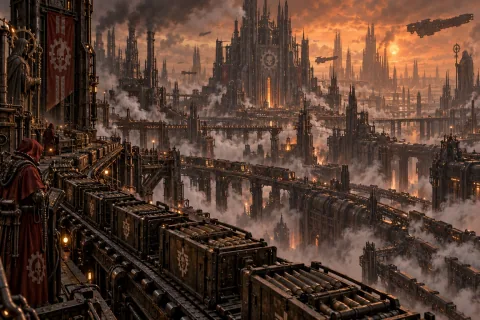
This connection begins with small and trivial realities. Ammunition for guns must arrive, and there must be parts to repair damaged machines. If there are no technicians who know the equipment, long-accumulated achievements can turn into metal debris. Therefore, logistics is not an explanation added after the fight is over, but a condition for the next fight to exist. This commentary explains to the reader why the Mechanicum is treated as the industrial heart of the Empire in official records.
There is no need to think that every Forge World followed the Martian system in the same way. Official retrospectives explain that these worlds strongly maintained autonomy and strange quasi-feudal hierarchies. It was an alliance where individual powers, technologies, and different interests gathered. Even if the names written in an institution's documents were the same, various rulers beneath them were making their own calculations.
As a result, the logistics network of the Great Crusade created danger along with immense power. Which side a Forge World turns to does not end as a problem for that planet alone. The warships and Legions that relied on its output, and even the wars in the surrounding regions, could be shaken. One can already read at this starting point why occupying factories becomes a military objective in the later civil war.
Chapter 4 · Whose Commands Do Automated Weapons Follow?
The forces the Mechanicum sent to war included modified human slaves, cyborg warriors, and combat automated weapons. Knight Houses, Titan Legions, and massive Ordinatus-class war machines also fall within the scope of official military introductions. These are not all the same type of robot. One must distinguish how much of the human remains, how they receive orders, and to which organization's power they are bound to see the characteristics of that army.
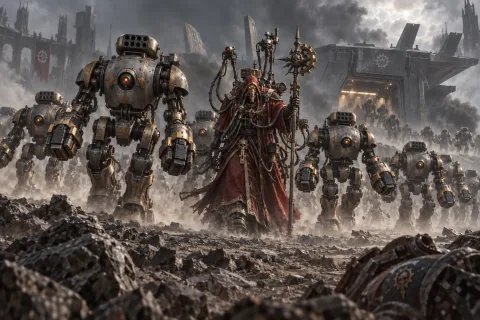
Among these, the composition of the Legio Cybernetica is particularly significant. Official public materials state that the Legions were divided into several independent cohorts according to the Crimson Treaty of Mars. It was a structure to prevent one Archmagos from holding too much power. Under the high priests and the Magos Dominus who commanded automated weapons on the battlefield, units equipped with support systems moved.
These cohorts could carry out missions by possessing their own workshops, transport means, landing craft, and ships. According to the treaty, units were moved from the defense of Forge Worlds to the Great Crusade. This was the passage through which the war capabilities of the priests were practically integrated into the Empire's expedition. It was the moment when the declaration of an alliance turned into battlefield forces and maintenance systems.
There were also cohorts that formed special bonds with the counterparts they fought alongside. Using the colors and emblems of a Legion, Knight House, or Titan Legion on automated weapons made that union visible. However, which comrade one follows and whether one follows central commands could eventually go in different directions. That the same public materials explain the various choices of loyalty in the later civil war means that this bond held both advantages and the potential for cracks.
Chapter 5 · There Were Ordinary Humans on the Path to the Stars
The grand stories of the Legions easily overshadow the scale of human armies. In reality, countless unaugmented human soldiers also marched under the banner of the Empire. If one reduces their existence to shadows carrying ammunition behind the Legions, the actual composition of the Great Crusade disappears. Not every expeditionary fleet had Astartes, and the armies of the people had to bear their own share of the war.
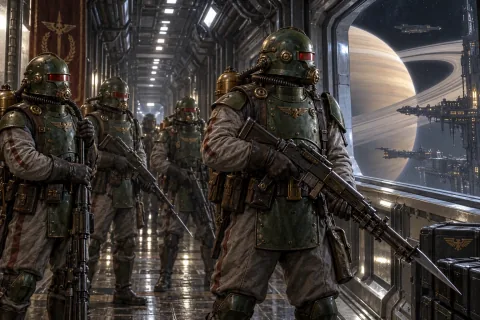
The origins of the Solar Auxilia were not only on Terra. According to official introductions, the tradition started with the technological communities of Saturn during the Age of Strife. Various settlements scattered across satellites and asteroids maintained high technological levels despite experiencing conflict, and developed ways of fighting in outer space. Even within the same solar system, there was not only one way for humans to survive.
As the Emperor left Terra and gained the loyalty of Luna and Mars, Saturn also joined relatively quickly. Saturn's regiments entered the expedition, and as their equipment and tactics proved effective, other units followed. Equipment modified by the Mechanicum was part of such diffusion. Where technology and combat experience met, a common tradition of elite human forces was created.
The fact that the Solar Auxilia was later organized into large cohorts and small combat units, and operated sealed armor and reliable weapons, is connected to this background. One should not explain everything with the genius of the Primarchs, but also look at the human proficiency and community achievements that continued from the previous era. For the countless soldiers of the Empire, the expedition was not an event of meeting a legendary father again, but a matter of entrusting their lives to the war of a new power.
Chapter 6 · The Emperor Who Trusted the Alliance While Being Wary of It
Just because the Mechanicum was essential to the Empire does not mean one can conclude that the Emperor trusted that power entirely. Official public excerpts from the Black Books explain the danger that if the industrial heart were to rebel, the Empire would have to fight against its own war technology. An alliance that possessed its own army, faith, and production capacity showed the Emperor two faces: help and threat.
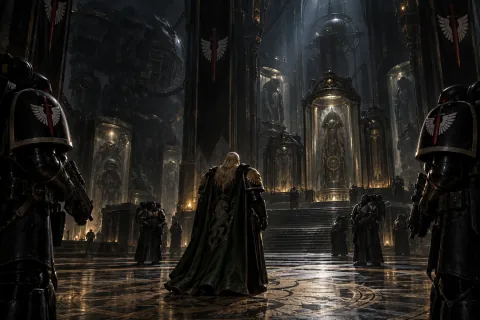
One of the contingency measures appearing in those records is the Ikaros Contingency. It gave Lion El'Jonson and the First Legion the authority to possess certain forbidden technologies, allowing them to preemptively neutralize elements of the Mechanicum judged to be contrary to the Empire's needs. Relics with a different nature than Martian technology became a means to counter Martian technological power. However, one should not call a secret plan a clause of a public treaty.
This fact is also connected to the Lion's earlier background. The role taken on by the hunter who grew up in the forest after gaining a Legion was not just tracking enemies on distant planets. His name was also included in the means the Emperor left behind to deal with dangers within the new Empire. This installment explains the existence and nature of that plan, and the specific activation scenes of the later Thramas Crusade are covered separately in the chapter for that era.
Looking at the relationship of the alliance this way, it is difficult to read the two heads of the Empire solely as symbols of brilliant harmony. Powers that needed each other but feared each other's military might headed to the stars together. Beneath the grandeur of the start were also surveillance, secrets, and efforts to protect one's own authority. That is why the later rift cannot be explained solely by the sudden change of heart of one person.
Chapter 7 · The Martian Rift That Has Not Yet Burst
Later official introductions of the civil war convey that many Magos of Mars had long felt uncomfortable with the Emperor's restrictions. They suspected that autonomy might be permitted only while it was convenient, and conflicted over forbidden research. Reading this retrospective, one cannot paint the cooperation of the Great Crusade as a conflict-free unity. Even as production increased and the expedition went further, such problems remained within.
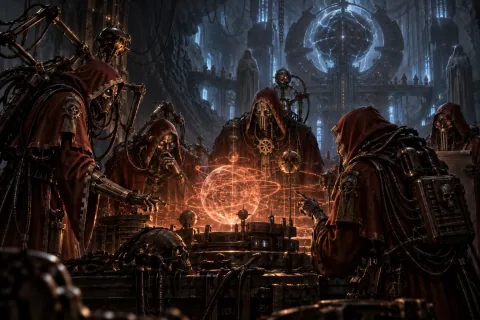
However, one should not describe Mars at this point as having already turned entirely to Chaos. Loyalty and betrayal are choices that split in the actual civil war, and official materials convey the resistance along with the priests who did not join the rebellion. The disaster where Kelbor-Hal later opens the Vaults of Moravec and scrap-code spreads is a separate era. If one mixes it as if it happened from the time the alliance was signed, the weight of the choices made on both sides disappears.
The civil war on Mars also does not end with a single factory explosion. Official author introductions cover the period by dividing it into the recovery of armor in the beginning, subsequent underground resistance and support operations, and separate attacks just before the Siege of Terra. These events are ranges to be assigned to the later Heresy series. What is needed here is not to imagine all the contents of the unopened vaults, but to understand why that door became a temptation and a threat.
Chapter 8 · The Starting Line Created by the Red Planet
The Unification Wars put Terra into the Emperor's hands. The gene-Legions prepared soldiers to fight beyond a single planet. The scattered Primarchs were preparing to return with the talents and scars they had gained from different worlds. And the industrial system of Mars and the various human forces of the solar system turned this plan into an actual expedition. The Great Crusade begins where all these threads are intertwined.
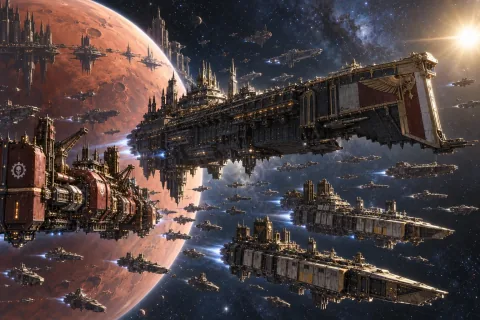
The grandeur of this path does not come solely from the number of massive warships. The possibility that severed human worlds could meet again, and the scale at which technology and experience that survived in the darkness move toward a single goal, create the emotion. At the same time, it remains a question what the new Empire will demand of worlds and people that do not follow that goal. The two sides of the war occurring in the name of reunification will be examined together in the following chapters.
Now the expedition has armies, ships, and an industrial base. But is everyone looking at the same future? The priests of Mars who serve the Machine God, the Imperial Truth that seeks to drive out faith, and sons who accept the Emperor as a father and sons who understand him in different ways have gathered within one order. The moment the door to the stars opens, the contradictions of that order also went out into the galaxy together.
Organization and Terminology Guide
Mechanicum: The priesthood system and power of the Machine God rooted on Mars during the Great Crusade and Horus Heresy era. Historically connected to the later Adeptus Mechanicus, but not the same name and institution of the same period.
Forge World: A planet where massive industrial production and technological power are concentrated. A core concept for understanding not only the expedition's forces but also the paths of supply and repair that maintain those forces.
Omnissiah: The central name of the Mechanicus faith. Do not mix the later Imperial State Church's explanation with the politics and dogma of the early Great Crusade.
Legio Cybernetica: The organization that operates combat automated weapons. Independent cohorts, control structures, and bonds with allied units have both military and political significance.
Archmagos Prime and Magos Dominus: Titles for understanding high priest/command authority and the role of handling automated weapons on the battlefield, respectively. Not every priest has the same rank and body.
Solar Auxilia: The Empire's elite human forces originating from Saturn's space warfare tradition. Does not mean gene-augmented Legions like the Astartes.
Ikaros Contingency: Secret authority of the First Legion prepared for the threat of the Mechanicum. Distinguish between the contingency measures of the Great Crusade era and the operations actually carried out in the later Heresy.
Further Reading: Part 8 covers the Emperor and the unification of Terra, Part 9 covers the Legions after the Thunder Warriors, and Part 10 covers the background of the Primarchs' growth. Links in the same language for the published preceding and following parts can be found in the series table of contents for this text.
Official Materials and Confirmation Scope
Confirmation Date: October 8, 2026 (UTC). Written based on the settings and events confirmed in the official public materials below. Public samples and setting introductions were only checked for their respective scope, and it is not indicated that the entire book was read. Illustrations are AI reconstructions, not official images.
Starting an Adeptus Mechanicus Army — lore primer
Liber Mechanicum: Forces of the Omnissiah — official introduction
What Makes the Solar Auxilia the Best Human Soldiers Around?
Bonded Cybernetica Support Formations — public background
The Thramas Crusade — Ikaros Contingency public extract
Dark Mechanicum Lore — renegade tech-magi and the Martian schism
The Martian Civil War — official author account of the supplement
comments 0