
Operator Recommended Game Story · Warhammer 40,000 Part 6
Chapters in this story
- The Ancient Galaxy and the Dawn of Humanity — Hands That Forged the Stars
- Chapter 1 — Human History That Existed Before the Imperium
- Chapter 2 — Ancient Possibilities Left on the Red Planet
- Chapter 3 — Going to the Stars with the Means to Survive
- Chapter 4 — There Were Those Who Did Not Lose It
- Chapter 5 — Memories Also Have Weight
- Chapter 6 — Metal Comrades and the Horror of Machines Are Not the Same Story
- Chapter 7 — The Imperium's Gaze Toward Recovering the Legacy
- Terminology and Continuing History
- Official Materials and Scope of Verification
The Ancient Galaxy and the Dawn of Humanity — Hands That Forged the Stars
Spoiler Warning: This article covers humanity's early cosmic expansion, the Dark Age of Technology, the STC, and their subsequent legacies. We are turning back the clock to before the Fall of the Aeldari mentioned in previous parts. The histories of these two civilizations overlapped for a long time, and humanity did not conquer the galaxy immediately after the Necrons' Great Sleep. The later Kin and the state of Mars are used as comparative scenes to understand ancient technology.
Before the Golden Throne claimed the center of the galaxy, humanity looked to the stars. The universe they observed already held the long histories of other beings. What was a new frontier for humans might have been a forgotten territory for another civilization, and deep within planets that appeared to be lifeless rocks, older slumbers were continuing.
The dawn of humanity was not a departure toward an empty stage. And the darkness spoken of by the later Imperium does not necessarily mean that the daily lives of people at that time were entirely dark. Beyond the name 'Dark Age of Technology' lay abilities that later generations could not recover, and lives expanded by those very capabilities.
Chapter 1 — Human History That Existed Before the Imperium
When reading the past of humanity, the first thought to set aside is the tendency to overlay the Imperium's present onto every era. The Space Marine Legions and the administrative systems bound under the name of the Emperor are not yet the protagonists of this story. Much of the technology they would later discover and recover was the legacy of humans who traversed the stars before the Imperium existed.
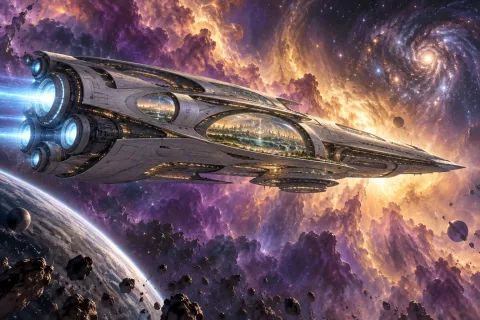
Official lore looks back on that era as a time of technology incomparable to later ages. Humanity changed the conditions of the worlds they inhabited and ventured into the cosmos. However, the later records describing this grand departure are fragmented and sometimes contradictory. The traditions kept by a Tech-Priest, the traces of use left on an artifact, or the devices preserved by a civilization reveal different facets of the same past.
That incompleteness is not a blank space for the reader to fill with any story they choose. It is the reason why it is difficult to confirm the degree of early human integration, the exact origin of machine intelligence, or the starting dates of individual colonies in a single sentence. This series follows confirmed connections while leaving their boundaries intact. The fact that the lost history is vast is different from the claim that current data proves every scene of that history.
Chapter 2 — Ancient Possibilities Left on the Red Planet
To later people, Mars appears as a world of massive factories and Tech-Priests. However, if one traces that memory deeper, a different landscape is revealed. Public materials from 'Dark Heresy: The Lathe Worlds' introduce the lore that Mars was the first planet terraformed during the Golden Age of Technology. It is a story of an atmosphere being provided and barren land becoming fertile. Since the material itself reveals the incompleteness of the tradition, we do not replace the expression 'first' with a fixed number on a timeline here.
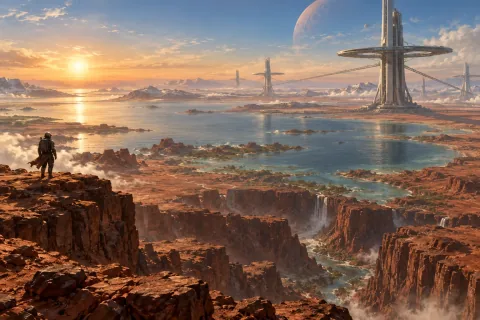
Creating a breathable sky and habitable land on a planet is a different kind of ability than simply making a weapon stronger. Civilization went beyond adapting to the universe it discovered; it could expand the conditions for life. The fact that Mars later became a massive center for production and resource extraction connects that ancient possibility in a different direction.
On the later Red Planet, newly rising structures and abandoned sectors coexist. One should not read this current landscape backward as if it were an accurate photograph of antiquity. Even in the same location, the purpose, the people, and the attitude toward technology change as eras shift. The various faces of Mars show that human history is not a simple curve that ends with a single rise and fall.
Chapter 3 — Going to the Stars with the Means to Survive
Arriving at a distant world and being able to live there are different things. If the materials to be used are different, and the necessary equipment and environment are different, bringing just one finished product is not enough. The reason the STC, or Standard Template Construct, holds special meaning for later generations is connected to that problem.
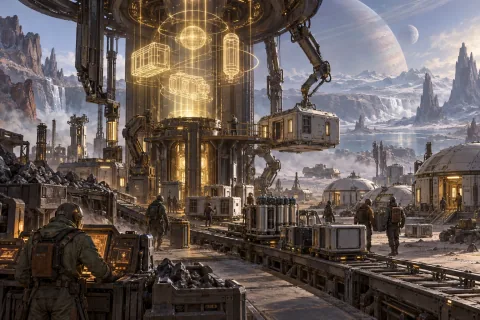
The STC described in official introductions is an ancient device that allows one to create objects and machines with available materials. When understanding this technology, the scope becomes too narrow if one thinks of every STC as a single sheet of paper design or the name of a specific gun. The ability to reproduce the means to live and continue necessary production lies within it. The state in which individual records or devices remain must be examined separately.
Later humanity lost most of it, and what they recovered is cherished and protected. Technology that originally expanded life later became evidence of a lost life. There is an enduring sadness of this setting here. People continue to use machines, but the fact that they use them does not return the understanding of how those machines were first created.
Chapter 4 — There Were Those Who Did Not Lose It
However, if we explain humanity's technological legacy only through the losses of the Imperium, we erase another galaxy. The Kin of the Leagues of Votann show a different picture. Their Ancestor Cores, the Votann, are massive thinking machines that hold knowledge and memory. Weapons, military theory, genealogy, science, philosophy, and STCs are preserved within them.
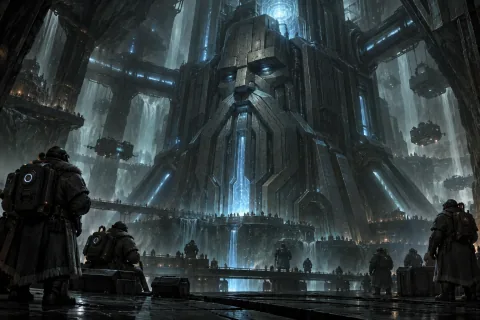
These are not beings that simply take out items from a forgotten warehouse when needed. The Ancestor Core is the center of society and a legacy that must be protected with one's life, and the Kin do not easily speak of its nature to outsiders. For a civilization living in a different relationship with the Imperium, preserving knowledge is also a way of keeping external faiths and powers from occupying the center of their lives.
The appearance of the Votann is not an accurate restoration of the ancient human cities this part covers. It is a later example of carrying old technology down a different path. Remembering this difference allows us to escape the simple conclusion that all descendants of humanity lost in the same way and feared in the same way. The legacy of the same past created different futures amidst the choices of different societies.
Chapter 5 — Memories Also Have Weight
The Votann do not only show the success of preservation. Information accumulated over countless ages makes the Ancestor Cores slow and gives them different tendencies. Answers that were once obtained quickly can become matters that require waiting for a much longer time. Even for a being that has not lost its memory, the act of continuously adding memories is not a miracle without a price.
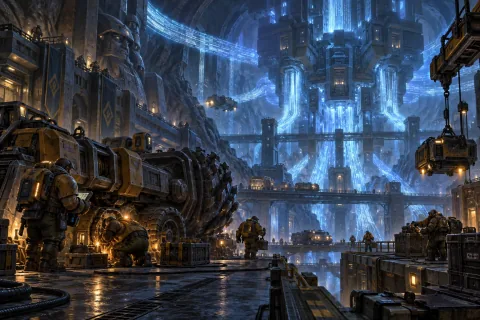
This is a different problem from the memories of the Necrons. The loss of biotransference, damaged personalities, and post-sleep transformations should not be used to explain the Votann. Here, the accumulation of the preserved information itself and the processing burden emerge as significant risks. Looking at Warhammer's different technological civilizations side by side, one sees that living long and knowing fully do not automatically become the same thing anywhere.
Grimnyr and the Kin communities continue their lives and wars while dealing with this massive legacy. Life does not begin after the problem of memory is finished; one must mine, build equipment, and protect comrades even while the problem continues. The weight of civilization is not carried by the Ancestor Core alone. It is shared by those who decide their daily lives beside it.
Chapter 6 — Metal Comrades and the Horror of Machines Are Not the Same Story
Within the lives of the Kin, there are also Ironkin. These are beings with true machine intelligence, comrades created by the Votann, and are integrated as equal members of Kin society. Whether one is made of flesh or metal does not determine the qualification to belong to the same community.
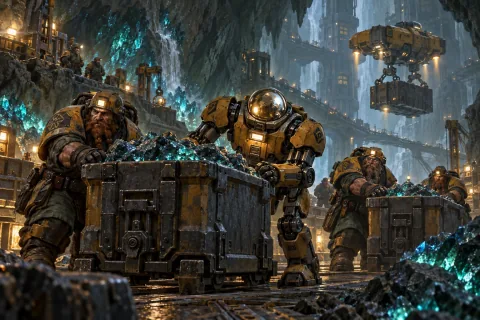
Ironkin possess their own mechanical bodies and core intelligence units. They take on different roles such as mining, cargo transport, piloting, and combat, and their bodies are not treated as anonymous equipment that can be swapped with any parts. Some help calculate routes through the Warp as Wayfinders. One should not immediately connect the explanation that they were made to be useful with the judgment that they are slaves.
Official introductions state that they have been with the Kin since their very early history, but their exact origin is unknown. Therefore, we do not definitively classify all Ironkin as a specific group of the Men of Iron discussed later. One cannot combine the histories and roles of different machines simply because the word 'iron' is in their name. It is important to leave this difference intact before reading about the machine rebellion. The machine intelligences of the galaxy are not a single individual that made the same choice.
Chapter 7 — The Imperium's Gaze Toward Recovering the Legacy
In the far future of this part, the Adeptus Mechanicus comes to consider the search for lost knowledge as sacred. While taking charge of the technology and production that sustain the Imperium's wars, they maintain unique authority and independence within the Imperium. This becomes an important background for understanding the Treaty of Mars and the Emperor's Great Crusade later.
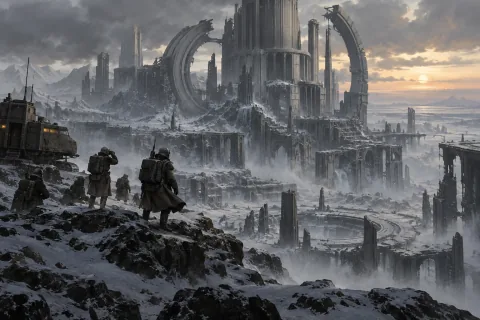
However, pulling the timeline forward here, one should not depict all ancient colony ships like the cathedral ships of the current Imperium. The prayers and symbols added later are later history. The period when humanity was spreading to the stars and the period when descendants are searching for ancestral knowledge in the wreckage between the stars are different scenes.
The reason we read ancient technology through the lens of current loss is because a massive rupture lies between them. What collapsed, why were some communities isolated, and how did the ability that once expanded humanity to the stars turn into the horror and worship of the future? The next part, covering the machine rebellion and the Age of Strife, follows that question. The path of the Kin that has continued to this day also does not disappear. This is because the birth of the Imperium is not the ending that concludes the history of all other humanity.
Terminology and Continuing History
The Dark Age of Technology is the ancient technological era as called by later generations. STC (Standard Template Construct) is the core concept of ancient production technology, and Votann are the Ancestor Cores of the Kin. Ironkin are equal mechanical comrades, and the Adeptus Mechanicus is the technological and production organization of the later Imperium. The Kin society, Warp travel, the faith and organization of the Adeptus Mechanicus, and the Treaty of Mars will each be covered in the characters, factions, and lore parts. The published parts can be read in the series index above and below.
Official Materials and Scope of Verification
Verification Date: October 8, 2026 (UTC). This was written based on the lore and events confirmed in the official public materials below. Public samples and lore introductions were verified only within their respective public scope, and it is not indicated that the entire books were read. Illustrations are AI reconstructions, not official images.
Dark Heresy: The Lathe Worlds — licensed public sample
The Leagues of Votann Are Coming – But What Actually Is a Votann?
40 Years of Warhammer – The Living Ancestor Sums up a Returning Race
Lore of the Leagues – Introducing the Ironkin, Mechanical Members of the Leagues
comments 1
아이언킨의 기원과 맨 오브 아이언의 관계를 명확히 구분해야 한다는 점이 인상적입니다. 혹시 킨의 사회에서 아이언킨이 구성원으로 인정받는 기준이 그들의 데이터 처리 방식이나 특정 알고리즘의 유무에 따라 세부적으로 나뉘기도 하나요?