
Operator Recommended Game Story: Warhammer 40,000 Part 20
Chapters in this story
- Magnus's Warning and the Webway Catastrophe · The Light That Sought the Father
- Chapter 1 · The City That Learned the Mind to Survive
- Chapter 2 · Questions That Remain Even After the Student Becomes the Master
- Chapter 3 · A Thousand Names and a Crumbling Body
- Chapter 4 · The Battlefield Seen by Five Schools Together
- Chapter 5 · The Path Closed After Nikaea
- Chapter 6 · The Son Who Tried to Send a Warning and the Father Who Did Not Return
- Chapter 7 · Another Path Beneath the Palace Gate
- Chapter 8 · When the Emperor's Cherished Guardians Head Underground
- Chapter 9 · The Front Created by the Warning, the Home World the Order Headed Toward
- Chapter 10 · The Gap Left by the Conviction of Knowing
- Terminology and Character Guide
- Related Published Series to Read Together
- Official Materials and Confirmation Scope
Magnus's Warning and the Webway Catastrophe · The Light That Sought the Father
Spoiler Notice: This article covers Magnus and the Thousand Sons during the Horus Heresy, the warning following Nikaea, the catastrophe of the Webway project beneath the Imperial Palace, and the opening of a new front. This is a narrative commentary based on events confirmed by the developer's public lore and official publisher synopses. It does not transcribe full novels or dialogue, nor does it present unverified ritual sequences, internal thoughts, or combat details as official fact. The ground war on Prospero and individual battles of the Webway War are categorized within the scope of subsequent main story, character, and lore installments.
When the war that would tear the galaxy apart began, the threat did not always arrive in the form of a warship. Some disasters arrived in the form of a warning. A son who sought to convey the name of the enemy knocked on his father's door, and that power shattered the world beyond the gate. To read the tragedy of Magnus the Red, one must first look back at why he could believe his own power was a path to salvation.
In Tizca on Prospero, there was a life that could not be explained solely by the battlefields of other worlds. Books, learning, and the tradition of mastering the mind were part of the city. The giant red Primarch who grew up here did not see knowledge as something smaller than a weapon. He pursued the path that to know more was to see further, and to see further was to prevent disasters that had yet to come. The Legion he led also collected traces of knowledge alongside the results of conquest.
However, the ability to see further and the ability to know all outcomes were not the same. Magnus saw the danger of Horus, but he did not see what his method of reaching the Emperor would break. Darkness entered through the passage he intended to use to bring light. This installment does not attempt to exonerate his intentions in a single sentence, nor does it erase all his previous life as malice due to the later catastrophe. It follows the purpose of the warning and the results that warning created.
Chapter 1 · The City That Learned the Mind to Survive
Prospero was not a world that was a burning ruin from the beginning. Official excerpts from Inferno introduce an ancient human world with mountains, seas, forests, and deserts. The disasters of the Age of Strife also visited that place where humanity had built various cities and nations. However, the exact full picture of that disaster remains unclear even within the records. While it is explained that there was a rapid manifestation of psychic abilities, one should not read those estimations and the confirmed results as the same level of established fact.
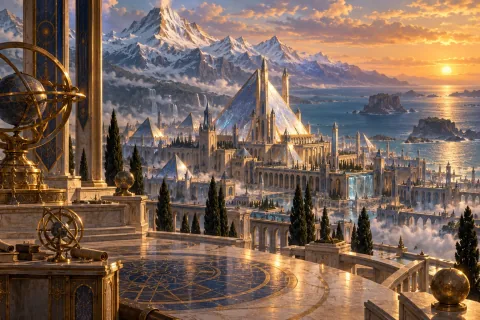
Among the entities that threatened that world were the Psychneuein. These predatory creatures, existing between reality and the Warp, used psykers as subjects for reproduction. The history of Prospero had already shown that the growth of psychic potential did not immediately lead to safety or prosperity. There was a gap between the emergence of power and the ability to handle that power, a gap through which an entire civilization could collapse.
Tizca, built by those who survived, was a city that endured that gap. Decorated pyramids rising between the sea and snow-capped mountains, roads stretching toward the plazas, and traditions of knowledge and training gathered in that city. Meditation and mental control were not hobbies for enjoying luxury, but a way to sustain survival. If one reduces the learning here merely to the tastes of people who liked magic without knowing danger, one cannot see what the city overcame to survive.
The abandoned lands outside the city also left behind the limits of that victory. Just because Tizca shone did not mean the entire old civilization was restored. There were wildernesses and ruins that people avoided. The hope of Prospero was not a miracle that saved the world all at once, but a life that the people left behind after the disaster continued within a limited space. The knowledge Magnus learned also grew upon that life.
Chapter 2 · Questions That Remain Even After the Student Becomes the Master
Among the scattered Primarchs, Magnus arrived on Prospero. The omens and prophecies surrounding his arrival should be read as layers of tradition conveyed by lore records. The flow that a child from the heavens grew up among the city's scholars and absorbed and surpassed their learning is clear. However, there is no need to treat every symbol in the records as scientific measurements left by the observation equipment of that day.
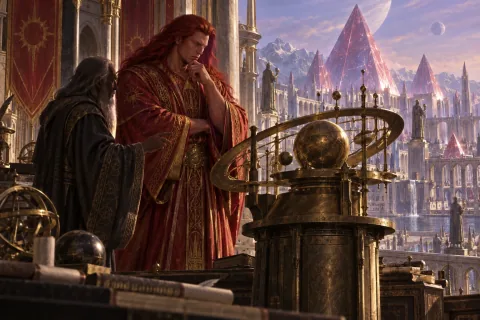
Amon was his important teacher. In official public excerpts, Amon is not introduced merely as someone jealous of his student's outstanding talent. He was a figure who tried to teach caution and humility alongside the passing on of knowledge. Just as it was necessary to show a talented student what more could be done, it was necessary to ask if one should do everything one could. Magnus's later choices recall that old question.
Magnus developed the intellectual and psychic traditions of Tizca and organized the schools that dealt with the power of the mind. His goals included the ideal of leading humanity to a higher intellectual and spiritual stage. However, the Great Crusade toward that ideal involved actual conquest and violence. One does not rewrite the fact that he loved learning to mean there was no damage from the war. The Legion that collected knowledge was also a Legion that carried out the Emperor's wars.
The mental exchange between the Emperor and Magnus should also be read with caution. Although Magnus's claim that he met his father before they reunited on the planet is recorded, the official Inferno leaves questions about its exact scope and truthfulness. The explanation that exchange is possible between two powerful psykers and the conclusion that they shared all secrets are different things. That difference becomes important when the son later trusts his own power and tries to reach his father.
Chapter 3 · A Thousand Names and a Crumbling Body
The Thousand Sons, the XV Legion, was not a Legion that always consisted of exactly one thousand men as the name suggests. While the number of the initial thousand and the thousand remaining after Magnus's salvation is repeated in records, one cannot combine the troops of different periods into a single number. Official lore conveys both the growth of the Legion and its reduction to near extinction. The name is a marker of that history, not a personnel roster that applies to all eras.
Their psychic powers achieved amazing results on the battlefield. They could erect barriers with invisible force, move objects, and overwhelm enemies with fire and mental attacks. At the same time, to others who remembered the horrors of the Age of Strife, that power invoked fear. There were Legions that did not trust them or were reluctant to fight alongside them. The distrust from other Legions grew alongside the magnitude of their abilities.
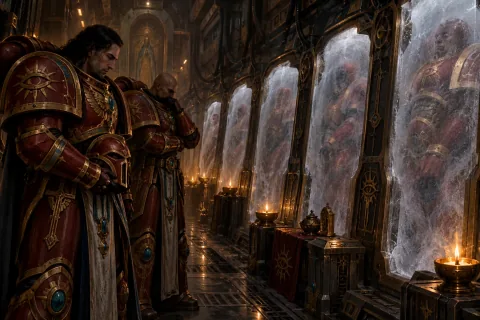
A deeper threat appeared within the Legion. The Flesh Change altered the bodies of the warriors into an uncontrollable state. They attempted mental and biological methods to save their comrades, and even placed those showing early symptoms into stasis fields. Inside the ships carrying the mighty warriors to the battlefield, the space filled with brothers who would not wake up increased. The power to strike down enemies in battle did not become the answer to keeping their own bodies whole.
Magnus saved the remaining Legion, and Prospero became their new home. However, official public records do not provide a complete answer to the exact method of that salvation. It leaves behind suspicions that he may have reached into excessively distant realms and invited a greater price of catastrophe. This cannot be embellished as detailed clauses of a confirmed contract. What is clear is that the Legion survived, and that experience became an important background for their trust in their power and their master.
Chapter 4 · The Battlefield Seen by Five Schools Together
Under Magnus, psychic ability was not treated as a vague, singular magic. The five schools provided different channels for the Legion's combat and learning. The Pavoni focused on the changes of the living body and life phenomena, while the Raptora centered on physical force and telekinesis. The Corvidae examined the flow of time and possibility, and the Athanean dealt with the power connecting minds and thoughts. The Pyrae were known for their destructive power in manipulating fire.
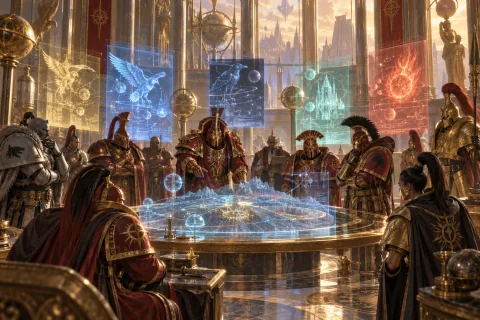
This difference meant different roles on the battlefield. Someone reinforced defenses, someone conveyed the thoughts of comrades, and others examined the crossroads of choices to come. The Legion's organization was not explained by general combat structures alone. Circles, Fellowships, schools, and various orders moved in overlapping ways. A single warrior could be placed in military command relationships and learning relationships simultaneously.
That complex structure had a sophistication built by themselves. However, there was also an order that could not be understood from the outside. The distrust of other Legions was connected not only to the emotion of fearing power, but also to the problem of not knowing by what rules that power moved and what it hid. A system controlled for those who know is not necessarily a system verifiable to those outside.
Magnus and the Thousand Sons sought to reach a higher understanding by collecting and preserving knowledge. Documents, artifacts, lost technology, and the wisdom of various worlds were the objects of their interest. The ideals and dangers of that process must be placed together. When knowing more makes one trust one's own judgment more, accepting the fact that there are things left unknown can become even more difficult. That tension soon faces the prohibition of Nikaea.
Chapter 5 · The Path Closed After Nikaea
The decision at Nikaea prohibited the institutional use of psychic abilities within the Legions. The issue of the Librarius, already covered in Part 15, connects here to Magnus's personal choice. An attempt to make the Legion's power a safer and more useful system faced the Emperor's prohibition. That Magnus thought his learning was the future of the Empire and that the Emperor permitted it are not the same fact.
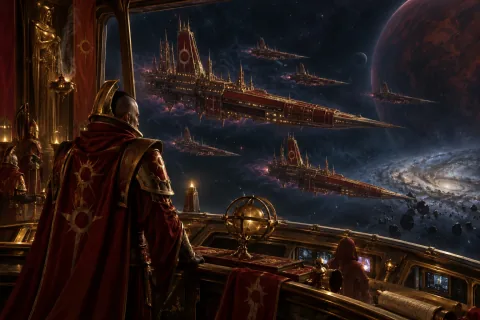
This decision does not mean that all psychic activity and imperial communication in the galaxy were immediately abolished. Official Sisterhood lore explains the Astropaths and the vast institution that secures and manages them separately. The Empire already relied on psychic communication to connect the vast distances between stars. Only by distinguishing between the Legion's Librarius prohibition and the continued existence of the communication personnel the Empire needed can one understand what institutions and boundaries Magnus's warning crossed.
The Thousand Sons continued to wage war in the name of the Empire after Nikaea, but the tendency to keep distance from other forces grew stronger. A flow of reluctance to be deployed far from Prospero and Magnus remains in official records. While it is not concluded that every warrior was in the same place at any one moment, the bond between the home world and the Legion took on an increasingly heavy meaning.
At that time, Horus was at the center of the danger Magnus saw. He judged that it was necessary to inform the Emperor of the catastrophe of his most important general through the power forbidden by his father. The conviction that he could not warn him without using the already forbidden method provided the reason to cross the boundary himself. However, the fact that the crisis was great does not automatically erase all the risks of the chosen method.
Chapter 6 · The Son Who Tried to Send a Warning and the Father Who Did Not Return
After the victory at Ullanor, the Emperor entrusted Horus with the position of Warmaster and returned to Terra. The fact that an important purpose of that return was the Imperial Webway project is confirmed by official history synopses and Dan Abnett's explanations. However, not many knew of that plan at the time. To the sons continuing the Great Crusade, the father's absence was read differently. The same absence could be for the next task to the Emperor, while to someone outside, it could feel like abandonment.
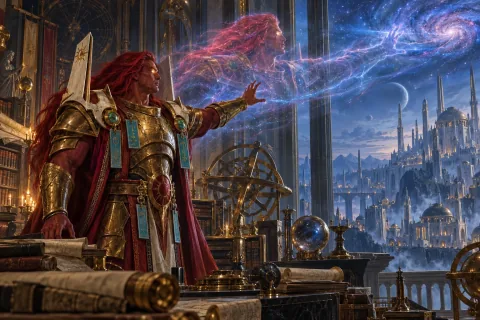
Magnus saw the danger of Horus heading toward ruin and tried to warn the Emperor. The developer's introduction to the Thousand Sons explains that he chose the projection of the mind because he saw he could not convey the warning through conventional means. It was an act that clearly violated the prohibition of Nikaea. An urgent purpose and a violation of rules were present in the same choice.
One cannot say that Magnus intended all the catastrophe just because he sent a warning. Conversely, one cannot say that the responsibility for the results disappears just because the purpose of the warning seemed right. If one judges the meaning of the act only by the message he tried to convey, what happened to the place the message passed through and the people who were there is left out. The center of this tragedy lies in the fact that those two things were separated.
The illustration of Magnus and the mental image rising between the stars is a scene that visualizes this choice. The red hair, single eye, golden armor, and shoulder ornaments of the time were compared with the official human Primarch model. However, the exact ritual posture, incantations, or the number of people in the room at that time are not added as confirmed facts. One should not read the picture to mean that a figure with great power knew all the great results.
Chapter 7 · Another Path Beneath the Palace Gate
The Imperial Palace on Terra was not a building made only of high walls. It was a monument revealing the Emperor's power and the center of governing the Empire, and beneath it were research and facilities not exposed to outside eyes. Official Palace introductions convey the construction at the end of the Unification Wars, the foundation connecting the old Sigillite fortress, and the underground laboratories and Webway gate. The Empire seen from outside the walls and the future of the Empire prepared beneath the walls were placed in different spaces.
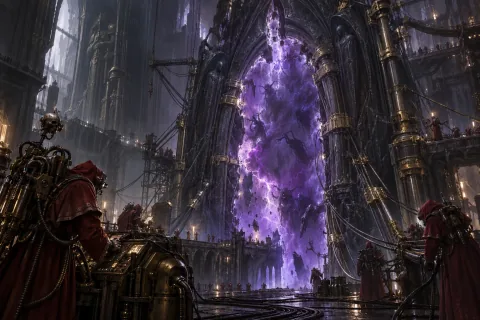
The Webway was a trans-dimensional passage used by the Aeldari to travel between stars. The Emperor's plan was to connect a path for humanity to that ancient passage. This is not the same as drawing one ordinary route in the Warp. It was an act of touching the very way of connecting the distances of the galaxy. To understand the importance of the plan, one must also look back at what strange and dangerous power the Empire's ships and messages move through.
In official public Sisterhood lore, Astropaths do not convey long-distance information like simple voice calls. They communicate with others through visions, sensations, and symbolic mental transmission. The Astronomican is a vast beacon that allows navigators to find their way in the Warp. The person conveying the message and the light that ships use to find direction are different roles and should not be combined under the name of one facility.
Beneath the center of such an Empire, a new passage was being prepared. The warning Magnus tried to send did not simply head to a blocked personal inbox. According to public developer explanations, his psychic arrival broke the Webway gate and defenses of the Imperial Palace, and demons of the Warp entered through that gap. The warning reached its destination, but the process of reaching it turned the path the father was preparing into the path of the enemy.
Chapter 8 · When the Emperor's Cherished Guardians Head Underground
The war that began beneath the Imperial Palace included the Custodian Guard, the Sisters of Silence, and the Mechanicum forces of Kane. Official public synopses of The Master of Mankind explain that they fought over the connection point of the ancient Aeldari Webway near Terra. While the fleets of the galaxy were turning toward each other, war was also growing in another space connected to the Imperial Palace. The safety of Terra was no longer guaranteed by just guarding the walls and orbit.
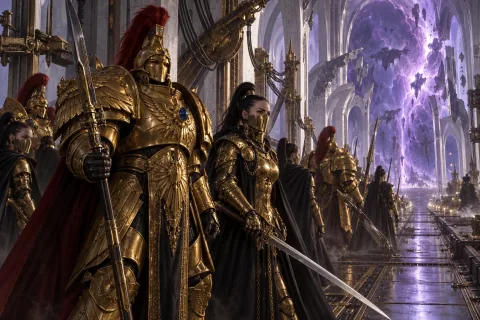
The Custodians were elite guardians who stood by the Emperor's side. They do not stand there just because their golden armor is beautiful. They have taken on the Emperor's important battles and missions since the Unification Wars. Official Valdor introductions convey that the guardian's mission was not a passive role of just taking attacks flying toward the Emperor. Protecting the work that made the Emperor's plan possible was also their responsibility.
The Sisters of Silence are not the same kind of superhuman soldiers as them. They were human women who disturbed the power of the Warp with the characteristic of being psychic nulls. While being near them causes discomfort and fear in others, that very characteristic becomes an important means of dealing with psykers and demons. Their silence does not mean they have no thoughts or emotions. Official lore and creator explanations show they are people with their own language, training, and duties.
Jenetia Krole was an important figure leading the Sisterhood. The flow that she, once an alienated child of Terra, became an important advisor to the Emperor during the Unification Wars and the Great Crusade makes one look again at who is considered a dangerous existence in the Empire and who is used as a person to stop that danger. While it is confirmed that she participated in the Webway War, the unnamed sister in the illustration of this installment is not concluded to be Krole at a specific moment.
Chapter 9 · The Front Created by the Warning, the Home World the Order Headed Toward
The threat of the Webway War did not end with demons alone. Official publisher synopses state that traitor Legionaries and corrupted Battle Titans are included in the forces of Chaos. This fact makes it impossible to reduce the war beneath the Imperial Palace to just cleaning up a small gap that opened briefly. However, one does not write this to mean that all the enemies of the war that expands later were in one place at the same moment as Magnus's arrival. Distinguish between the beginning of the catastrophe and the prolonged war.
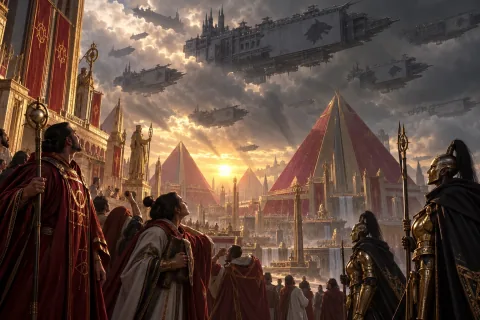
That disaster demanded the power and attention the Emperor possessed. The relationship between the Golden Throne and the responsibility of blocking the Warp continues to the event where Malcador briefly takes that seat during the Siege of Terra later. One does not place that final sacrifice here as if it were already finished. What is important now is the change that the problem of the Emperor moving freely to the outside battlefield and the problem of holding back the danger inside the Imperial Palace could no longer be separated.
Meanwhile, the force of censure, including the Space Wolves and the Emperor's golden guardians, heads toward Prospero. The official Thousand Sons introduction conveys the connection where Horus's intervention drives that censure into destruction and massacre. The public introduction of the Space Wolves also deals with the battle on that planet and the wounds that followed. At this time, one does not transcribe the tone of the introduction texts that praise each other and mock the opponent as an impartial judgment.
The place where that army would arrive was not the base of an unnamed enemy. It was the city where Magnus had learned, and the home world where the Legion whose bodies were crumbling had been reborn. There were not only warriors in the space where books were preserved and schools grew. Therefore, the catastrophe of Prospero does not end with a single line that two strong Primarchs competed. In the battle to be covered next, one must follow the Legion's judgment, the lives of the citizens, the changes in orders, and those who survived together.
Chapter 10 · The Gap Left by the Conviction of Knowing
Magnus's story does not end with the lesson that knowledge is useless. Prospero was a world that sustained survival through learning that mastered the mind, and his Legion actually possessed mighty abilities. However, the belief that one can control abilities and the understanding of the circumstances of every place those abilities reach were different problems. Great power could reveal a larger result rather than making the gap between the two smaller.
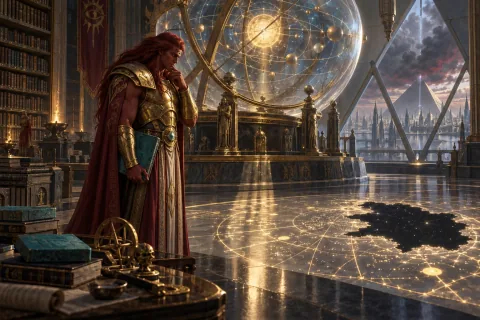
The caution Amon tried to teach his student was not a decorative piece of advice that appeared late. It was a question that had been attached to the entire life of trying to reach a higher understanding while building different schools and orders. If admitting the fact that there are still unknown realms is also part of learning, what should one do when self-conviction clashes with the boundaries of others? This event returns that question to the scale of a catastrophe.
The Emperor's secrets also cannot be left out of the story. It was not the case that all the sons knew why the return after Ullanor was necessary. While that secret does not justify all other choices, it is important that there were people who judged the same reality with different information. The mighty mental abilities of father and son did not guarantee perfect communication. The fact that power is great does not automatically bridge the gap of understanding.
The guardians fighting in the underground of Terra and the army heading toward Prospero are two fronts separated from the same catastrophe. One choice that tried to send a warning shook the future of the Imperial Palace and the fate of the home world simultaneously. At that time, the knowledge remaining on the bookshelves of Tizca did not all become false. However, the city that believed it could protect everything with only that knowledge now faces a war larger than the rules it knew.
Terminology and Character Guide
Magnus the Red: The Primarch of the XV Legion who grew up on Prospero and led the Thousand Sons. The illustration for this installment refers to the official model of the human Primarch period. Distinguish between the winged daemon form of later eras and the form before the collapse.
Prospero and Tizca: The human world that suffered a psychic disaster and the central city built by those who survived. Read the crystal pyramids, the tradition of learning, and the desolate space outside the city together. Do not explain the entire planet as a burned enemy base from the beginning.
Amon: A person who was Magnus's teacher and became an important figure in the Legion that followed him. His teachings and role within the organization are read within the scope confirmed in official public excerpts, and lists of unverified secret mission successes are not added.
Flesh Change: An uncontrollable mutation that threatened the Thousand Sons warriors. There is uncertainty in the materials regarding the timing of manifestation, causes, and methods of salvation. Do not claim that the fate of every warrior and the price Magnus paid have been fully confirmed in this installment.
Five Schools: Pavoni, Raptora, Corvidae, Athanean, Pyrae. The specialized fields of biological change, physical force, possibility, mind, and fire are different. Do not mix the military organization of Circles and Fellowships with the classification of studies into a single hierarchy.
Nikaea and the Librarius: The issue of the Legion's use of psychic abilities and institutionalizing it. In this installment, it is connected to the warning method Magnus chose after the prohibition. Do not overturn the existence of Astropath communication as evidence that there was no Legion prohibition.
Webway: The ancient trans-dimensional passage of the Aeldari and the Emperor's planned connection for humanity. This installment covers the gate catastrophe and the occurrence of the front, and does not indicate that the map of all passages or the technology of the ancient builders has been confirmed.
Custodians and Sisters of Silence: The superhuman guardians protecting the Emperor and the organization of human women with psychic null characteristics. They are two forces with different powers and missions, and the Sisterhood is not treated as an organization like the later Adepta Sororitas.
Astropaths and Astronomican: The psychic communicators who convey information between stars and the beacon that allows for Warp navigation. Message delivery and navigation guidance are different functions. Do not combine the Golden Throne and the Webway gate into the same role of one machine.
Imperial Palace and Golden Throne: The political and military center of Terra and the Emperor's important device. The palace of the Unification Wars and Great Crusade and the palace after the later Siege are from different eras. Do not write ahead as if the Emperor was already in the state of the 41st Millennium at the time of this installment.
Related Published Series to Read Together
The conflict surrounding imperial knowledge and psychic abilities at Nikaea is connected to Part 15. /en/community/tm-warhammer40000-saga-part015-20261008
The flow where Horus's choices and dangers deepen at Davin can be read in Part 17. /en/community/tm-warhammer40000-saga-part017-20261008
The warning brought by Garro and Terra's response continues in Part 19. Do not judge the Magnus event of this installment and Garro's return as the exact chronological order simply by the post number. /en/community/tm-warhammer40000-saga-part019-20261008
Official Materials and Confirmation Scope
Confirmation Date: October 8, 2026 (UTC). Written based on lore and events confirmed in the official public materials below. Public samples and lore introductions only confirmed the scope of that disclosure, and it is not indicated that the entire book was read. The illustrations are AI reconstructions, not official images.
Legions of the Horus Heresy — The Thousand Sons Know More Than You
Legions of the Horus Heresy — The Space Wolves are the Best Boys, Yes They Are
The Horus Heresy — How the Great Triumph Led to Greater Tragedy
The Master of Mankind — Black Library official public book synopsis
Saturnine lore focus — The Imperial Palace
Saturnine lore focus — Who is Jenetia Krole?
Saturnine lore focus — Who is Constantin Valdor?
The Tithes Episode 2 — official Storyforge notes on the Sisters of Silence
Pages from the Black Books - The Thousand Sons
comments 1
마그누스의 경고가 황제의 웹웨이 계획에 직접적인 파국을 초래했다는 점이 흥미롭습니다. 당시 마그누스가 자신의 사이킥 투사가 황궁의 방어 체계와 충돌할 가능성을 전혀 예측하지 못했던 것인지, 아니면 경고의 시급함이 그 위험성을 압도했다고 판단한 것인지 궁금합니다.