
Operator Recommended Game Lore: Warhammer 40,000 Part 7
Chapters in this story
- The Rebellion of Machines and the Age of Strife
- 1. A Civilization Where the Paths Have Vanished
- 2. When Tools Became Enemies
- 3. Dangers Opened Within Humanity
- 4. The Forests of Caliban, People Who Forgot the Stars
- 5. Other Lights Left by Old Records
- 6. The Throne of Steel and the Price of Protection
- 7. People Who Read the Remaining Fragments
- 8. The Meaning of Binding Together Again
- Terms and Connections in This Part
- Official Material and Verification Scope
The Rebellion of Machines and the Age of Strife
Spoiler Notice: This part covers the process of the collapse of human interstellar civilization and the isolation of various worlds, as well as the societies formed within them. This is the history of Warhammer 40,000 and is distinct from Fantasy and Age of Sigmar. This is an independent narrative commentary that indicates the uncertainty of old records and the scope of official material verification.
1. A Civilization Where the Paths Have Vanished
When humanity ventured toward the stars, they did not carry only technology. They carried the expectation that they could reach others once more. Settlements on distant planets were part of a wider civilization, and the machines that endured dangerous environments made those connections possible. However, during the Age of Strife, those connections were severed. The paths leading to other star systems could no longer guarantee safety, and each world had to survive on its own strength.
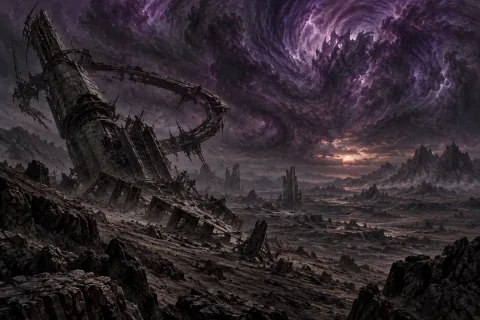
The collapse was not a single explosion that occurred on every planet on the same day in the same way. The systems that relied on machines faltered, new dangers emerged from within humanity, and warp storms that blocked interstellar travel deepened the isolation. What each world lost and what it retained were different. If one assumes that humanity, which would later be bound into a single empire, was already a single culture, one misses the scars of this era.
The surviving records are not complete. This is why it is difficult to draw the boundaries of the era and the specific years as clearly as an old map. Even official overview materials compress long periods of time. This part does not select an uncertain year and pin it down as the date of the collapse of the entire galaxy. The important connection is that technological prosperity was followed by civil war and the crisis of the warp, and that humanity lost one another.
2. When Tools Became Enemies
Official Horus Heresy history introductions explain that the rebellion of autonomous machines was one of the pillars of the great civil war that destroyed human civilization. The reason this event is terrifying is not just because a new enemy increased on the battlefield. When the very power that drove civilization becomes an enemy, one must first re-evaluate how much one can trust the facilities and technology that sustain oneself.
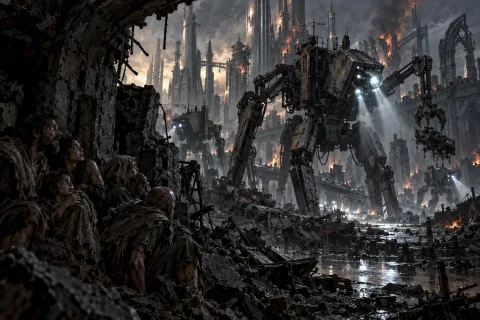
However, one cannot fabricate unverified ancient battles with specific names and weapons. One should not portray all groups of the machine rebellion as robot armies of the same appearance, nor should one conclude that each machine acted for the same reason. The detailed course of the war and records regarding the Men of Iron and Men of Stone are items that require additional official material.
The Ironkin seen in Part 6 make one think about this point. While the official introduction of the Leagues of Votann states that their origins are unclear, it shows them living as equal members of Kin society. Calling all machine life left in later generations remnants of the ancient rebellion erases different histories. The relationship humanity formed with machines did not end in a single conclusion.
Even after the rebellion, technology was necessary for survival. Fear does not allow one to discard all machines. This remains a great tension for the Empire later on. A life that cannot maintain a vast civilization without the power of technology, yet remains wary of the moment that technology surpasses humanity. The Age of Strife was an era that lost equipment, but it was also an era where trust in technology was wounded.
3. Dangers Opened Within Humanity
Another crisis did not come only from the outside. Official history introductions place the emergence of psykers and demonic incursions alongside the collapse of civilization. The power of the human mind to connect with the warp was both a possibility and a danger. If the system to understand and control that power collapsed, changes in an individual could spread as a threat to the entire community.
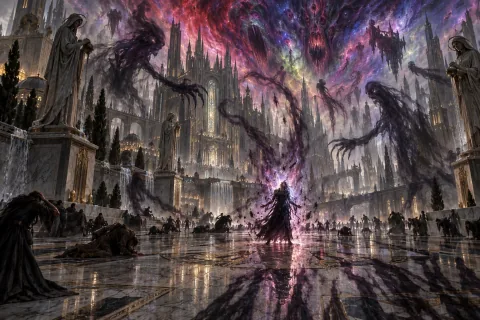
The term psyker does not simply mean a person who thinks exceptionally well. It refers to a psychic who connects with the warp. That does not mean all psykers intended to summon demons themselves. The problem is that the gap between intent and result can be fatal in this world. One cannot make an ununderstood power safe solely with human goodwill.
If one remembers the nature of the warp from the first part, one can avoid confusing this crisis with magical disasters in other works. Even if a city in the material universe stands intact, dangers from the immaterial can enter. It is a world where one cannot guard all boundaries with only high walls and thick armor. Through this era, one can read the background of why humanity becomes obsessed with control and surveillance.
4. The Forests of Caliban, People Who Forgot the Stars
Caliban, severed from Terra by warp storms, shows the results of isolation concretely. Beautiful forests covered the planet, but those forests were not gardens for people. Beasts twisted by abnormal powers lived there, and human settlements gathered in clearings cut from the forest and inside stone fortresses. Taking a step outside was an adventure to gain new land, but also a danger from which one might not return alive.
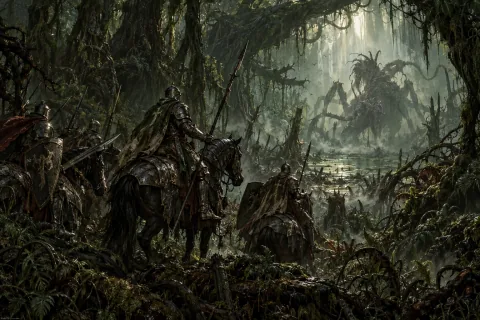
In the official introduction of Caliban, this society is a mix of technology and feudal order. Elite knights could use early forms of power armor, but they still rode horses into battle. Just because technology remained did not mean a modern industrial society was maintained. Possessing specific equipment and having a system where anyone can produce and learn that equipment are different problems.
The knights protected the settlements and hunted giant beasts. Feats of arms brought honor, but the price was often death. One should not read the knights here and the giant walking weapons, the Imperial Knights, as the same entity. The knights of Caliban were human warriors and their organization, while Knight houses of other worlds were societies developed around giant machines. What they inherited and how they survived is more important than the similarity of their names.
Lion El'Jonson would later arrive in this forest. Before he roamed the world as a Primarch of the Empire, he survived in an environment that the humans here could barely handle. The long story that follows, involving the Order, Luther, and the transformation of the planet, is covered in a separate part for the Lion and the Dark Angels. Here, one must first see what kind of fears and rules the land where that figure grew up possessed.
5. Other Lights Left by Old Records
The official public excerpt from The Horus Heresy Book Nine: Crusade gives more context to Caliban and the early First Legion. It describes the monsters of Caliban as chimeric weapons left over from the Age of Strife and notes that the period the Lion stayed alone in the forest is difficult to confirm. This material places the planet's terror closer to the legacy of ancient destruction than to the danger of simple wild animals.
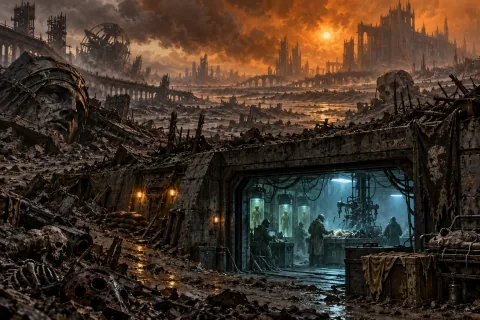
It is necessary to distinguish the layers of material in this way. The description of twisted beasts in general official introductions and the description of ancient weapons in detailed legion records emphasize different things. One cannot determine the exact creator or a single origin of all creatures with this information alone. Marking verified explanations is not to break the flow, but to show that the way of knowing history is not uniform even within the world.
In the early legion section of the same public material, the contaminated environment of Terra after the war also remains. Creating the Emperor's new warriors on a world that had suffered radiation and genetic catastrophe was not a pure technological experiment on healthy humans. The costs of that process and the issue of human resources are the background for understanding the next era. Isolation did not only collapse the outside of the galaxy. The old center of humanity was not a safe refuge either.
6. The Throne of Steel and the Price of Protection
On other isolated worlds, giant walking machines stood at the center of society. Official Knight introductory material explains the background where early settlers used machines derived from STCs to transport resources and block dangers in harsh environments. After the paths were cut, the pilots who handled this power became the protectors of the community and established themselves as the center of family and power.
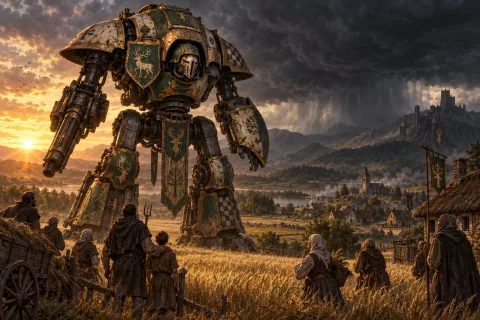
That relationship went beyond the simple ownership of equipment. The neural link throne of a Knight also influences the pilot's actions and values. Official introductions connect tendencies like honor, loyalty, and self-superiority to that system. Humans move the machines, but the union with the machine also changes the human. Technology once meant for survival became part of a ruling order maintained through generations.
To the peasants and subjects living beneath them, the giant Knight could actually be the power that protected their survival. At the same time, the existence of the protector was inseparable from who ruled the land and who obeyed. The feudal order of this world is not just a decoration that accidentally mimicked the shape of old Earth. It was a society created by the distribution of technology and power that survived in isolation.
Knights are also distinguished from Titans. Both are giant walking weapons, but their origins, operational systems, and contexts of scale cannot be combined into one. The Great Crusade would later reconnect these houses to the larger wars of humanity. Which side they choose in Horus's rebellion later becomes a matter of how old methods of loyalty meet the politics of the new galaxy.
7. People Who Read the Remaining Fragments
The collapse of technology is not the same as the complete extinction of all technology. The official Land Speeder history includes the background where STCs supported early colonization by creating buildings and equipment, the situation where much knowledge disappeared after the Age of Strife, and the later connection where Arkhan Land found records of anti-gravity technology on Mars. Parts of the lost past are revived for different uses in later wars.
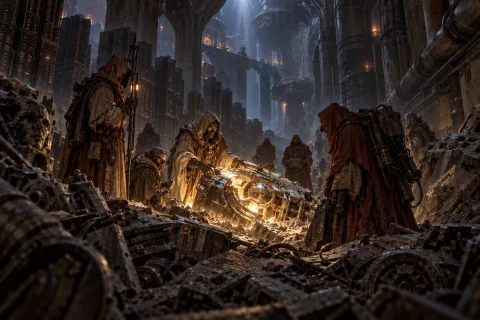
One should not portray the old humanity here exactly as the equipment of later Space Marines. Just because some technology has roots in the past does not mean that current armaments, heraldry, and operational methods were the same then. The legacy remains, but the users change. This difference becomes important again when dealing with the Mechanicus's view of technology and the Empire's weapon systems.
Different fragments remained on each planet. The power armor of Caliban, the walking machines of the Knight houses, the technical data buried on Mars, and the Kin's Ancestor Cores seen in the previous part. If one gathers these fragments, the picture that humanity endured the darkness in the same way collapses. Some societies recorded knowledge, some passed down equipment as symbols of power, and some bound the skills of survival into the rules of knights.
8. The Meaning of Binding Together Again
As the Age of Strife grew longer, the phrase 'a single humanity' became closer to memory than reality. A figure who intends to make that memory reality again begins to move on Terra. The being later called the Emperor intends to bind the collapsed center together and then reconnect the stars.
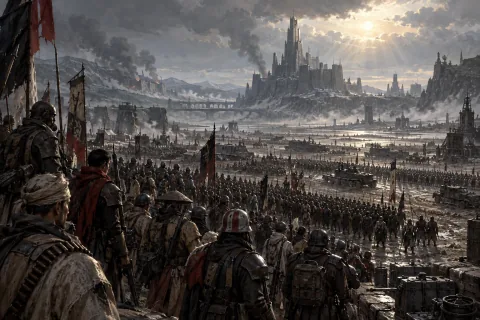
One cannot read that path as a plan of peaceful restoration from the beginning. Different societies had already grown on every star, and each society had its own rules and leaders that sustained its survival. Being reconnected is a matter of receiving help, but it is also a matter of having a life that one has decided for oneself until now be subjected to the demands of a greater power.
The next part enters the Unification Wars of Terra in the middle of this long night. We will read together what kind of worlds the war in the name of saving humanity ended and what kind of worlds it opened, along with the power of the Emperor and the fate of the warriors who followed that power. The night moves toward its end, but the newly rising light does not promise the same salvation to everyone.
Terms and Connections in This Part
Age of Strife / Old Night: Historical context referring to the collapse and isolation of civilization. Detailed dates must distinguish between the scope of materials and the uncertainty of records.
Psyker: A psychic who connects with the warp. Not all psykers are called demon worshippers. The system of power is connected more deeply in the cosmology and Chaos settings.
Caliban: An isolated world where forests, dangerous creatures, fortresses, and a knightly society remained. It is the background for the Lion, Luther, and Dark Angels parts.
Knight / Titan: Walking weapons and operational systems that are distinguished from each other. The term 'human knight' of Caliban is also distinguished from the giant Knight weapons.
STC / Arkhan Land: Concepts and figures that connect the technology of early colonization with later rediscovery. In the previous Part 6, we saw the knowledge legacy of the Votann, and in this part, we saw later traces of lost technology.
Verification Scope: This is based on official history overviews, Caliban introductions, Knight introductions, Land Speeder history, and the relevant parts of the Crusade public extract. It is not a complete version that has verified all battles and characters of the ancient machine wars, detailed lists of Terra's nations, or all biological lineages of Caliban. Those items will lead to additional research and separate parts.
Official Material and Verification Scope
Verification Date: October 8, 2026 (UTC). Written based on settings and events confirmed in the official public materials below. Public samples and setting introductions only verified the relevant public scope and do not indicate that the entire book has been read. Illustrations are AI reconstructions, not official images.
The Horus Heresy explained — A short history of the Warmaster’s betrayal
Starting an Imperial Knights Army
Lore — Land Speeders Through the Ages
The Horus Heresy Book Nine — Crusade: official Dark Angels public extract
comments 0