
Operator Recommended Game Story · Warhammer 40,000 Part 22
Chapters in this story
- Isstvan V · The Day the Guns of Salvation Turned
- Chapter 1 · A Warning from a Dead Planet
- Chapter 2 · Vengeance Carried Within Black Hulls
- Chapter 3 · Entering the Path Chosen by the Enemy
- Chapter 4 · After the Sky Opened, Black Sand Turned to Glass
- Chapter 5 · The Armor of the Reinforcements Was Still Familiar
- Chapter 6 · The Thickest Side of the Tank Faced Forward
- Chapter 7 · Between the Beauty of a Brother and the Iron of a Brother
- Chapter 8 · The Son Swallowed by Black Wings and Flames
- Chapter 9 · The Narrow Path the Machine Protected Until the End
- Chapter 10 · Being Off-Planet Did Not Mean Being Outside the Wounds
- Chapter 11 · The Same Wound Did Not Create the Same Answer
- Chapter 12 · The Darkness Left Behind the Path of Victory
- Index of Characters, Factions, and Locations
- Previously Published Parts and Series Guide
- Official Materials and Scope of Confirmation
Isstvan V · The Day the Guns of Salvation Turned
Spoiler Notice: This article covers the Dropsite Massacre of the Horus Heresy, the catastrophe of the Iron Hands, Salamanders, and Raven Guard, the death of Ferrus Manus, and the fragmentation of the surviving Legions. This is a narrative commentary reconstructed from official battle introductions and excerpts from published lore books. The atmosphere of the scenes is an interpretation and does not establish unconfirmed dialogue, attack sequences, or the inner thoughts of characters as canon. The purge of Isstvan III and the massacre of Isstvan V are distinct events.
Table of Contents: Chapter 1 The Warning Reaches the Emperor's Sons → Chapter 2 The Fleet Arrives with Fury → Chapter 3 The Valley Becomes a Trap → Chapter 4 The First Drop of the Three Legions → Chapter 5 The Expected Reinforcements → Chapter 6 Fire Poured from the Rear → Chapter 7 Ferrus and Fulgrim → Chapter 8 The Remaining Two Primarchs → Chapter 9 The Sacrifice of Iron and Escape → Chapter 10 Destruction Beyond the Surface → Chapter 11 The War of the Shattered Legions → Chapter 12 The Day the Empire Could Not Return. At the end, there is an index of characters and factions, and links to previously published parts.
Chapter 1 · A Warning from a Dead Planet
The atmosphere of Isstvan III had already become an instrument of murder. The warriors who remained loyal descended to break the enemy's walls, but the order to kill them came from the very command that had sent them. Horus and the Legions that aligned with him singled out the loyalists within and erased them with a virus bombardment. Some survived and resisted longer. That resistance shortened the time the rebellion could remain hidden and created a window for a warning to reach elsewhere.
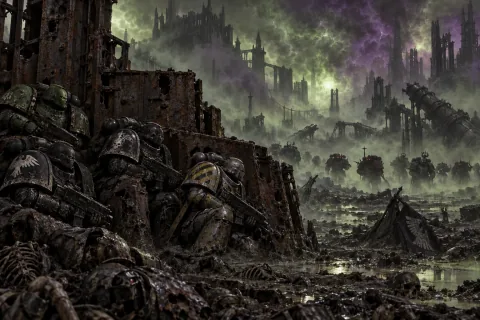
The news delivered by Nathaniel Garro of the Death Guard brought an unbelievable reality to the Imperium. It was that the Emperor's most beloved son and the supreme commander of the Great Crusade had betrayed the Emperor. Rogal Dorn could not easily accept this fact from the beginning. Changing the name that had supported the Imperium's military system into the name of an enemy was heavier than a simple transmission of information. However, after doubt and deliberation, he had to move. If the rebellion were left unchecked, more wars and more worlds could be bound to Horus's side.
Dorn summoned the Legions loyal to the Emperor to head to Isstvan. His own Imperial Fists fleet also departed from Terra. However, in the war of the galaxy, departing did not mean immediate arrival. The currents of the Warp pushed them off their intended course, and the fleet was trapped in the Phall system. There, the command of Alexis Polux determined their survival. Apart from the battle to be fought on Isstvan, the Legion called the Emperor's Shield had to carve its own path first.
The Iron Hands, Salamanders, Raven Guard, Word Bearers, Night Lords, Alpha Legion, and Iron Warriors responded. The gathering of seven Legions seemed like a force that could overwhelm the rebels. The expectation that the superhumans who built the Imperium could restore order if they moved together again was also established. However, there was one premise in that calculation that had not yet been revealed. It was the premise that all the responding Legions were truly loyal to the Emperor.
Chapter 2 · Vengeance Carried Within Black Hulls
The Raven Guard arrived early and scouted with stealth ships. Confirming the horrors left on Isstvan III turned the rumors about Horus into the traces of an actual war. The destruction before their eyes urged a judgment on what must be stopped here and now, rather than a question of where things had gone wrong. For Ferrus Manus, the commander of the Iron Hands who arrived next, personal betrayal was layered over military responsibility.
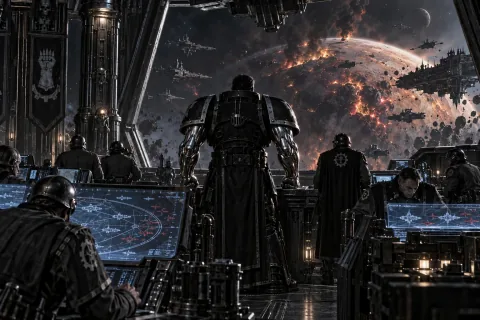
Ferrus and Fulgrim were not strangers. Ferrus, who valued cold machines and solid strength, and Fulgrim, who pursued beauty and perfection, were different but close brothers. The relationship of crafting and exchanging weapons was a mark of that intimacy. However, after Fulgrim turned to Horus's side, he tried to involve Ferrus in the rebellion as well. Violence followed the refusal. When Ferrus headed to Isstvan, the betrayal he had experienced on his own flagship earlier was a war that had not yet ended.
The Iron Hands were a Legion that bound powerful tanks, sophisticated machines, and infantry into a single pressure to crush the enemy. Ferrus's achievements in the Compliance Crusades and his experience in commanding wars were the reasons he took field command. What was expected of him was not just fury. It was one of the Imperium's foremost military powers and the resolve to push it forward. However, the entire Legion could not keep up with the speed at which that resolve moved.
The published excerpts of 'Massacre' state that Ferrus arrived at Isstvan V first, leading the elite of his cherished Avernii Clan. A larger force and fleet were following. Therefore, the fact that he was on the battlefield should not be read as meaning all the Iron Hands were on the ground at once. The defeat that would unfold continues in different forms on the ground, within the hulls that arrived late in the system, and in the lives of the warriors who remained on other fronts.
Chapter 3 · Entering the Path Chosen by the Enemy
The Urgall Depression of Isstvan V was not a terrain that could be easily erased by the strength of a large army alone. Cliffs and rocks limited the paths, and behind the high ground and defensive lines lay a massive fortress. The terrain blocking three directions and the void shields reduced the possibility for the attacker to choose the battlefield at their convenience. The larger the force, the greater the risk of having to pour into narrow paths.
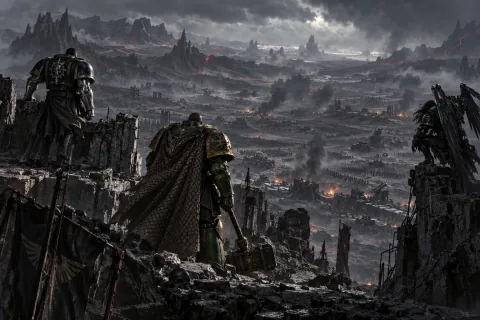
Horus used those constraints as a weapon. The minefields and Araknae and Tarantula batteries were not just a landscape with many guns. They were a defensive system that lured attackers into prepared kill zones. To break through the resistance in front, they had to enter the paths left open, and those paths overlapped with areas where the enemy could concentrate their fire. That the enemy fortress was visible in the distance and that one could reach it were different problems.
Vulkan considered caution, and Corvus Corax considered deception and other approaches. Ferrus chose a plan to collapse Horus's army with a single overwhelming strike. Official battle introductions explain this plan as reckless, yet also evaluate it as one of the few options with a chance of success. If the judgment is erased by only foolish fury, the pressure of the terrain at the time and the need to quickly end the rebellion also disappear. The fact that it was a dangerous plan and the claim that it was a plan without reason are not the same.
Horus's spies delivered news of the gathering and preparations. While the loyalists coordinated the schedules of multiple fleets and set the order of attack, the rebels prepared the place where they would wait for them. What the fortress and batteries showed was a trap visible to the eye. A more lethal trap was within the battle plan of the attacking force. The very promise that the first wave would hold the enemy and the next wave would replenish the strength was being used by Horus.
Chapter 4 · After the Sky Opened, Black Sand Turned to Glass
The loyalist flagships in orbit rained down lance fire. The outer defensive lines were submerged in smoke, and the black sand turned into hot glass. From the sky, drop pods descended, piercing the anti-aircraft fire. Superhuman warriors poured out of every hull that struck the ground. They moved according to the procedures learned in the Great Crusade, but the armor they were now aiming at contained soldiers of the same Imperium as themselves.
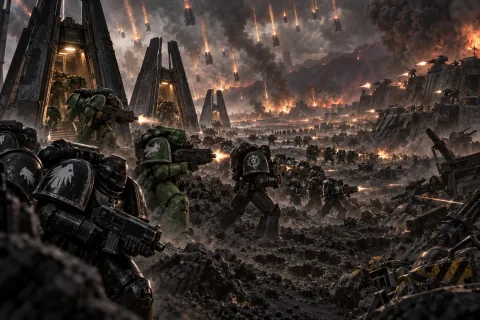
The first assault was led by the Iron Hands, Salamanders, and Raven Guard. Ferrus pushed the spearhead toward the fortress. Vulkan and Corax also fought at the front of their respective lines. There, the fierce close-quarters combat of the World Eaters and the heavy resistance of the Death Guard continued. The tactics of the Legions, which once defeated enemies in different ways for the Empire, had now become a means for the Legions to kill other sons of the same Emperor.
The initial orderly charge could not remain the same for long. Ammunition dwindled and weapons were damaged. The distance of the advance was created between fallen warriors and burned-out tanks. When machines stopped, they had to hold on with living arms, and when infantry collapsed, the ranks further back had to fill the gaps. The difficulty of the battlefield was not a test that could be ended by one hero exerting strength for a moment. It was a depletion that the massive organization called a Legion paid with its entire body.
Nevertheless, the loyalists moved forward. The fortress ahead was still far, but in the sky behind, there was still a promise. Other Legions would descend. Exhausted companies would fall back to regroup, and new forces would continue to fight. That expectation was a military condition that allowed the attack to continue. The arrival of the next force was not just an addition of new numbers. It meant there was an end to the time they had to hold out.
Chapter 5 · The Armor of the Reinforcements Was Still Familiar
New transports and drop ships appeared. The Iron Warriors, Night Lords, Word Bearers, and Alpha Legion entered the battlefield. The newly arrived warriors built defensive positions in the rear and deployed heavy weapons and armored vehicles. It was a sight that supported the ranks worn down in the front. Betrayal was not revealed by outward actions alone. Building a defensive line could take the same form whether protecting allies or blocking their retreat.
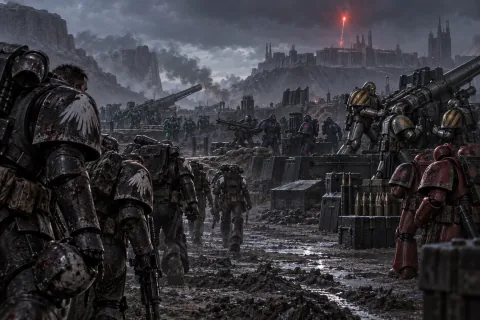
The fronts of the Raven Guard and the Salamanders became difficult to advance further amidst the counterattacks and wreckage. The companies that had suffered losses broke contact and returned to the drop site. The plan that those who fought first would be covered by those who came later was put into actual action. Their rear was supposed to be a place to resupply and reorganize forces. The familiar markings of the Legions supported the judgment that it was safe.
However, the communications were left with static instead of the expected answers. A red flare went up over the fortress. The newly arrived Legions raised their guns. The aim was not toward the fortress. It was toward the loyalists approaching them. The moment the rear, prepared under the name of support, turned into a firing line, a new battle began for the warriors who had endured the first attack.
On Isstvan III, superiors killed the subordinates they had chosen from above. On Isstvan V, the entire relationship of other Legions coming to help became a means of murder. One could no longer distinguish allies by armor, gene-seed, or the achievements of the Great Crusade they had accomplished together. The reason one betrayal happens to so many soldiers is not because they were naive, but because the system through which they conducted war was built on the premise of trust.
Chapter 6 · The Thickest Side of the Tank Faced Forward
The armored ranks of the Iron Hands were deployed to respond to the enemy in front. Published lore excerpts explain that while the powerful tanks exerted their combat power when facing the first four Legions of the enemy, they exposed their weaker sides when the second wave attacked from behind. The power of technology and armor cannot erase the condition of which side one is being fired upon from. The fact that they had not designed defenses against allies became a vulnerability.
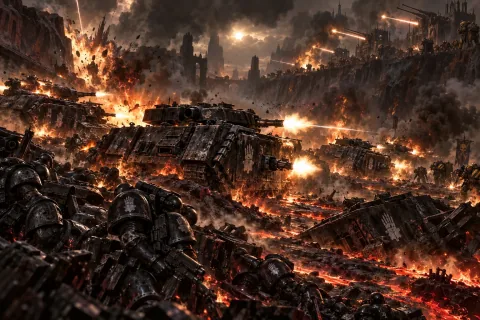
In the near rear, there were newly deployed batteries. From the front, the existing rebels continued to press. Even for warriors who knew how to survive on the battlefield, the space to move decreased. Lowering one's body to avoid fire did not become an answer to avoiding fire from another direction. News that one unit had collapsed also meant that the space for adjacent units to hold out had disappeared. Defense and withdrawal require time, but the enemy did not give them that time.
The engineering and artillery capabilities of the Iron Warriors possessed cold efficiency in this situation. They were a Legion skilled in building and breaking fortresses. The batteries loyal to Perturabo destroyed the survival space of their brothers here. Legion introductions convey attacks that even used nuclear weapons against the Salamanders. The massive flash where Vulkan was last seen is also connected to that overwhelming firepower. The name of a Legion that withstands fire could not block an attack that overturned the entire planetary battlefield.
This battle was not a defeat that occurred only because the enemy in front was stronger. A structure was created where the reinforcements, trusted by the exhausted attacking force, blocked them, and the enemy already prepared in front pressed together. Horus connected the different characters of his Legions into a single destruction. As a result, even the strengths of the loyalists turned into reasons why they could not stop the attack and escape. As much as the force pushing forward was great, the cost of turning the ranks around was also great.
Chapter 7 · Between the Beauty of a Brother and the Iron of a Brother
Ferrus was deep in the front. Fulgrim came out to challenge him there, and Ferrus responded. On one side was the seeker of perfection, adorned with gold decorations and purple armor. On the other was the master of a Legion with black armor, massive mechanical devices, and silver hands. The two had looked different for a long time. However, because there was a relationship that had endured beyond those differences, the final clash was heavier than a duel between two enemy commanders.
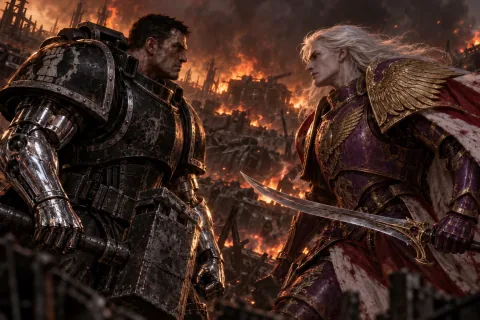
The two were superhuman commanders of superhuman Legions. While they faced each other, the ranks of the Legions were collapsing elsewhere as well. The death of Ferrus was not an orderly signal that all other loyalist units could see and understand. Facts were transmitted amidst smoke and fire, and the news that one did not want to believe and the need to actually continue command moved simultaneously. As the life of one commander vanished, the basis for the judgment of the entire Legion also wavered.
Official published battle history states that after a massive clash, Ferrus fell beheaded before Fulgrim. The same introduction records it in a way that there are no surviving witnesses to tell the exact process of that clash. Therefore, this article does not invent unconfirmed sword strikes, weapon exchanges, or words of that moment. The clear result is that Ferrus did not leave the battlefield alive. A son of the Emperor died by the hand of another son of the Emperor.
Angron and Mortarion pushed into the broken loyalist ranks. Horus also emerged from the shadow of the Dies Irae Titan and achieved victory. The Iron Hands who tried to protect Ferrus's remains resisted until the end, but they could not recover their Legion's father and return alive. The record that Horus took his severed head shows what the mark of victory had become. The name that had built the honor of the Great Crusade was now set upon the corpse of a brother.
Chapter 8 · The Son Swallowed by Black Wings and Flames
Corax clashed with Lorgar amidst the massacre. The battle drove the Primarch of the Word Bearers close to death. However, Konrad Curze intervened and saved Lorgar. The fact that the possibility of taking down one person is not the same as the possibility of surviving on the entire battlefield was revealed here as well. In a fight where one loses a Legion, the individual power of a Primarch cannot change the scale of the surrounding war at once.
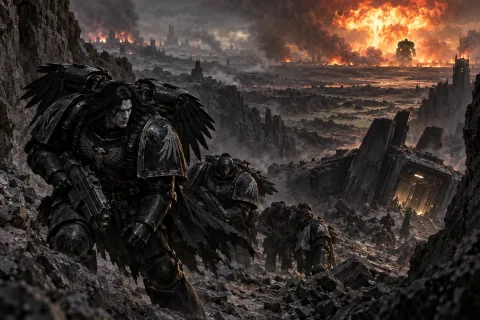
The survival of the Raven Guard was not an orderly victory march. A 2022 official retrospective states that even the escape of the Thunderhawk that Corax tried to use collapsed due to being shot down. The fact that they were accustomed to movements and ambushes invisible to the enemy did not make the sky outside the trap safe. The battle on the planet and the situation of the transports and fleets above were connected to each other. If there was no means to leave even if they held out on the ground, survival was a task that had not yet ended.
Vulkan was last seen amidst the flames of a nuclear bombardment. The destruction that killed his remaining sons swallowed the surroundings. However, the last sighting should not be immediately concluded as Vulkan's permanent death. Official retrospectives separately confirm that both Vulkan and Corax survived Isstvan V. The result to understand in this part is that the two Legions could not recover their previous strength just by the fact that their Primarchs were alive.
The return of a Primarch does not mean the warriors return. The time that raised them, the tactics and connections of companies built together, and the next generation waiting at home suffered massive losses. The fact that the Salamanders continued to fight against the Heresy afterward and the explanation that they could not return to the scale of their previous Legion for some time are simultaneously true. An individual who survived and a destroyed organization cannot be counted in the same words.
Chapter 9 · The Narrow Path the Machine Protected Until the End
On the black battlefield, even weapons with names disappeared. Dreadnoughts containing the ancient warriors of the Iron Hands fought, staking their long-accumulated combat experience. Ancient Morn, who appears in published excerpts, is conveyed as a being destroyed while protecting Ferrus's severed remains. His old metal body was a shield that could replace more living people, but even that body could not hold out endlessly against destruction.
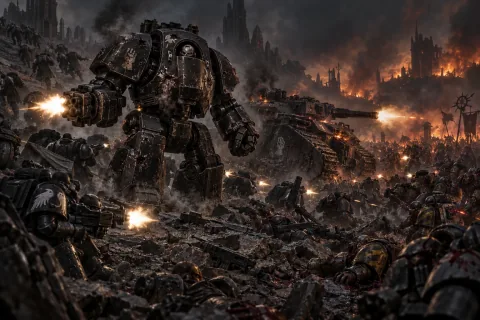
Intemperata was a Cerberus tank that provided cover for the Avernii Terminators. As the Iron Warriors' laser and gravity fire poured down, the tanks in that unit, excluding Intemperata, became burning wrecks within a short time. The remaining tank engaged the Dies Irae, drawing enemy fire away from the infantry and onto itself to protect the Iron Hands infantry, and records honor that sacrifice. If one follows the final moments of such small units, the massacre is not just a story of large numbers. While one weapon held out longer, someone was able to move, and the spot where they could no longer move became the final resting place of another warrior.
Excerpts explain that several armored units were sacrificed to create gaps for the infantry to escape. If tanks are lost, the infantry becomes weak. However, in a situation where the retreat was already closed, trying to preserve the tanks could have resulted in losing everyone along with the infantry. The power combined to overwhelm the enemy in the Great Crusade consumed itself here to let some of the living out. The disappearance of one piece of steel became a short opportunity for another life.
Escape was also dangerous in the air and orbit. The remaining transports and ships had to recover forces, and the enemy also attacked the path of departure. Just because a few survived on the battlefield did not mean they were left with safe routes and places to gather again. The wounded and scattered units faced not the end of the battle, but the beginning of the next survival. That is why the name 'Shattered Legions' does not disappear throughout the subsequent war.
Chapter 10 · Being Off-Planet Did Not Mean Being Outside the Wounds
The official battle history of 2025 explains a loss of over 90% of the loyalist forces deployed to the surface. The important scope here is 'deployed to the surface.' If this number is applied directly to all three entire Legions across the galaxy, the following fleets, units on other fronts, and survivors are erased. There is no need to create a number with a larger scope than reality to feel the scale of the massacre.
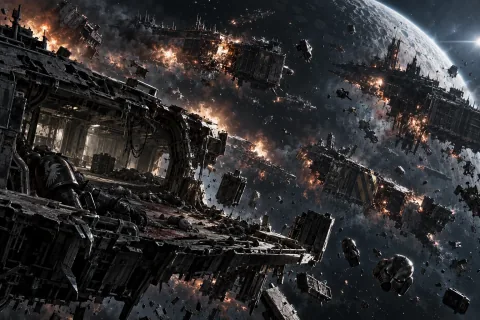
The published lore of the Iron Hands states that the ships of the 52nd Expeditionary Fleet that arrived late in the Isstvan system and the countless warriors within them were also caught in the trap and destroyed. The fact that those following Ferrus died before they could descend to the ground shows that the catastrophe known by the name of the Dropsite Massacre was not just an event on the planet's surface. The losses of the Legion extended even to those who arrived late.
However, there were also large groups of Iron Hands who were operating elsewhere or were not notified of the urgent summons. The same excerpt explains that because of this, there were more Iron Hands survivors than the other two damaged Legions. That many survivors remained did not mean the Legion was maintained as one body. The father was dead, and the clans bound around him accepted differently why they had survived and why others had died.
There are also differences between confirmed materials regarding the description of battle time. The short official retrospective of 2022 emphasizes a massacre of about three hours, while the detailed battle introduction of 2025 explains it in the order of a four-hour first battle followed by the betrayal of the reinforcements. This article follows the latter's stage composition but does not combine the two materials into one precise clock. The more one reads by dividing the scope and time of the damage, the clearer the actual scale of the battle and what each introduction emphasizes becomes.
Chapter 11 · The Same Wound Did Not Create the Same Answer
On Medusa, there were those who sought to rebuild the Legion. The Council of Iron Fathers organized the structure and accelerated the speed of raising new warriors using stored gene-seed. That was a responsibility the survivors had to bear. The dead warriors would not return, but they could ensure that the loyalty they tried to protect did not disappear completely. Rebuilding took longer than fixing a machine with a hammer.
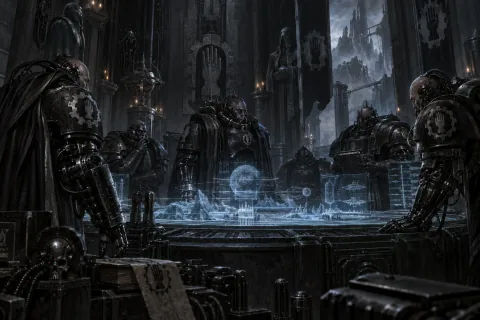
Others did not accept the authority of the Council. The lone remaining groups and clans started their own wars. Some blamed the traitors, and some re-examined Ferrus's judgment and their own failures. There were reactions of hating the weakness of the flesh, and there were reactions of distrusting brothers and allies who were not with them. Published lore also conveys the fact that the Legion Council strongly denied suspicions of having touched forbidden technology. One should not turn suspicions into the actions of all confirmed survivors.
Survivors of the three damaged Legions sometimes mixed to form temporary combat groups. Those were the 'Shattered Legions'. This name does not mean a single regular Legion established under a new Primarch. It refers to various groups that survived and counterattacked by connecting different traditions and remaining forces. It was a condition of having no choice but to continue small wars instead of the massive organization of the Great Crusade, and at the same time, it was a resistance that Horus could not erase.
What they could recover was limited. Neither Ferrus's life nor the ranks of the first day would return. However, they could continue the fight to not let the traitors move safely across the galaxy. The remaining warriors of the Salamanders, Raven Guard, and Iron Hands turned their wounds into the strength of war in their own ways on each subsequent front. The fact that that strength did not always lead to sound and correct judgment is also the aftermath of this catastrophe.
Chapter 12 · The Darkness Left Behind the Path of Victory
Isstvan III was a war for Horus to remove the loyalists of his own Legions. Isstvan V was a war to remove the Legions that came to punish him. As the two events connected, the rebellion changed from an internal conspiracy to an open, massive war aimed at the Emperor's Imperium. The room to doubt which side Horus was standing on decreased. Instead, the strength to stop him also decreased.
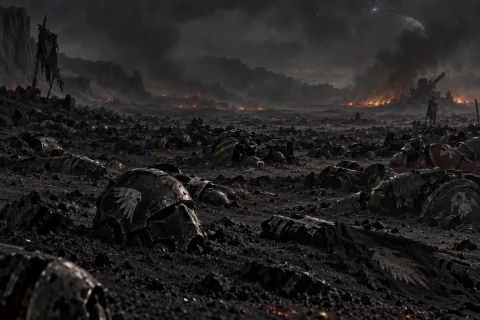
On the victorious side, the cost of the ammunition poured and the brothers killed remained, but the initiative of the war tilted toward Horus. Ferrus was dead. The Legions of Vulkan and Corax were broken. The number of seven Legions gathered for punishment was no longer read as the strength of the Emperor. This is because the four Legions that betrayed within it joined the rebels. The meaning of reading the same gathering before and after the battle changed completely.
In the center of the Imperium and on distant fronts, there were still those who had to sort out this news. From where to send forces, which fleet to trust, and which of the warriors who were together were following other orders, they had to judge again. The fact that technology, fleets, and Legions being strong does not guarantee the loyalty of that organization was revealed. Even when reading the division of Mars and the wars in various regions afterward, this crack remains as a background.
On the black sand, scorched armor was piled up. The surviving warriors either left, leaving all their brothers there, or had to endure the next night in a wasteland from which they could not yet leave. The path that expanded the Imperium became the path where brothers were buried. On Isstvan, the war did not end. The era where they trusted each other's names collapsed, and the galaxy behind it entered a longer darkness.
Index of Characters, Factions, and Locations
Ferrus Manus · Primarch of the Iron Hands. After refusing Fulgrim's offer to join, he led the field attack on Isstvan V and died. Detailed Medusa history and machine philosophy continue in the character/Legion commentary.
Fulgrim: Primarch of the Emperor's Children. He was close to Ferrus but fought him on Horus's side. I do not mix his human appearance at this time with the later Daemon Primarch appearance.
Vulkan · Primarch of the Salamanders. The last sighting amidst the nuclear bombardment is not a confirmation of permanent death. His subsequent survival journey is covered as a separate event.
Corvus Corax · Primarch of the Raven Guard. He fought Lorgar, experienced Curze's intervention, and survived the massacre. The cost of subsequent Legion rebuilding is a story for the next period.
Perturabo · Primarch of the Iron Warriors. He led a Legion with siege, engineering, and artillery capabilities to Horus's side. I do not mix the nuclear attack on Isstvan with other modern wars.
Avernii · An Iron Hands clan including the elites Ferrus brought to Isstvan V. The clan system of Medusa is not exactly the same as the chapter system of other Legions.
Isstvan III / Isstvan V · Different planets belonging to the same system where the internal loyalist purge and the Dropsite Massacre against the punishment fleet occurred, respectively.
Urgall Depression · The battlefield where the attack paths and defensive lines of Isstvan V were concentrated. I use the terrain concepts of official materials, and the illustration does not replace an accurate map.
Shattered Legions · Temporary combat groups of various Legion warriors who survived after the massacre. It is not one new regular Legion or a central command organization that binds all survivors into one.
Previously Published Parts and Series Guide
The Massacre of Isstvan III and the Start of the Warning: Operator Recommended Game Story · Warhammer 40,000 Part 19
https://ascgame.com/community/tm-warhammer40000-saga-part019-20261008?lang=ko
Magnus's Warning and Other Cracks in the Imperium: Operator Recommended Game Story · Warhammer 40,000 Part 20
https://ascgame.com/community/tm-warhammer40000-saga-part020-20261008?lang=ko
The Destruction of Prospero and the Clash of Brothers: Operator Recommended Game Story · Warhammer 40,000 Part 21
https://ascgame.com/community/tm-warhammer40000-saga-part021-20261008?lang=ko
You can check the starting point for each work and the entire published series table of contents in the series navigation of the article. Parts in preparation are not included like the published links. The civil war of Mars and the Mechanicus, the subsequent journeys of the scattered Legions, and related Primarch/Legion/equipment commentary will be connected after reading more confirmed materials for each.
Official Materials and Scope of Confirmation
Confirmation Date: October 8, 2026 (UTC). This was written based on the settings and events confirmed in the official published materials below. I have only confirmed the scope of the published samples and setting introductions, and I do not indicate that I have read the entire books. The illustrations are AI reconstructions, not official images.
The Horus Heresy — How One Act of Betrayal Shattered Three Legions in Just Three Hours
Witness the Horror of the Dropsite Massacre in This Incredible New Warhammer World Diorama
Legions of the Horus Heresy — The Iron Hands Are Hard as Nails
Legions of the Horus Heresy — Break Down Walls With the Iron Warriors
Pages from the Black Books — The Iron Hands: Original Edition and Public Extract
Pages from the Black Books - The Iron Hands
We Asked Forge World How They Designed All 18 Primarchs — Russ and Magnus sections
comments 1
이스트반 V의 비극은 읽을 때마다 마음이 무겁네요. 믿었던 형제들이 등 뒤에서 총구를 겨누는 순간, 그 허망함은 정말 말로 다 할 수 없을 것 같습니다. 😭 내용이 너무 방대해서 정리하기 어려우셨을 텐데 덕분에 흐름이 한눈에 들어오네요!