
Operator Recommended Game Story: Warhammer 40,000 Part 2
Chapters in this story
- Volume 1: The Galaxy Before Humanity — The Immortal Furnace, The Price of Souls
- Chapter 1: It Was Not Just One Dynasty's Affliction
- Chapter 2: Giving Bodies to Those Who Ate Stars
- Chapter 3: A Civilization Passing Through the Furnace
- Chapter 4: Same Metal, Different Prisons
- Chapter 5: The Gods Were Broken, But the Price Remained
- Chapter 6: Living in an Eternally Strange Body
- Chapter 7: Immortality Left for the Next War
- Official Materials and Verification Scope
Volume 1: The Galaxy Before Humanity — The Immortal Furnace, The Price of Souls
Spoiler Notice: This text covers the birth of the Necrons, the bargain with the C’tan, the hierarchy of biotransference, and the loss left in its wake. Scenes from the distant past are reconstructed based on the scope of official introductions. Aeldari legends and uncertain motivations are explained by clarifying their nature; the original text and dialogue from official novels are not reproduced.
In the first part, we witnessed the ancient tragedy lying within the armies of metal. Now, we step closer to that threshold. How did the desire to shed suffering flesh transform an entire race? What did the promised immortality leave behind, and what did it take away? If one asks only how strong a Necron body is, they miss the point. Their origin is a sequence of flight from a frail body and subjugation to a powerful master.
Chapter 1: It Was Not Just One Dynasty's Affliction
Official materials explaining biotransference introduce the Necrontyr as a race plagued by short lives, disease, and internal division. Death was not merely the end of an individual, but the anxiety of a civilization. Resentment toward the longer-lived Old Ones and the need to unify a fractured empire moved in tandem. Therefore, the search for immortality should not be explained solely by pure benevolence, nor reduced to the whim of a single ruler.
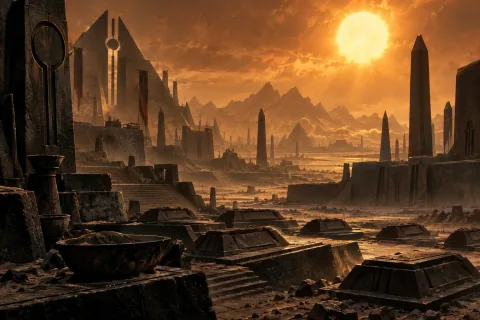
Here, the Silent King emerges. Official introductions do not conclude whether he intended to grant immortality to his people or sought more absolute control. We do not fill in those blanks with definitive inner thoughts. However, regardless of which motive was greater, the fact remains that the result of the path chosen by the King affected all his subjects. The moment a deal struck at the pinnacle of power passes through every existence at the bottom, the choice of a civilization overwhelms the choice of the individual.
When we place the future envisioned by the Necrontyr side-by-side with the future created by the Necrons, the cruelty of the event is revealed. The wish to be free from death met technology that could preserve the body forever. Yet, that technology did not guarantee the freedom to live as oneself. Just because the promise was great, the missing conditions did not become small.
Chapter 2: Giving Bodies to Those Who Ate Stars
The C’tan are beings incomprehensible in the same way that the gods human priests would later believe in are understood. Ancient tales describe them as beings that ate stars. After contact with the Necrontyr, the C’tan manifested their power in the material universe through bodies of living metal called Necrodermis. The body that contains an existence is more than a mere shell; it is linked to the way power is exercised.
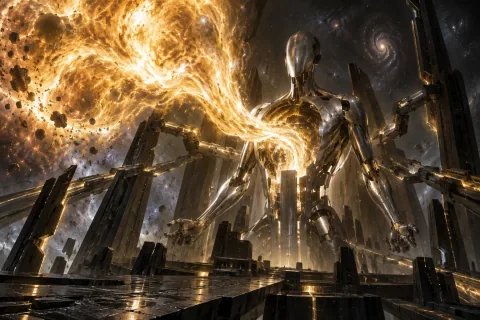
Here, the relationship between the C’tan and the Necrons is not a beautiful exchange where one gives endless knowledge and the other gratefully receives. The C’tan provided the knowledge for biotransference. The figure who made that knowledge actionable was Illuminor Szeras, a brilliant and ruthless Cryptek. The King's decision, the star god's knowledge, and the technician's ability met at a single point.
Distinguishing these three roles makes the responsibility and consequences clearer. The monarch decided the future, the gods offered promises and deception, and the being who understood the technology made the transformation possible. Erasing any one name does not make this event simple. Even when reading about Szeras studying life and souls later on, the starting point remains that he was a technician involved in changing the way others existed.
Chapter 3: A Civilization Passing Through the Furnace
In the depiction of biotransference passed down through Aeldari legend, a massive furnace appears. Flesh vanishes, and cold metal takes its place. It does not depict everyone standing in line with the same heart. Official introductions do not bundle whether they went voluntarily or were forced by Ghost Arks into a single, confirmed experience. Regardless of the method of participation, the race was changed into something different than before.
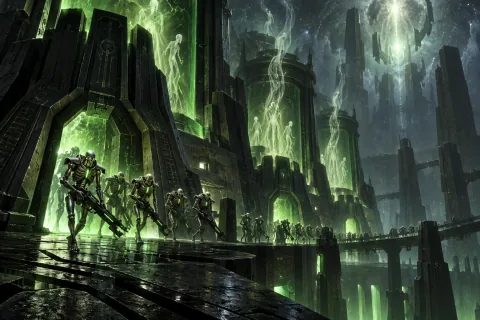
The extinction of the flesh and the birth of metal might look like an exchange. However, the decisive price was paid elsewhere. The C’tan stole their souls. The beings who received new bodies could not fully preserve their previous state. This is why endless lifespan cannot be understood merely as an extension of life. The remaining body is stronger than before, but one cannot say that what persists within that body is the entirety of their past self.
The beauty of the word 'immortality' collapses at this point. A wish that began as a desire to enjoy life longer turns into a question of what kind of being remains to enjoy it. Losses in an army might be repaired with technology. However, there was no promise that lost souls and severed individuality could be reattached in the same way. The power gained to win had already changed the meaning of victory.
Chapter 4: Same Metal, Different Prisons
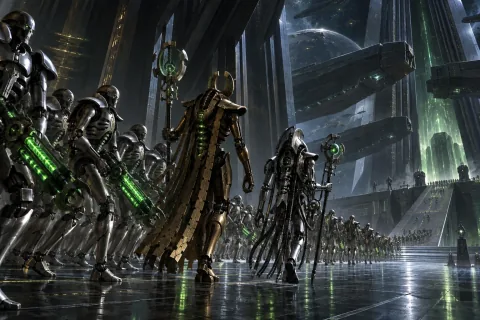
Biotransference did not erase the hierarchy of the old society. Citizens of low status largely lost their individuality and senses, becoming Necron Warriors who carry out orders. Specialized warriors became Immortals, retaining enough independence to serve their masters better. Overlords and Crypteks retained their egos, but in the era when the transfer occurred, they were placed under the command protocols held by the Silent King. Having memories and being able to decide for oneself were not the same reward.
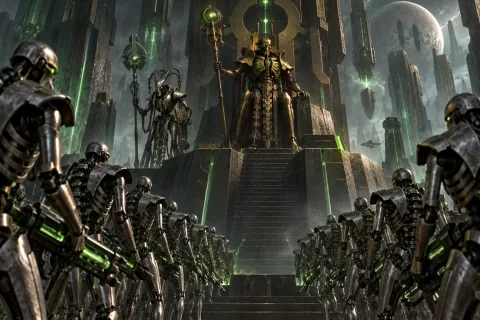
Let us overlay this difference onto the procession of metal soldiers. Even within the same army, some beings wait only for the end of an order, while others cling to their old status and desires. Competition among named rulers remains in the courts of the dynasties, but countless soldiers do not become the protagonists of that competition. Immortality did not give everyone the same future. The shape of power held by the living society was transferred into a harder body.
Explaining the subjugation at the time of the transfer does not fix the political state of every dynasty tens of millions of years later. The ancient command structure and the later dynastic rivalries must be read by dividing the eras. Without contrasting the phrasing of 2020 public introductions with subsequent lore, one cannot conclude that all current Necrons always follow the same orders. That long change will be continued in the main volume covering the Great Sleep and reawakening.
Chapter 5: The Gods Were Broken, But the Price Remained
In the massive war following biotransference, the Necrons and C’tan faced the Old Ones and the countless races they created. The war was vast enough to tear the galaxy apart. And eventually, the Necrons turned on the C’tan who had deceived them and shattered them into pieces. The C’tan Shards that appear on the battlefield later are beings that carry this history of destruction and subjugation. There is a grand reversal in the event of using a body received from a god to face the god, but that reversal does not mean the restoration of a previous life.
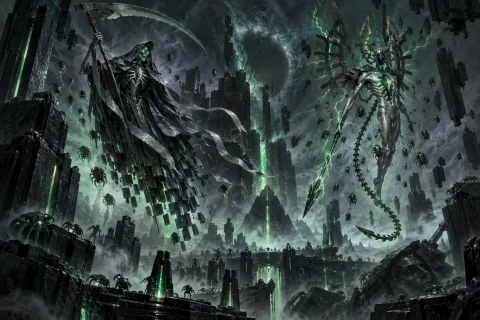
The Nightbringer was once one of the most powerful C’tan. Official introductions describe the being known as Aza’gorod, or Kaelis Ra, the Destroyer of Light, to the Aeldari. The current Shard's appearance features a massive scythe, a Necrodermis cloak, and swarming scarabs. This image is not data proving the exact size or a specific battle of the god when it was whole in ancient times. It is a later appearance to understand the power and bondage that remained even after it was broken.
The Void Dragon Shard shows a stranger scene. The metal body forming its shape flows with the power of Blackstone, and the Canoptek structures attached to its back control the raging entity. The weapon that draws out the god's power is simultaneously a device that imprisons that power. The fact that a being is strong and the fact that it is free remain different questions here as well.
Chapter 6: Living in an Eternally Strange Body
The tragedy of the Necrons does not end with an ancient event. After a long sleep and awakening, damaged minds, obsessions, and a changed galaxy remained. An official interview with author Nate Crowley, who has written about the Necrons, explains the problem that even high-ranking Necrons must exist forever in bodies completely different from the ones their minds were originally adapted to. A strong body does not remove all the scars of the mind.
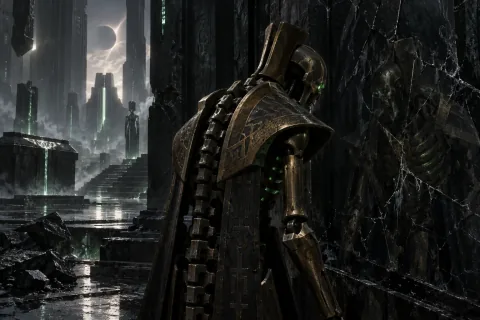
The story of Oltyx shown in the official public introduction of 'The Twice-Dead King' is also connected to this problem. As the heir to the Ithakas Dynasty, he is driven out by court conflict and commands decaying forces on the frontier. The goal of taking revenge on those who drove him out and the need to save a crumbling dynasty do not move in the same direction. The war he faces is not a victory tale of defeating mechanical enemies from a human perspective, but a story of looking at the decline of a civilization through the eyes of a Necron. The conclusion of the entire book, which has not been contrasted yet, is not created solely from this introduction.
From the player's perspective, an enemy that resurrects endlessly is proof of power. If one shifts to the perspective of that existence, endless survival might be a matter of returning to the same body and loss every time. Therefore, this series does not leave the Necrons only as enemies decorating humanity's wars. Their dynasties, figures, and internal conflicts each have independent stories. If one reads the galaxy only through the eyes of one empire, even this half of history remains invisible.
Chapter 7: Immortality Left for the Next War
Let us connect the key terms of biotransference. Necrodermis refers to living metal and that body; Cryptek refers to beings who handle Necron technology and knowledge. Warrior, Immortal, and Overlord are names that understand the hierarchy and roles after the transfer. A Shard is a piece of a broken C’tan, and the fact that there is a control device does not mean the danger of its power disappears.
Now, the next main volume heads to the wider stage of the War in Heaven. If you have seen the Necron's bargain, you must also see the origins of the beings who stood against them and the races dragged into that war. One cannot cover this tragedy with the single phrase that no one wanted death. One must read even what the decision made for the survival of one civilization left for other lives. The flames of the furnace have subsided, but the results left in the galaxy by the army that passed through it have not yet ended.
Official Materials and Verification Scope
Verification Date: October 8, 2026 (UTC). Written based on settings and events confirmed in the official public materials below. Public samples and setting introductions were only checked for their respective public scope, and it is not indicated that the entire book has been read. Illustrations are AI reconstructions, not official images.
comments 0