
Operator Recommended Game Story · Warhammer 40,000 Part 4
Chapters in this story
- Ancient Galaxy · Imprisoning the Star Gods and Waiting for Time
- Chapter 1 · Facing the Gods with Bodies Received from Gods
- Chapter 2 · The Fear Left by Imprisoned Gods
- Chapter 3 · Time Could Have Been on the Necrons' Side
- Chapter 4 · What Does Not Return Upon Awakening
- Chapter 5 · The Returned Monarch, The Changed Dynasty
- Chapter 6 · Erased Memory Becomes Today's War
- Chapter 7 · The Galaxy Left by Those Who Slept
- Official Materials and Scope of Verification
Ancient Galaxy · Imprisoning the Star Gods and Waiting for Time
Spoiler Notice: This article covers the Necron betrayal of the C'tan, the Great Sleep, the losses left by the long slumber, and the conflicts of later dynasties. The return of the Silent King and Ammentar are used as comparisons to view the later impacts of ancient events. This is a novel-style commentary directly linked to official materials, and it does not fabricate an unconfirmed sequence of individual battles that shattered the C'tan.
The victorious army turned its weapons against its own gods. The beings who had promised to grant them immortal bodies had stolen their souls, and at the end of that promise, the people had become something different than they were before. Now, what the Necrons sought to destroy were not just distant enemies. They were the masters who had changed and ruled them.
However, the success of that betrayal did not mean time flowed backward. The fall of the C'tan did not bring back flesh and breath. The Necrons remained as living metal, and the war left deep scars upon the galaxy. The path ahead for a civilization that had surpassed its old masters was not a new life, but a sleep that was far too long.
Chapter 1 · Facing the Gods with Bodies Received from Gods
The C'tan's promise seemed like a way for the Necrontyr to escape death. As seen in Part 2, the result was the loss of soul and individuality. Having endured the War in Heaven, the Necrons eventually turned against the star gods who had deceived them. It was a moment where the boundary between enemy and master shifted. The transaction that had bolstered the strength of an army became linked to the power that would bring down the other party of that transaction.
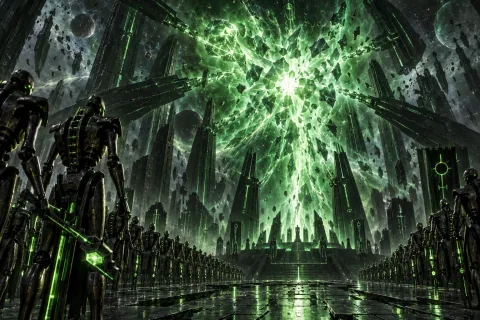
Official introductions explain that the Necrons shattered the C'tan into shards. Let us not read this result as total annihilation. The shards that appear on current battlefields still possess immense power. The betrayal changed the status of the gods, but it could not eliminate all the dangers those beings brought. The masters became fragments, and the fragments were used again as shackled power.
There is both the majesty of reversal and tragedy in this image. Beings who had their souls stolen now wield their former masters as weapons. Yet, there is no ending where what was stolen is returned. This is why freedom and power, immortality and a whole life, continue to conflict in Necron history. The mere fact that they became stronger on the battlefield cannot be said to mean they reached the future they desired.
Chapter 2 · The Fear Left by Imprisoned Gods
C'tan Shards cannot be read as simple pieces of green gemstones. The scythe and cloak of the Nightbringer, or the living metal and control mechanisms of the Void Dragon, show different aspects of the power that remained even after they were broken. It is as if the beings who once changed an entire race are still within that race's armory. It is easy to think that the stronger the containment technology, the smaller the power contained within, but bondage and danger exist together.
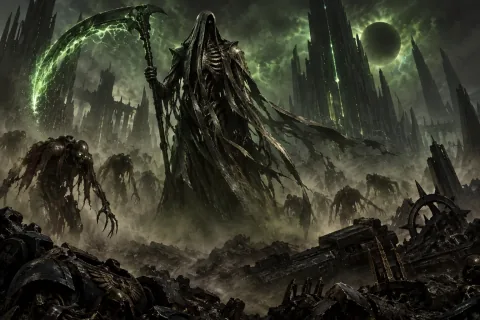
The illustrations showing current appearances are not accurate scenes from the ancient betrayal. They are images intended to visually understand the bondage that continued thereafter. Rather than filling the space with flashy scenes of unconfirmed star god combat techniques or sequences of death, let us look at the results shown by official materials. The fact that broken gods continue to appear on later battlefields is enough to make the end of that war deeply unsettling.
There are other scars passed down in connection with the C'tan betrayal. Official descriptions link the death of Llandu'gor and the curse to the origin of the Flayed Ones, but they leave this in the form of lore. They do not turn this into a single history confirmed by everyone. The sight of a being who has lost its flesh wearing the flesh of other living things more harshly reveals the paradox that a single liberation could not end all bondage.
Chapter 3 · Time Could Have Been on the Necrons' Side
The Silent King ordered the Necrons into the Great Sleep. The goal was to outlive their enemies. It was a choice to obtain a future that was difficult to achieve by waking and fighting, through sleeping and waiting. It is a strategy difficult to imagine for a race with a limited lifespan, but for those with bodies of metal, time could be used as a weapon.
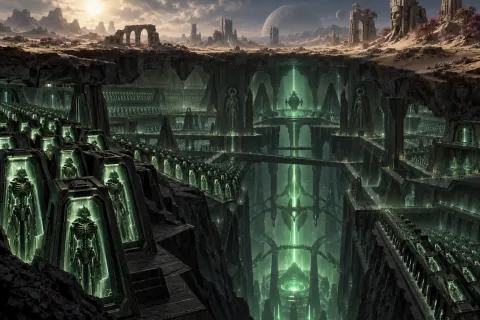
If one views this sleep merely as a loser's flight, one misses the scale. The tomb complexes preserved armies, dynasties, technology, and memories. It was a plan to find their place again someday, no matter how many times the eras changed. So that ancient rule could lead to a future return, the civilization closed itself off beneath worlds across the galaxy.
However, the one who waits does not become the master of time. Outside, other races prospered and planets changed. Some places were destroyed, and some places were occupied by new inhabitants. The destroyed tomb world case from the Gilead example in Part 3 shows that the long wait did not always end in successful preservation. The galaxy that the awakened dynasties would see was different from the one they had left behind.
Chapter 4 · What Does Not Return Upon Awakening
The long sleep left traces on the mind as well. When Necron records and programs are damaged, even if the machine body is repaired, memory and judgment do not return to the same state. This is why one cannot assume that the entire civilization has fully recovered its past just because a king recognizes his court and soldiers follow orders.
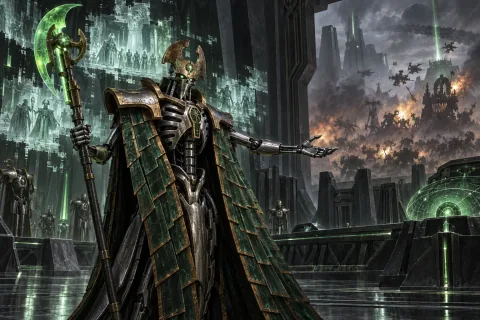
Zahndrekh believes he is living in a different era. According to official introductions, he still acts like a being with flesh, interpreting current Ork or Aeldari enemies as rebel forces of the old Necrontyr. This is a problem beyond mere eccentricity to be laughed off. When the surviving subject and the world that subject understands are misaligned, a single judgment changes the meaning of war in a different direction.
Not all mental changes appear in the same form. The obsession of the Destroyers, the terror of the Flayed Ones, and the memory damage of individual nobles must be distinguished. The causes, narrative perspectives, and confirmed cases for each will be continued in the characters and factions section. If one combines the results of passing through the ages of sleep into the single word of madness, the countless differences within the Necrons disappear.
Chapter 5 · The Returned Monarch, The Changed Dynasty
Here, we shift our gaze briefly to the later era of reawakening. The 2020 official codex introduction explains that while the Silent King returned from his self-imposed exile, not all dynasties welcomed him. The rise of his dynasty, the Szarekhan, also affected other Phaerons. The return of the king was not a scene where all internal conflict vanished with a single order.
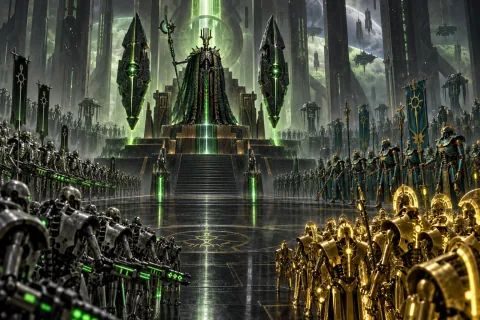
The Sautekh Dynasty expanded strongly under Imotekh. The Nihilakh saw their old territories plundered after the Great Sleep and continued wars of restoration while reclaiming lost power. The Nephrekh are introduced as warriors of shining living metal who utilize the energy of three suns. Dynasties cannot be explained merely by the color differences of identical silver soldiers. The resources they possess, their pasts, and what they want now are different.
One must view it this way to avoid confusing old command protocols with current politics. One cannot take a single phrase describing subjugation during biotransference and decree that all later monarchs always have the same goal. After the era has changed, the relationships between dynasties must be re-verified in separate official materials. There is another story between the authority of the Silent King and the choices of the beings who receive that authority.
Chapter 6 · Erased Memory Becomes Today's War
In more recent official introductions, the Necrosor Ammentar appears as an unsettling being connected to the history of shattering the C'tan. It is explained that the memory of his origin seems to have been erased from the collective consciousness, but who created that blank space and for what reason is not determined here. What is confirmed is that Ammentar is a reality-threatening force and that his goal is to gather the scattered shards of the Nightbringer to revive a whole star god.
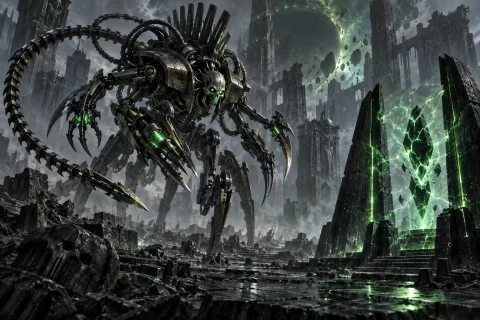
This is a later situation from the 2025 release 500 Worlds: Titus, and it is not moved to the same timeline as the deeds during the ancient war. It is important that the plan, which many Necrons also see as dangerous, leads to the war in modern Ultramar. The betrayal that once shattered a god has not vanished into a legend too distant. The fragments that remain as a result become the cause that moves today's armies and planets.
Once you know the ancient story, even a single shard appearing in later times looks different. Before it is the name of a strong enemy, it is a trace of failed immortality and a liberation that succeeded but was incomplete. The confirmed campaign events of Ammentar and Titus will be connected in more detail in the main story and related game/character sections of that era. We do not create and attach an ending to the campaign based solely on the announcement introduction.
Chapter 7 · The Galaxy Left by Those Who Slept
Silent King (Szarekh), Great Sleep, Tomb World, Phaeron, and C'tan Shard are terms that will be encountered again in the next era. Between those words lies a long change of transaction, war, betrayal, waiting, and reawakening. Depending on which stage of the Necrons one is looking at, the same metal body holds a different history.
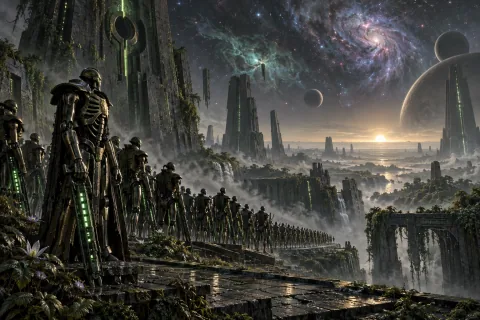
The main story now moves to the prosperity and fall of the Aeldari who inherited the stars. During the years the Necrons waited, how far did other civilizations go, and what catastrophes did they encounter? In Parts 2 and 3 of the table of contents below, you can re-read about biotransference and the War in Heaven. Even after the tomb doors closed, the story of the galaxy continued. Upon that long silence, the next empire began to dream of its own eternal future.
Official Materials and Scope of Verification
Verification Date: October 8, 2026 (UTC). This was written based on settings and events confirmed in the official public materials below. Public samples and setting introductions were checked only for their respective public scope, and it is not indicated that the entire books were read. Illustrations are AI reconstructions, not official images.
Welcome Your New Necron Overlords
The Codex Show — Necron lore and visual references
comments 0