
Operator Recommended Game Story · Warhammer 40,000 Part 12
Chapters in this story
- The Truth of the Imperium and the Shadows of Conquest · The World Left Behind After Victory
- Chapter 1 · After the Fleet Departs
- Chapter 2 · A Faith to Eradicate Faith
- Chapter 3 · Small People in a Great War
- Chapter 4 · Different Legions Given the Same Command
- Chapter 5 · A Fleet from Outside the Map of Victory
- Chapter 6 · Surviving and Being Remembered
- Chapter 7 · A Victory Without Light
- Terminology and Character Guide
- Official Materials and Scope of Verification
The Truth of the Imperium and the Shadows of Conquest · The World Left Behind After Victory
Spoiler Notice: This article covers the truth of the Imperium during the Great Crusade, the governance and human forces after planetary compliance, the differences within the Legions, and the three Rangdan Xenocides. Imperial records contain bias and redactions. Unverified alien appearances or lost histories are not filled with new facts.
Chapter 1 · After the Fleet Departs
When an expeditionary fleet leaves orbit, the history of victory moves on to the next star. However, the history of the people left on that star is only just beginning. Power to replace the collapsed government, forces to maintain order in the cities, and administrators to explain the new laws are required. The Great Crusade left such worlds behind every time a battle ended. Painting the galaxy in the colors of the Imperium and binding the people living on those lands into a single nation required different spans of time.
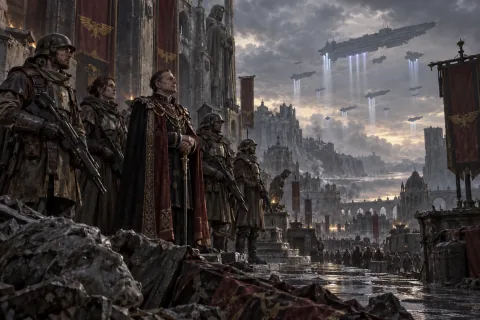
Once a planet was brought into compliance, the appointed Planetary Governor was responsible for defense. The Imperialis Militia, which mobilized local residents, protected the remaining administrators and Iterators while maintaining the Imperium's order. Whether it was suppressing rebellions or holding the line against external attacks while waiting for salvation, the planet's own forces stood at the front. The things that were not easily visible under the halo of the massive fleet were what actually held the Imperium together.
The militia was not a single, uniform army across the galaxy wearing one set of gear. There were worlds with ancient warrior castes, and worlds that called upon their residents only when a crisis struck. The differences were vast, ranging from troops clad in furs and hides to those equipped with sophisticated protective gear. The command structure also retained a mix of the common framework required by the Imperium and local customs. Unification was not a miracle that instantly erased all differences.
In the midst of this, there were cases where retired expeditionary soldiers built new lives and became the core of local forces. Conversely, there were dark mobilizations where prisoners or marginalized abhumans were forcibly conscripted and controlled through drugs and punishment. Under the name of the same Imperium, voluntary defense and harsh coercion existed together. People who spoke of the safety brought by the new order and people who felt their freedom had been stolen by that order could live on the same planet.
Chapter 2 · A Faith to Eradicate Faith
What the Imperium delivered was not just the name of a ruler. The Imperial Truth put forward a worldview that denied gods and superstition, insisting that the universe must be understood through reason. Humanity could rule the stars itself, and the Emperor's crusade was the enterprise that opened that path. This must be distinguished from the Emperor-worship that would become widespread in the later Imperium. The name of the same Emperor is used with entirely different meanings in different eras.
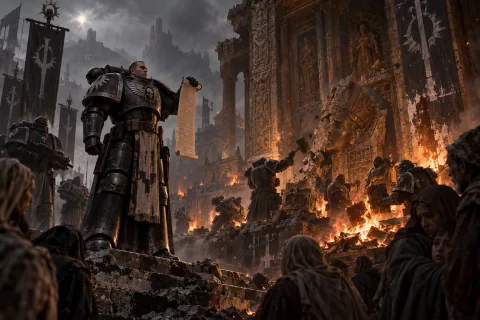
Delivering that ideal was not achieved solely through gentle persuasion. The 17th Legion, the Imperial Heralds, delivered ultimatums and destroyed religious facilities and records that conflicted with the new truth. The past of the Legion that would later meet Lorgar and become the Word Bearers held this mission. Young soldiers learned loyalty to the Emperor who had struck down their families. The language of salvation and the violence of conquest overlapped at the inception of a Legion.
If a reader accepts those slogans immediately as the objective answer of the work's world, it becomes difficult to understand the tragedy of the next era. The Imperial Truth is the explanation put forward by the Imperium. The existence of the Warp and Chaos, examined in previous parts, does not vanish through that explanation alone. Furthermore, exceptions and compromises remained within the unified nation, such as the religious autonomy of Mars. The politics of asserting a single principle and the act of applying it in reality do not move in the same shape.
The role of the discipline masters operating among planetary forces shows this difference on a human scale. They established law and order and encouraged courage, while simultaneously enforcing the Imperial Truth and the principle that humanity must rule the stars. It was also their mission to make local soldiers accept the worldview of the Imperium, which had become their strange new master. Courage on the front lines and the ideology of the state were placed within the same command structure.
Chapter 3 · Small People in a Great War
The choices of the Primarchs and the assaults of the Astartes overwhelm the stories of this era. However, ordinary humans remain in the places they have passed. As the expedition expands, it is impossible to help every planet at the same speed. To the defense forces far away, the relief fleet was a promise that could be delayed. The bodies of the people who had to hold out until that promise arrived were different from the bodies of the superhuman Legions.
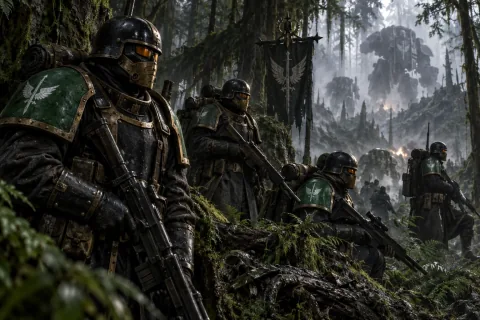
Looking at the equipment and training of regular forces like the Solar Auxilia alongside the conditions of the militia that differed from planet to planet makes the Imperial military look three-dimensional. The fact that they are equipped with excellent protective suits does not mean every front line is in the same environment. Logistics, command, and responsibility for one's own home change the meaning of the battle. Behind the color of the uniform indicating affiliation are the environment and culture of the world the soldiers left behind.
Official Heresy-era uniform records show an example of Jaeger units from Caliban using black armor with bronze trim and green shoulder markings that evoke the forest. Such markings reveal the relationship between human forces and the Legions that sponsor them. The memory of the planet is not completely erased under the mark of the Imperium. The illustration for this part also refers to the equipment of human soldiers of that era, but it does not depict all local militias wearing the same clothes.
This relationship can be a promise of solid protection, and in the later civil war, it could split the direction of loyalty. This is because the moment comes when the act of trusting the Legion that protected you and the act of trusting the Imperium above all Legions collide. For the people of the Great Crusade, that is a catastrophe that has not yet arrived. For the reader, it becomes the foundation for understanding why even ordinary soldiers split into different sides in the subsequent war.
Chapter 4 · Different Legions Given the Same Command
The Legions did not move with a single voice either. The 19th Legion was initially used for Horus's expeditions and ruthlessly suppressed resistance. Later, this Legion, having met Corvus Corax, learned the different direction of the Raven Guard. To Corax, who grew up on a moon where slaves lived and stood against the rule of Kiavahr, the brutal suppression methods of his own soldiers were not a strange technique of victory. It was a sight that resembled the oppression he had sought to tear down.
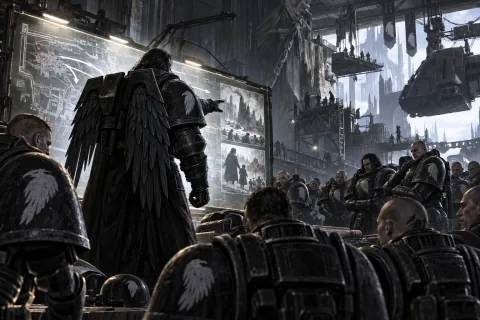
He changed the Legion's terror tactics and those who insisted on them, retraining them in methods of fast strikes and reducing civilian casualties. This does not mean that one Legion left the Imperium. It means that even within the framework of the same expedition, the methods of fighting and the attitude toward people could differ. Corax himself left behind massive sacrifices in the process of liberation. If that choice is made only into the legend of a flawless savior, the contradiction disappears.
The Imperium tried to use the individuality of every Legion efficiently, but that individuality contained the worlds the Primarchs had lived in and their scars. To some, quick victory was the priority; to others, the lives of the people left behind after victory were the issue. That difference started from tactical choices and could grow into trust and conflict between brothers. As the Great Crusade expanded, one is led to ask if the thoughts of those fighting for a single nation were the same.
One cannot conclude that all the cracks at this time were later betrayals. Both the heart to protect others and cold duty could earn the name of loyalty. What is important is the fact that many types of choices were contained within the victory of the Imperium. When those choices could understand each other, the Legions fought together. When that understanding was severed, distrust grew even under the same banner.
Chapter 5 · A Fleet from Outside the Map of Victory
The Rangdan Xenocides show that the Great Crusade was not always an overwhelming march for the Imperium. Imperial records leave behind three wars. The first clash occurred at Advex-mors in 839.M30. It was a difficult victory, but that place was merely a small outpost of the Rangdan. Beyond what the Imperium had occupied, there was a greater force.
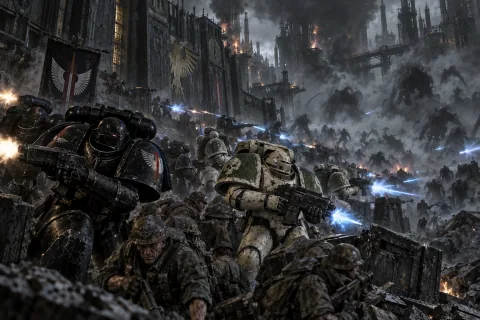
What returned in 862.M30 was a fleet that included thousands of ships and over a dozen war moons. The nascent colonies on the northern frontier collapsed, and the residents were bound by neural restraint devices. The 5th and 19th Legions bought time. At Xana, the defense forces that held out for eight months were saved by the attacks of the Dark Angels and the Death Guard. The reopened industrial planet became a base to support the Imperium's counterattack.
The subsequent war grew into a long war of attrition involving multiple Legions and Primarchs. The records report 19 devastated star systems and the large-scale deployment of troops at the Battle of Taxal. The final engagement of the second war is estimated to be 882.M30. One cannot change the estimates of records into confirmed dates. The exact appearance of the Rangdan also remains unclear beyond blurry footage and ghost stories.
Chapter 6 · Surviving and Being Remembered
The third war continued after the restricted zone was reopened in 887.M30 and the White Scars discovered the remaining strongholds. The Legions of Lion El'Jonson and Leman Russ finished off those worlds to prevent a reinvasion. The final stage reported by the records was less of an equal battle and more of a thorough annihilation. The site where the city of Rangda once stood remained as a plain of glass melted and hardened by nuclear fire.
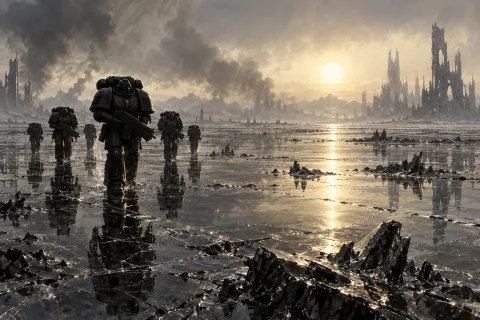
Behind that victory was another form of destruction. The materials of the Rangdan Xenocides were deleted, and survivors were required to remain silent. Later propaganda and stories mixed fact and imagination. The Imperium overcame the crisis, but it did not show the full picture of that crisis to its people. It was a victory where it was not even easy to know whose sacrifice allowed them to survive.
The reader who reads that event also sees the power that leaves the records. If those who hold weapons decide the outcome of a war, those who manage the records can decide what kind of story that result remains as. Even among soldiers of the same Imperium, there are those who put their names on the festival of victory and those who are buried in silence. Some heroic tales are not problematic because they are lies, but because they become incomplete as the other stories that should be beside them are erased.
Therefore, I do not connect the fate of the two missing Legions or the unverified identity of the Rangdan with imagination here. The story is heavy enough even when reading blank records as blank records. The fact that the nation that survived the war chose to hide the price of that survival itself creates the atmosphere of this world. This is also why the enemy's appearance remains in the smoke behind the illustration depicting the savior forces in black armor.
Chapter 7 · A Victory Without Light
If one explains the ideals of the Great Crusade and their execution in only one way, one loses this era. Ending humanity's ancient isolation and opening paths between the stars actually held the possibility of safety and exchange. There were soldiers fighting to save people from threats like the Rangdan. At the same time, unification could operate as a force that trampled on local choices and erased lives that did not fit the new principles.
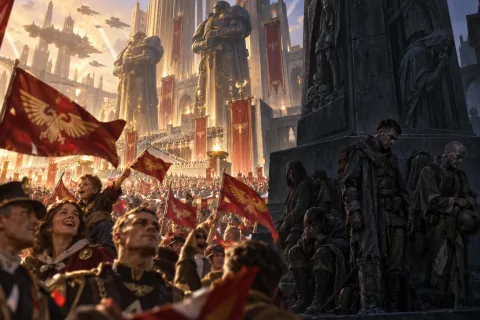
Those contradictions do not cancel each other out. The joy of the saved cannot erase the experience of the oppressed, and the violence of conquest cannot make the sacrifice of those who protected others on the front lines a lie. This is where the fun and discomfort of reading the human Imperium of Warhammer arise together. The reader looks beyond who is strong to see what kind of world was created by that power.
In the next flow, the victory at Ullanor portrays this complex expedition as one massive success. More land, greater glory, and more important command authority are gathered in one figure. However, what a festival can illuminate is not every front line. The nameless soldier who defended Xana, the residents left under the new government, and the survivors in the erased records do not stand on the same stage as that cheering.
To understand the final light of the Great Crusade, one must remember its shadows together. What did the nation that sought to bind everyone have to know? What beliefs did it eradicate while forcing other convictions? What did it demand of the people it claimed to have saved? The civil war that would erupt later does not suddenly arise from an empty universe. The relationships that bound them together, the hidden truths, and the people who remembered the same victory differently were already within this galaxy.
Terminology and Character Guide
Imperial Truth: The rational, non-religious worldview and governing principle of the Great Crusade. It is not identical to later Emperor-worship or an objective, complete explanation of the Warp.
Compliance, Imperial Commander, Iterator: Terms to understand the process by which the Imperium brings worlds under its rule and the subsequent governance, persuasion, and administration.
Imperialis Militia: Defense forces centered on residents and governors of each planet. It is not simplified into the same organization or uniform as the regular Solar Auxilia.
Corvus Corax, Raven Guard: An example where the liberator's experience changed the Legion's combat style and attitude toward civilians. The longer personal backstory is a scope that leads to the character section.
Rangdan, Xana, Taxal: The opponents of the war that threatened the Imperium's survival and the major battlefields. The uncertain appearance and erased history are left in an uncertain state.
M30 and M31: Setting-based date notations referring to the 30th and 31st millennia, respectively. Numbers like 839.M30 are not read as real-world years or dates.
Further Reading: Part 11, Mars and Expeditionary Weapons, explains the material basis of this nation. The next main part heads toward Ullanor and the appearance of the Warmaster. Links in the same language for the published series can be found in the table of contents.
Official Materials and Scope of Verification
Verification Date: October 8, 2026 (UTC). Written based on settings and events confirmed in the official public materials below. Public samples and setting introductions were verified only for their respective public scope, and it is not indicated that the entire book was read. Illustrations are AI reconstructions, not official images.
The Imperialis Militia — Legacies of the Age of Darkness
Imperialis Militia Legacies — Discipline Master background
Legions of the Horus Heresy — The Word Bearers
Legions of the Horus Heresy — Raven Guard
The Horus Heresy Book Nine — Crusade: official Dark Angels public extract
comments 0