
Operator Recommended Game Story · Warhammer 40,000 Part 13
Chapters in this story
- The Triumph of Ullanor · The Son Who Inherited the Galaxy's Army
- Chapter 1 · When the End of Conquest Seemed Near
- Chapter 2 · A Name Earned on the Moon
- Chapter 3 · In the Heart of the Fortress
- Chapter 4 · Land for Victory
- Chapter 5 · The Highest Responsibility
- Chapter 6 · Where the Emperor Returned
- Chapter 7 · An Imperium Extending Beyond the Army
- Chapter 8 · Why One Must Remember the Dazzling Days First
- Glossary and Character Guide
- Official Materials and Scope of Verification
The Triumph of Ullanor · The Son Who Inherited the Galaxy's Army
Spoiler Notice: This article covers the Ullanor Crusade and the Triumph at the end of the Great Crusade, the appointment of Horus as Warmaster, and the Emperor's return to Terra. Horus has not yet committed treason, and his portrayal in this episode is distinct from the Warmaster corrupted by Chaos in later times. The following Lorgar episode will return to the events of Monarchia, which occurred before this triumph, to connect other fissures that were already forming in the same era.
Chapter 1 · When the End of Conquest Seemed Near
The Great Crusade, which began on Terra, transformed the army of a single planet into the army of the galaxy. The expeditionary fleets advanced along the shipping lanes, and the Primarchs led their respective Legions. The militias and administrative systems of the surrendered worlds, seen in previous episodes, were the forces that held the conquests together even after the fleets departed. However, the fact that the galaxy was vast meant that the next enemy also possessed vast territory.
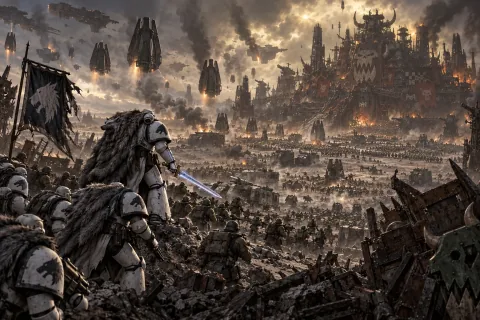
On Ullanor, there was a massive Ork empire led by Warlord Urlakk Urg. Its power spanned many star systems and commanded an immense number of Orks. This was not a situation where the Imperial expeditionary forces could simply clear out smaller enemies in sequence. Breaking this threat could determine the military achievements of the Great Crusade. The Imperium, which championed the unification of humanity, clashed once again with a massive alien power.
At this time, Horus Lupercal was already one of the sons closest to his father for the longest time. He was not an unknown commander who had to find new reasons for the galaxy's army to follow him. Thus, the victory at Ullanor could yield results greater than a single military achievement. Long-accumulated trust and newly gained glory converged at a single point.
It is difficult to understand the choices of this era if one views the man who would later be remembered by the name of a traitor only as a traitor from the beginning. There was a reason why the Legion was loyal to Horus and why the Emperor entrusted him with responsibility. Not everyone who followed him chose to do so while knowing of the coming catastrophe. When the war seemed to be ending, they looked to a successful commander for the next future.
Chapter 2 · A Name Earned on the Moon
Horus's Legion did not bear only his name from the beginning. The early soldiers of the XVI Legion were recruited from the rugged hunting tribes and slums of Terra. The fame gained during the process of bringing the Moon to heel led to the name Luna Wolves. After Horus was discovered and led the Legion, gang warriors from Cthonia also joined. The genetic facilities on the Moon contributed to the growth of the Legion.
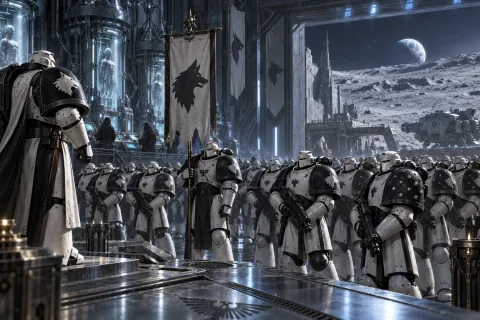
They built their reputation by finding weaknesses, striking suddenly, and severing the enemy's strength. Official Legion introductions describe both their small-scale, flexible organization and their strong devotion to Horus. Just because the soldiers' origins were rough does not mean it was an army whose command was loosely broken. At the center of that rough spirit was Horus.
This character is also important for reading the war on Ullanor. The Luna Wolves were a Legion capable of targeting the center that moved the enemy's numbers rather than the total number of enemies. Their method of breakthrough, decisiveness, and betting on victory in a short moment also connects to the structure of loyalty that would later collapse. When the abilities gathered around a strong commander shine, too many fates could be hung on that same center.
Those soldiers must be distinguished from the later Sons of Horus in sea-green armor. Official introductions convey the flow of the Legion's name changing, the white armor shifting to sea-green, and the wolf iconography leading to the Eye of Horus. Armies in history gain different names and symbols even while sharing the same genetic lineage. The Battle of Ullanor in this episode is placed before that transition.
Chapter 3 · In the Heart of the Fortress
On Ullanor Prime, the war reached its climax. Official expedition introductions state that Horus and the Justaerin Terminator squad teleported into the heart of Urg's fortress. It was an attack that struck directly at the heart of the command while facing a massive army head-on. A war that could easily have been overwhelming based on troop numbers alone could be moved by a fight within a single fortress.
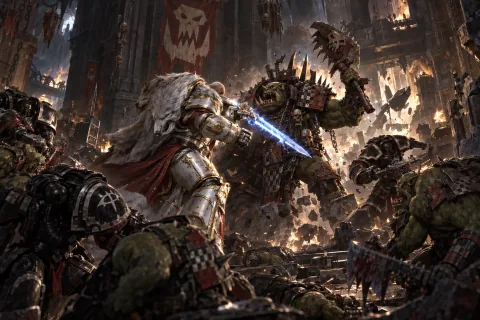
If the role of the Justaerin is removed from this scene, Horus's victory narrows down to a superhuman duel fought alone. He entered with elite soldiers. However, public materials do not list the names of every squad member or every action taken immediately after teleportation. This illustration reconstructs the atmosphere of their old heavy armor and teleportation without attaching unrecorded individual orders or soldier deaths as facts.
Urg was no small enemy. He wounded Horus. However, at the end of the duel, Horus dropped Urg from the heights of the fortress. The commander's defeat broke the momentum of the Ork forces. The victory of the massive expedition came after countless battles, but the scene that decided the end was placed near the name of Horus in the Imperium's story.
When depicting the battle, it was not mixed with later appearances. The Horus seen in official Ullanor battle art is a human-form Primarch wearing white armor and wolf pelts, wielding a blue-glowing sword. He is not equipped with Worldbreaker, which he would receive as a symbol of the Warmaster, nor the claws and black equipment of his later corrupted form in this attack. This is to ensure that the final appearance known to the reader does not cover up the choices of this time.
Chapter 4 · Land for Victory
The Emperor touted this victory as the greatest achievement of the Great Crusade. A massive Triumph was prepared on Ullanor. Thousands of square kilometers of land were turned into a flat parade ground, and the skulls of the defeated Orks were used as decorations to display the Imperium's victory. Clearing the battlefield led to a different direction than restoring the lives of the survivors. This place became a stage to display new authority.
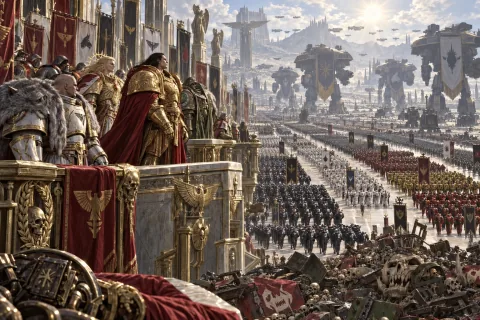
Countless human soldiers, Astartes from various Legions, and Titans gathered for the parade of victory. Official introductions specifically distinguish between the 14 Legions that participated in the parade and some of the Primarchs who stood by the Emperor's side. The fact that a Legion participated in the parade and the fact that the father of that Legion stood on the same balcony are not the same. The more one speaks of a grand scene, the more necessary it is to distinguish what is actually confirmed in scale.
The names gathered there included Horus, Sanguinius, Mortarion, Magnus, Angron, Jaghatai, Lorgar, Dorn, and Fulgrim. Brothers raised in different worlds and leading different Legions looked upon one victory. The reader remembers the wounds of previous episodes. Angron's lost comrades, Lorgar's faith, and the pride of each Legion were not discarded outside of this parade.
For now, those differences stood together within the scene of the triumph. That does not mean they were all reconciled. Even if they served the same father and defeated the same enemy, their perspectives on what they were fighting for and how they should be treated were different. The grandeur of Ullanor contained both the power to unite the army and the fissures remaining within that army.
Chapter 5 · The Highest Responsibility
At the Triumph, the Emperor appointed Horus as Warmaster. A father of one Legion was given command authority greater than his own Legion. It was the responsibility to move the armies and brothers that would continue the Great Crusade. The Emperor intended to leave his position at the front lines and return to Terra. The trusted son would fill that vacancy.
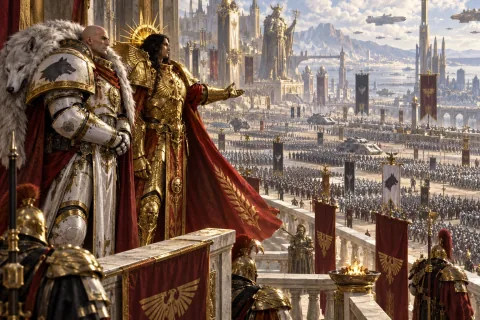
The massive mace called Worldbreaker was also given as a symbol of the new position. However, the appointment and the process of renaming the Legion are not forced into a single scene at the same moment. The 2025 official Legion introduction explains that Sanguinius's advice followed the acceptance of the name change proposed by the Emperor. The process of the Luna Wolves becoming the Sons of Horus is a flow where the recognition gained in the triumph solidifies into the Legion's identity.
The new name showed more clearly who the soldiers considered their closest center. Even if the fact that they were the Imperium's army remained the same, the name the army called itself now included Horus directly. Knowing of the later treason does not mean this choice can be immediately turned into a declaration of treason. The renaming at this time originated from the honor proposed by the Emperor. Honor and danger would later become intertwined within the same symbol.
Horus possessed the trust gained on the battlefield and the ability to draw people in. The responsibility of having to command his brothers did not easily disappear. The Primarchs, who possessed different prides, were brothers in that they were sons of the Emperor. When one of them stood above the other brothers as a military commander, the meaning of success and the difference in recognition became a new problem.
Chapter 6 · Where the Emperor Returned
The Emperor's return to Terra was not a retirement to stop working. He intended to pursue the secret Webway project. The inside story of this plan was almost unknown. The fact that military command was handed over on the stage of the triumph was visible to all, but the work the Emperor had to do after leaving the front lines was invisible to many.
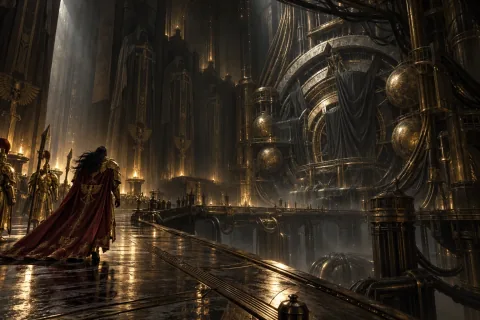
This difference is an important condition that moves the next era. What one believes and follows changes when there is a sufficiently shared purpose versus when one must guess the father's will. To the Emperor, the work on Terra could be connected to the future of humanity, but the commanders continuing the war felt the responsibilities they had taken on first. Trust and secrets entered the same relationship.
To understand the Webway in detail, one can recall the history of the Aeldari. Between travel in real space and the dangers of the Warp, there was the concept of other passages. The process by which the Emperor tried to handle it with his own plan, the war underground, and the results left by its failure are stories to be followed specifically in the later Terra episode. Pulling those results here would erase the uncertainty of the time as they looked at the place where the Emperor had disappeared.
It was the Emperor of that time who judged that Horus could be entrusted with the army. The future fact that this judgment led to disaster and the information already revealed when the judgment was made are not the same. When reading about a massive failure, one must not reverse cause and effect. If one writes as if everyone saw the catastrophe at Ullanor, the path to understanding how the relationship collapsed afterward narrows.
Chapter 7 · An Imperium Extending Beyond the Army
After gaining worlds in war, who would rule those worlds was another matter. The Imperium established systems of administration, taxation, law, and military force on conquered planets. The messengers of the expeditionary forces, planetary governors, and the roles of the militias seen in previous episodes stitched that order together. The army led by Horus could not handle the daily life of every region directly.
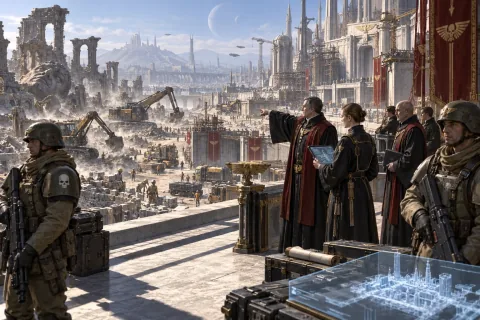
However, to someone who thinks military achievement is the greatest authority, the growth of civilian governance could also be felt as a problem of recognition. Official Horus introductions explain that Erebus later exploited his dissatisfaction with mortals occupying seats on the Council of Terra. This does not mean that dissatisfaction exploded all at once within this parade ground. The tension that remained in the relationship between the army and governance would later be used as language to persuade treason.
One must not pretend that the Horus of this episode already acted like a puppet of Chaos. The wound received on Davin and the ritual of Erebus are events that must actually be followed further. To understand those events, what is seen now is that the person who inherited command authority was simultaneously burdened with the responsibilities of the field, the pride of his brothers, and the Imperium's new method of governance.
The success of the Great Crusade was proven by military power. However, if a successful army thinks of itself as the owner of all rights, the future of humanity they intended to protect and the future the army wants can diverge. This is not a confession made up as if an official character said it, but an explanation to read the relationships of the events that will follow. The Imperium after victory has responsibilities as complex as the wider land it holds.
Chapter 8 · Why One Must Remember the Dazzling Days First
The Black Library's introduction to Horus Rising presents the Horus of this era as a hero and the son favored by the Emperor. On the threshold of the war ending, he is entrusted with new responsibilities. The start of the story that will lead to treason is not after everything has already collapsed. It is a place where authority and belief, which seemed as if they would never collapse, were at their height.
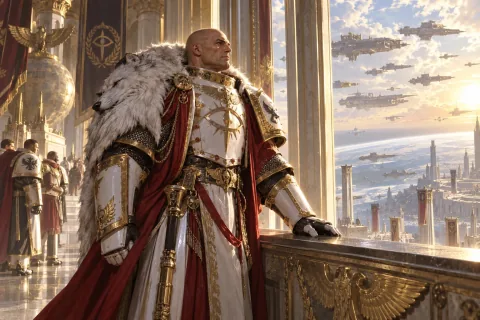
The initial context revealed in the public samples of this novel shows that war and expeditions continued even after Ullanor. The Triumph did not end every fight of the Great Crusade. However, without reading the entire novel, one does not fill in the detailed conversations of Loken and the Mournival, the negotiations with the Interex, and every scene of the Whispering Peaks as facts. Those connecting events remain as independent research items assigned to the narrative that will follow.
The Triumph of Ullanor is not a scene to be erased to explain the catastrophe. It is a scene that tells us why following Horus seemed plausible that day. A massive enemy was broken, the father who had fought alongside him for a long time recognized him, and his brothers and Legion saw the scale of that responsibility. Just because he failed later does not mean all the trust of that day was fake from the beginning.
That is precisely why the later betrayal is heavier. A story where a hated enemy attacks and a story where the person to whom one entrusted their future turns away are different. War does not leave only military damage. It can shake who can command, what one should believe, and what the time spent fighting together meant. One must see the light of Ullanor first to feel what is lost when that light goes out.
However, to understand the next fissure, one must turn back time for a moment. Before Ullanor, another son, Lorgar, experienced a moment where his faith and the Emperor's orders collided. The humiliation received at Monarchia was already continuing behind this massive triumph. The next episode returns to that preceding branch, following how the faith of one Legion opens toward a different power.
Glossary and Character Guide
Ullanor, Urg: The world where the expedition and triumph at the end of the Great Crusade took place, and the Warlord of the Ork empire there. The history of the Orks and the Imperium after this is distinguished from events of separate eras.
Luna Wolves, Sons of Horus: The names of the XVI Legion at different times. The change in official iconography from white armor to sea-green is included. This does not mean the two Legions are unrelated armies.
Justaerin: Elite Terminators who followed Horus into the heart of the fortress. They are distinguished from regular human militias or modern Primaris units.
Warmaster, Worldbreaker: The position entrusted with the command responsibility of the Great Crusade and the mace received as its symbol. One is a title, and the other is a weapon.
Webway, Council of Terra: The passage system connected to the Emperor's secret plan and the organization connected to the Imperium's civilian governance. These are not two names for the same place or a single military institution.
Sanguinius, Lorgar, Erebus: The figure among Horus's brothers who gave advice on the renaming, the Primarch of the Word Bearers, and the chaplain of that Legion who will later intervene in Horus's conversion. In this episode, the ritual on Davin has not yet occurred.
Further Reading: Part 12 covers the human world after conquest and the truth of the Imperium. The next Monarchia episode returns to the branch of Lorgar, which is earlier in time, and then connects the causes of the transition that will lead to Davin and Isstvan. Published episodes can be found in the serial table of contents in the same language.
Official Materials and Scope of Verification
Verification Date: October 8, 2026 (UTC). This was written based on settings and events confirmed in the official public materials below. Public samples and setting introductions were verified only within their respective public scope, and it is not indicated that the entire books were read. Illustrations are AI reconstructions, not official images.
The Horus Heresy — How the Great Triumph Led to Greater Tragedy
Legions of the Horus Heresy — The Sons of Horus Are the Real First Legion
Horus Rising: Book1 — official Black Library synopsis
The Horus Heresy explained — A short history of the Warmaster’s betrayal
comments 1
울라노르 승전식 당시 호루스가 워마스터로 임명된 것이 군단의 명칭 변경과 직접적으로 연계된 결정이었는지, 아니면 이후 생귀니우스의 조언 등을 거쳐 점진적으로 정체성이 확립된 것인지 궁금합니다.