
Operator Recommended Game Story: Warhammer 40,000 Part 18
Chapters in this story
- Preface · The Planet Descended Upon by the Father's Command
- Chapter 1 · The Facade of a War Where Four Legions Gathered
- Chapter 2 · Loyalty Becomes the Reason for Execution
- Chapter 3 · What Came from the Sky Was Not Reinforcement
- Chapter 4 · What Saul Tarvitz Protected Was the Legion's Other Oath
- Chapter 5 · Angron Descended, and Brothers Faced Each Other
- Chapter 6 · The Place Where the Mournival Stood Together Was Divided
- Chapter 7 · Rylanor, Who Carried the Legion's Memory
- Chapter 8 · Even for the Surviving Commander, Betrayal Did Not End
- Chapter 9 · The Name Eisenstein Carried Outside
- Paths of Terms and Characters
- Reading Along with Previous Public Serializations
- Official Materials and Scope of Confirmation
Preface · The Planet Descended Upon by the Father's Command
Spoiler Notice: This installment covers the purge of Isstvan III during the early Horus Heresy, the virus bombing, the survival and resistance of the loyalists, and the consequences leading to Saul Tarvitz, Garviel Loken, the division of the Mournival, and the warning of the Eisenstein. The Isstvan III incident and the subsequent Dropsite Massacre of Isstvan V are not the same battle. This is a narrative commentary reconstructed by contrasting official published history, character introductions, and public excerpts from authorized lore books; it is not a transcription of novel dialogue or scene text.
The warriors descending to the planet still carried their orders. It was a command to bring a world that had turned against the Empire back into submission. They had received such orders countless times during the Great Crusade. They knew from whose ship they departed, whose gene-seed they inherited, and whom they called brother. However, while they fought below, those who remained above prepared an entirely different purpose.
Horus had returned from Davin alive. The Legion's wish for his safe return had been granted, but the Empire that the returned commander desired was no longer the same as before. Within the Legion, there were warriors who would not walk that path. The enemies Horus sought to eliminate before beginning his rebellion were the sons who had fought for him for so long.
Chapter 1 · The Facade of a War Where Four Legions Gathered
Isstvan III was a world that had risen in rebellion. The reason Horus's forces headed there appeared, on the surface, to be an operation to restore the Empire's order. The sight of the Warmaster, recovered from the wounds of Davin, leading the war again was not an unfamiliar occurrence to the warriors who followed him. He was the entity who had always set the direction of the assault and moved the Legions.
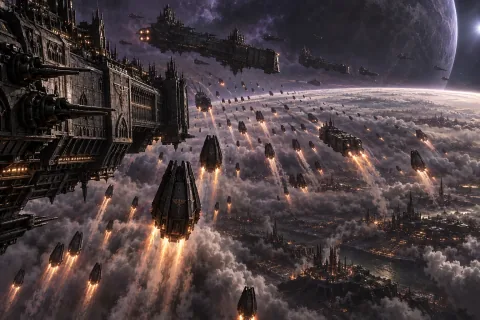
There, the Sons of Horus, Death Guard, World Eaters, and Emperor's Children gathered. The official publisher's synopsis of 'Galaxy in Flames' presents the strength of these four Legions as overwhelming compared to the planet's human defense force. It was a gathering that left one questioning why such scale was necessary if the goal was merely to end a war. Yet, the warriors descending to the surface placed their combat missions ahead of their suspicions.
Reading only the names of the Legions, it is easy to assume one knows who is on which side in advance. In future history, these four Legions remain the center of the rebellion. However, at this moment, not everyone within the Legions had already chosen the same loyalty. Even while respecting their Primarchs and following orders in battle, there were those who held fast to their oaths to the Emperor and the Empire until the end.
To the commanders conspiring with Horus, such warriors were both comrades to fight alongside and dangerous entities to future plans. To use the Legions for rebellion, those who would refuse it had to be separated from within. The attack order on the planet now contained that separation. The familiar landing operation became a mechanism to distinguish who was needed for the next Empire and who had to vanish.
Chapter 2 · Loyalty Becomes the Reason for Execution
The force sent down first included loyalists. Official lore explains that this purge was not a tragedy of accidentally attacking allies, but a plan to select necessary troops, send them to the planet, and then eliminate them. A mistake caused by misunderstanding an order is different from an event where one walked into a trap because they understood the order all too well.
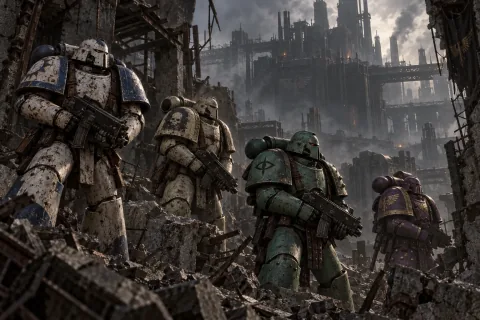
However, it is not concluded that the criteria for selecting these warriors were identical across all Legions. The description of the World Eaters in the published 'Betrayal' states that the composition of the purge targets is difficult to fully grasp. Terran-born were included, but not all of them, and Terran-born remained by Angron's side as well. The record does not support the explanation that only those who had not received the Butcher's Nails were removed.
Among the Death Guard, veteran Terran-born warriors were significant purge targets, but they were not the only ones sent down. Official public excerpts state that soldiers of other origins were also included in the first assault, leaving it unclear whether they were all distrusted or included as sacrifices for the operation. We do not reduce the parts that the records themselves cannot distinguish into a single simple rule.
The fact that they intended to fight for the Empire made them follow the orders. And that very loyalty to the Empire became the reason for those who issued the orders to kill them. The tragedy of Isstvan III lies in the fact that when different oaths still remained within the same army, one side used the other like a weapon.
Chapter 3 · What Came from the Sky Was Not Reinforcement
Horus's betrayal was revealed through the virus bombing. Above the loyalists fighting on the planet was the fleet that had sent them. In normal circumstances, this would be the direction from which reinforcements, supplies, and support would descend, but this time, an attack meant to erase the lives below came down. It was a moment where they had to realize not just where the battlefield was, but who was attacking them.
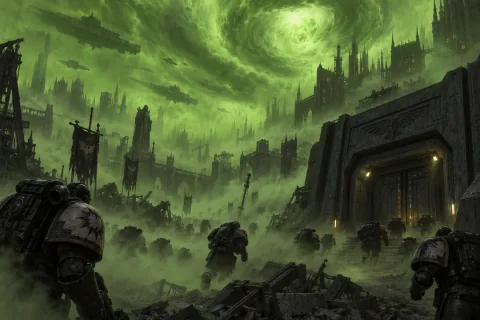
We do not read the virus weapon here as another name for ordinary explosive shells. The official public lore of the Death Guard specifically explains that Sorruk Vasha, who participated in the first landing, fell victim to the life-eater virus due to damage sustained by his armor in battle. The Legion's resilient bodies and protective equipment did not guarantee unconditional survival. Even a small gap where protection failed created an irreversible result.
Conversely, cases of survival are also recorded. Mica Vulkov of the World Eaters endured the virus bombing because he was engaged with the planet's rebels deep within a factory. That location and situation separated him from the first death. However, survival did not mean the war was over. He fought against his Legion's betrayal and later fell in battle alongside loyalist Death Guard in the northern city sector.
Protection, terrain, and someone's warning and response determined the outcome. Survival was sometimes decided not by whose gene-seed one inherited, but by what danger one knew at that moment and where one faced it. If we end this bombing as a single scene where all loyalists vanished immediately, the resistance itself that stole Horus's time becomes invisible.
Chapter 4 · What Saul Tarvitz Protected Was the Legion's Other Oath
Tarvitz was an officer of the Emperor's Children. He was not a figure who grew from the start to defy the Primarch and all superiors leading that Legion. In official introductions, he was close to Loken and Tarik Torgaddon of the Luna Wolves, and was connected to them by the intent to serve the Emperor and Primarch and build the future of humanity.
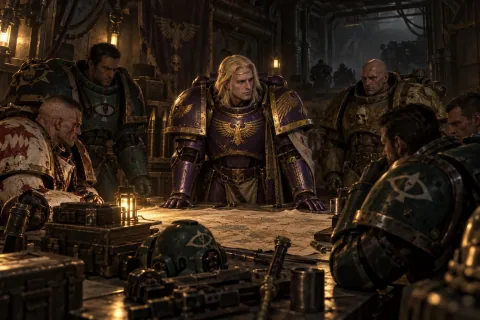
However, the day came when the same loyalty demanded opposing paths. Following the Legion and being loyal to the Emperor were no longer the same choice. Tarvitz stood on the side that preserved the bond between the Emperor and the Empire. The core of official character introductions is that thanks to his actions, a significant loyalist force survived the virus bombing and held Horus's forces for several weeks.
The surviving army was not the complete command structure of any one Legion. The remaining warriors of the Emperor's Children, World Eaters, Death Guard, and Sons of Horus fought together. Tarvitz was recognized as the commander leading them. The name of the Legion that tried to eliminate them could no longer divide enemies and comrades. Who kept the same oath to the end became a more important distinction.
The new illustration contrasts the official Tarvitz model and the blonde hair, purple armor, and gold trim from early cards with the equipment of the four Legions at the time as recorded in official lore books. The shelter's table and meeting posture are not a restoration of a confirmed specific novel scene, but a composition visually expressing the fact that loyalists from various Legions defended together. We do not add new dialogue regarding who gave which order.
The result Tarvitz created was not merely that individuals survived the danger. The warriors he saved became an army capable of protecting one another. The purge Horus intended to end quietly was prolonged in the face of the fact that those warriors could still choose. The people gathered in one place to be killed created a new alliance there.
Chapter 5 · Angron Descended, and Brothers Faced Each Other
The fact that the first strike did not end in the way Horus desired brought about other decisions. The public World Eaters record in 'Betrayal' explains that Angron defied the Warmaster's will and descended to the surface himself. He did not end it by dealing with his surviving warriors from afar; he intended to fight before them. The appearance of the warriors who followed Angron down after the virus bombing also remains in the equipment plates of the same official excerpt.
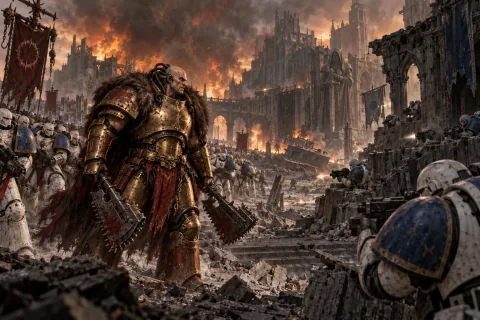
If one draws Angron at this time as the massive daemon he would later become, or changes all the World Eaters of that time into the later red Chaos armor, the eras become mixed. The Legion's old white and blue, the form of the equipment, and the traditions of the Great Crusade still remained. In the place where the same appearance stood face to face, loyalty was divided. The technology the Legion used and the warriors' abilities were now turned against the Legion itself.
The tenacity of the loyalist Death Guard was also an important axis of this battle. Public lore states that compared to other Legions, many Death Guard survived the first virus attack, and their endurance and resistance were a major hindrance to the traitors. The ability to fight in extreme environments, cultivated over a long time, remained in the hands of the sons abandoned by their Primarch.
Kaleb Molor, who belonged to the resistance under Crysos Morturg, is one such individual name. Official equipment descriptions convey his appearance, having repaired his armor with parts scavenged from the battlefield and having carved the Emperor's symbol after defacing the Legion's mark. He died fighting the World Eaters traitors. Even in the description of a small plate, the history of whom he called brother and against whom he raised his weapon remains.
Because of this resistance, the purge was not an event that ended with weapons falling from the sky. Behind it was a war that required deploying an army again to eliminate the surviving warriors. Between the plan of the one holding command and the actual actions of those abandoned by that order, Horus's time was consumed.
Chapter 6 · The Place Where the Mournival Stood Together Was Divided
Loken, Torgaddon, Abaddon, and Horus Aximand were once in the same Mournival. The relationship of the four men who offered opinions beside Horus and helped the Legion's judgment was divided between what the Warmaster wanted and whether that desire was just. On Isstvan III, they could no longer remain as different voices in the same room.
The official Aximand introduction states that Torgaddon and Loken were purge targets because they were loyalists, and that Abaddon and Aximand took a different path. We do not simplify Aximand into a machine of betrayal without any hesitation. The same introduction explains that he was a commander who entered the rebellion uncomfortably. However, the fact that there was discomfort does not change the side he chose and the result.
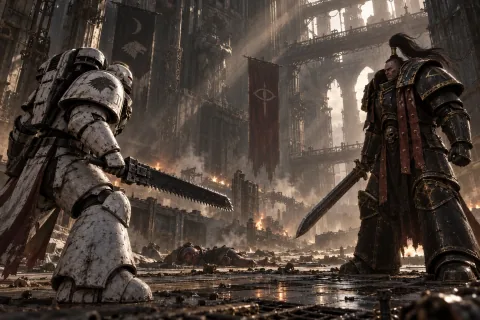
Loken and Abaddon clashed on Isstvan III. The 2026 official 'Galaxy in Flames' cover introduction explains that duel directly with the two characters' names. We do not fabricate the exact sequence of attacks or the final words. What is confirmed is the clash where long-time colleagues became enemies and had to endure each other's weapons, and the fact that this clash took place within the Warmaster's Legion.
The illustration reflects Loken's sea-green armor, the Eye of Horus emblem, chainsword, and pistol confirmed on the new official cover. Abaddon is contrasted with his red topknot, black Terminator armor, and the claws and sword of the time. We do not bring the Talon of Horus or the daemon sword Drach'nyen, obtained in later eras, into this early duel. The stairs, ruins, and the positions and momentary actions of the two are a newly interpreted composition.
Torgaddon died on Isstvan III. However, one must not end with Loken in the same confirmed death. The official Aximand introduction refers to Loken separately as a figure thought to be dead, and leaves the connection for him to face Aximand again. One must distinguish between the subsequent story of a person who survives this battle and the death of a comrade who truly did not return. The division of the Mournival was not an event of splitting four numbers into two, but an event where the memories built together were torn into different fates.
Chapter 7 · Rylanor, Who Carried the Legion's Memory
The loyalists also had Rylanor. An early generation of the Emperor's Children, he had a record of fighting beside the Emperor and was a warrior with long memories of having carried the Legion's banner with the Primarch. He was interred in a Dreadnought after being severely wounded in the war against the Aeldari, and had participated in both the Legion's rituals and battles.
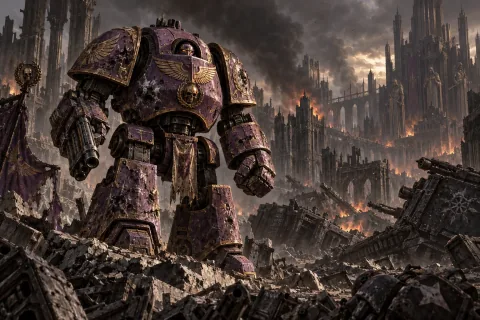
In the explanation of the released official 'Legacies', that long loyalty becomes the reason he was sent down to Isstvan III to die. However, he survived the first blow of betrayal. His holding out on the battlefield was a military threat to the traitors, and a symbol around which the remaining loyalist Emperor's Children could stand. It was a scene where the Legion sought to eliminate a warrior who carried the Legion's history itself.
The Dreadnought's body is different from a human body, but the loyalty within was not a mechanism that changed along with orders. Rylanor's existence shows that the Legion's past and its current choice are not the same. The fact that his own Primarch betrayed him could not erase whom he had fought for before that.
This public war record leaves his end as unclear. We do not read that as meaning his entire later story is forever unconfirmed. The point in time recorded by the battle of Isstvan and the scope of individual narratives handled in later eras are different. His story, which continues longer, remains as an investigation item to be connected by contrasting the relevant official short stories and character materials separately.
Chapter 8 · Even for the Surviving Commander, Betrayal Did Not End
What Tarvitz had to face was not just the army approaching from the outside. Lucius betrayed him, and the two clashed. Official introductions state that Tarvitz defeated Lucius in that duel. The belief that an excellent swordsman is on one's side is not a guarantee that the swordsman will remain on the same side until the end.
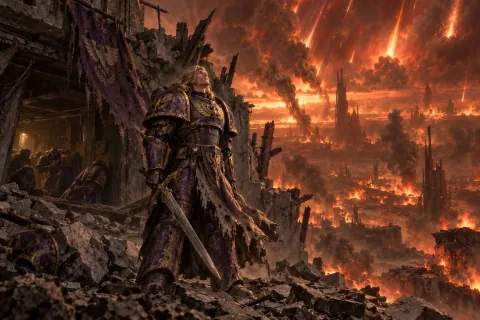
The fact that he defeated him could not overturn the entire war. The loyalists' remaining strength dwindled, and the traitors' final attack approached. Tarvitz fought to the end but died in the subsequent planetary bombardment. We do not change his story into a legend of a victor returning in the distant future. The conclusion left by official introductions is a life that ended there without abandoning loyalty.
However, death does not invalidate everything he did. He saved comrades from the virus attack and enabled warriors of different Legions to resist together. He turned a purge intended to end as quickly as possible into a war of several weeks. Even in a defense that did not result in victory, there was time actually changed, and during that time, someone could take the warning outside.
We do not bundle all the loyalists of Isstvan III into one person's conclusion. The stories of Torgaddon's death, Tarvitz's death, and other warriors who survived or were once thought dead are different from one another. That the final bombardment ended the battle and that it ended the lives of all characters present there equally are not the same sentence.
Chapter 9 · The Name Eisenstein Carried Outside
Tarvitz's actions did not end with the resistance on the planet's surface. Official introductions state that he persuaded Nathaniel Garro, a long-time brother in honor, to secure the Eisenstein and go to Terra to inform the Emperor of Horus's betrayal. Surviving and fighting on the planet and sending the truth outside the planet led to different roles.
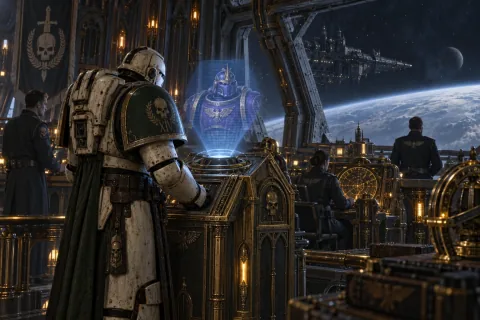
Garro was an officer of the Death Guard. He had fought faithfully for his Primarch, but because his loyalty to the Emperor was clear, he became a target for elimination. Official 'Legacies' states that as a result of him escaping the trap with the Eisenstein and warning the Empire, Horus abandoned the surprise raid on Terra he had planned and prepared for a longer march. The resistance on the surface and the information conveyed outside changed the speed of the same rebellion.
Afterward, the Empire would send an army to punish the rebellion to the Isstvan system. However, the Isstvan V Dropsite Massacre that the army experiences is the next trap occurring on a different planet. If one compresses the loyalist purge of Isstvan III, the warning of the Eisenstein, the retribution fleet, and the subsequent ambush into a single bombardment, the cause and effect disappear.
Horus sought to eliminate the refusal within his own Legion, but Isstvan III left the memory that the refusal actually existed. Even under the same armor, gene-seed, achievements, and commanders, choices were not determined as one. Some aimed at brothers they had fought alongside, some held out to save those brothers, and some carried the name of betrayal to more distant places.
If the heart that sought to save one father on Davin led to a war of the galaxy, on Isstvan III, the sons abandoned by that father's command revealed the truth of the war. Just because their cities and positions eventually collapsed does not mean the warning they left behind collapsed. Now, the Empire had to face the fact that the beloved Warmaster had turned against it.
Paths of Terms and Characters
Isstvan III: The planet where the loyalists within the four Legions conspired against by Horus were purged. Read by distinguishing the order to attack the rebels, the virus bombing, the resistance of survivors, and the subsequent bombardment.
Isstvan V: The planet the Empire's retribution fleet later headed toward. The Dropsite Massacre is a different battle from the purge of III, an event where the Imperial forces, moving after receiving the warning, meet a new betrayal.
Saul Tarvitz: A loyalist officer of the Emperor's Children. He led survivors of different Legions and held out to the end against Lucius's betrayal and subsequent attacks.
Mournival: The group of four advisors beside Horus. The relationship between Loken, Torgaddon, Abaddon, and Aximand is divided in the Legion's rebellion.
Life-eater Virus: A biological weapon used in the purge of Isstvan III. It does not mean the absolute neutralization of ordinary explosive shells or protective equipment; official equipment records include cases of sacrifice due to damaged armor.
Rylanor: A loyalist Dreadnought who connected the Legion's old history and rituals. Distinguish between the uncertain end in early battle records and the scope of confirmation in later individual narratives.
Nathaniel Garro and the Eisenstein: The officer and ship that conveyed the betrayal to the Empire. That warning changes the speed of the war and Horus's plans, leading to the retribution fleet of the next era.
Loyalists and Traitors: During this period, one cannot determine the side of all members by the Legion's name alone. The path chosen by the Legion's commander and the oath kept by each warrior can differ.
Reading Along with Previous Public Serializations
The wounds and rituals of Davin, and the purpose that changed after Horus returned, continue from Warhammer 40,000 Part 17. /en/community/tm-warhammer40000-saga-part017-20261008
The cracks in the Legion that Loken saw while in the Mournival, close to Horus, can be read in Part 15. /en/community/tm-warhammer40000-saga-part015-20261008
The process by which the Warmaster's authority was created at Ullanor is in Part 13. /en/community/tm-warhammer40000-saga-part013-20261008
Official Materials and Scope of Confirmation
Confirmation Date: October 8, 2026 (UTC). This was written based on the lore and events confirmed in the official public materials below. Public samples and lore introductions only confirmed the relevant public scope and do not indicate that the entire book was read. Illustrations are AI reconstructions, not official images.
Saul Tarvitz: The First Loyalist
Revealed — The new Galaxy in Flames cover for The Horus Heresy Saga
Heresy Thursday — Little Horus Aximand
Traitor lore — How the trap was set
Galaxy in Flames — Games Workshop publisher synopsis, 2014 edition
Legacies of the Age of Darkness — Rylanor and Nathaniel Garro
comments 1
이스트반 III에서 충성파가 보여준 저항이 호루스의 계획을 지연시킨 것은 사실이나, 당시 엠퍼러스 칠드런의 사울 타르비츠가 루시우스와의 결투에서 승리했다는 점이 이후 전개된 전투의 양상이나 반역파 지휘관들의 판단에 구체적으로 어떤 심리적 혹은 전술적 영향을 미쳤는지 궁금합니다.