
Operator Recommended Game Story: Warhammer 40,000 Part 17
Chapters in this story
- The Wound of Horus and Davin · The Gate Opened by Hands Seeking to Save a Father
- Chapter 1 · The War That Passed Through a Small Planet Did Not End
- Chapter 2 · A Different Promise Seeping into the Passage of Brotherhood
- Chapter 3 · The Name of Davin Returns to the Warmaster
- Chapter 4 · A Wound the Great Body Could Not Endure
- Chapter 5 · The Temple Toward Which the Heart That Could Not Let Him Die Turned
- Chapter 6 · What Do the Visions Show and What Do They Hide?
- Chapter 7 · A New Loyalty Attached to the Promise of Salvation
- Chapter 8 · The Returned Father and the Changed Direction of the Imperium
- Chapter 9 · The Longer Shadow That a Small Planet Will Leave
- The Paths of Terms and Figures
- Continuing from Previous Public Series
- Official Materials and Scope of Confirmation
The Wound of Horus and Davin · The Gate Opened by Hands Seeking to Save a Father
Spoiler Notice: This covers the subjugation of Davin during the Great Crusade, the connection between Warrior Lodges and the Word Bearers, the wound Horus sustained on Davin's moon after Ullanor, and the ritual conducted in the Serpent Lodge and the temptation by Erebus. The planet Davin and the moon where Horus was wounded are distinct locations. This commentary directly explains events confirmed in official published histories, legion introductions, and lore materials, and does not treat the visions shown in the ritual as objective records of the future.
Chapter 1 · The War That Passed Through a Small Planet Did Not End
Approximately 60 years before the Triumph at Ullanor, Davin encountered the overwhelming power of the Great Crusade. The humans of this planet had long lived in a culture of warriors, gathered into lodges that revered the beasts roaming the plains. From the outside, it was a human world with unfamiliar customs. However, in places unknown to the secular Imperium, the influence of Chaos had already taken hold.
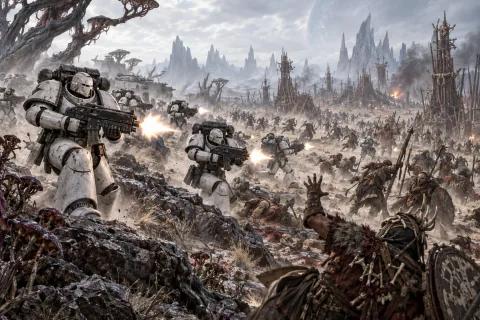
The Luna Wolves and the Word Bearers subjugated Davin. The fact that the warriors were brave did not mean they possessed power equal to the Legions. Faced with the disparity of war brought by technology, manpower, and gene-enhanced warriors, the lodges of Davin quickly surrendered.
That victory could have been just another event passed over on the map of the Great Crusade. The Luna Wolves headed to the next battlefield. But the Word Bearers remained. They had the mission of teaching the Imperial Truth to the new world. It was necessary to ensure that the subjugated society continued to live within the order of the Imperium even after the Legion departed.
However, the teachers also learned something on Davin. It was the form of the lodges where warriors bonded with one another. The structure where those who fought together shared brotherhood beyond official status and rank was something the warriors of the Legion could also accept.
Just as the Great Crusade changed Davin, Davin also changed the people of the Great Crusade. However, the Imperium's victory records did not fully understand this second direction from the beginning. What a surrendered world would leave for the future of a Legion could not be known through the military victory of that time alone.
Chapter 2 · A Different Promise Seeping into the Passage of Brotherhood
The Word Bearers spread this lodge format to other Legions as well. To a warrior, brotherhood and trust were not unfamiliar desires. For those who had to risk their lives on distant stars, a relationship of mutual reliance separate from the commands of rank was necessary.
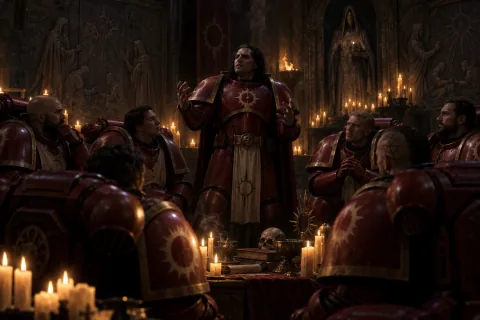
Therefore, if one reads everyone who sought out Warrior Lodges as conspirators with the same purpose from the start, the texture of history is erased. One must distinguish between the desire for solidarity and the plans that exploited that solidarity. Official history introductions explain that as the corruption of Lorgar and the Word Bearers progressed, the lodges also turned into passages for betrayal.
The warrior culture of one society was transferred to other Legions, and within it, a path toward Chaos grew. While the familiar language of brotherhood continued on the surface, it became important who led those gatherings and what they were hiding. There was a dangerous gap between trusting someone you know and trusting every path that person offers.
This is also why it is difficult to read the fall of Horus as merely a single scene where a giant demon suddenly appears and steals his will. Long-standing relationships and small gatherings existed first. So that someone's words could be trusted at the most critical moment, the path had been prepared among the people long before.
Chapter 3 · The Name of Davin Returns to the Warmaster
After Ullanor, Horus led the Great Crusade on behalf of the Emperor. His command was immense, but not all relationships had become comfortable. He had to continue the Emperor's plans, move other Primarchs and Legions, and as he accumulated victories, the power within the Imperium was also changing.
The fact that the relationship between Horus and his surrounding advisors became heavier after the catastrophe of the previous Interex incident is also confirmed in the official publisher's introduction to 'False Gods'. The details of this incident's negotiations and the history of the weapon are subjects for a separate follow-up and are not filled in with scenes not confirmed here. This part follows the transition that occurred as Horus responded to the request from Davin.
Erebus brought the problem of Davin. The Word Bearers' First Chaplain was by now a man deeply connected to the forces of darkness, but what he presented was, on the surface, a mission to suppress a rebellion against the Imperium. He claimed the Imperial Governor had rebelled and fled to the planet's moon.
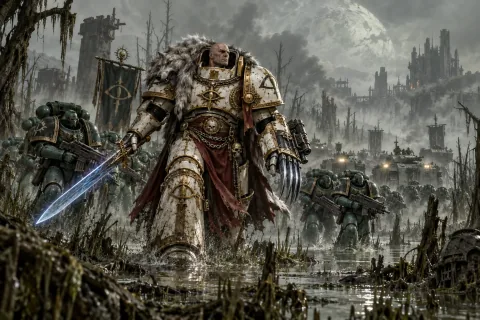
Horus led the attack himself. The image of the Warmaster acting as the spearhead of the front line was consistent with how his name had been built. He was not a commander who only gave orders from behind other Legions. He was a commander who opened the way for his army by personally breaking through dangerous points.
To a reader who knows this choice, the swamps of Davin appear as a trap. To those heading there, it was still a battlefield to reclaim the authority of the Imperium. The tragedy of the story lies between these two perspectives.
This is a scene of the attack on the moon, drawn from a new perspective, reflecting the white and gold armor, wolf pelts, power sword in the right hand, and claw/combi-bolter in the left hand shown on the 2026 official 'False Gods' cover. The swamp battlefield is not confused with the main planet of Davin where Erebus's ritual takes place. The black Chaos armor from after the betrayal is not placed on Horus at this time.
Chapter 4 · A Wound the Great Body Could Not Endure
The moon was a rotten and diseased land. Author Graham McNeill of 'False Gods' explains in a public interview that this scene of facing Temba is an intentional echo foreshadowing the final confrontation of the civil war. The traitor governor Horus faced was under the influence of Nurgle, and in his hand was the Anathame. This weapon did not strike down the Primarch simply because it was sharper or heavier. The power of the Warp pierced Horus's defenses and poisoned him.
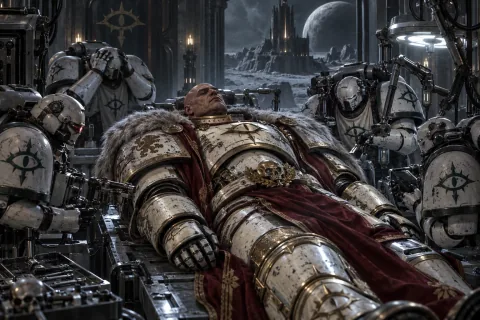
The Primarch's body far exceeded the limits of an ordinary human. Even the warriors of the Legion could look upon their genetic father as a being of another dimension. However, a strong body did not mean complete immunity to all forces. A danger the Imperium did not properly understand had entered Horus's body.
The Legion's Apothecaries could not resolve this wound. They were specialized personnel who had saved Astartes bodies and treated countless wounds in the midst of war. The fact that a problem appeared which their technology could not reach gave a different kind of terror to those around the Primarch.
The Warmaster falling was not merely an officer being wounded. The authority of the Great Crusade, the identity of the Legion, and the relationship between father and sons were tied to one body. But what was needed now was not words praising that symbol, but a way for him to survive.
At this time, Erebus stepped forward, claiming to know another way. The path presented where medicine had failed was in the hands of someone who had already gained trust through the closest of relationships.
Chapter 5 · The Temple Toward Which the Heart That Could Not Let Him Die Turned
The sons of Horus sought to save him. Returning to the main planet of Davin, they moved the Primarch to the temple of the Serpent Lodge according to the advice of Erebus. The wound from the diseased battlefield of the moon led to the ritual on the planet.
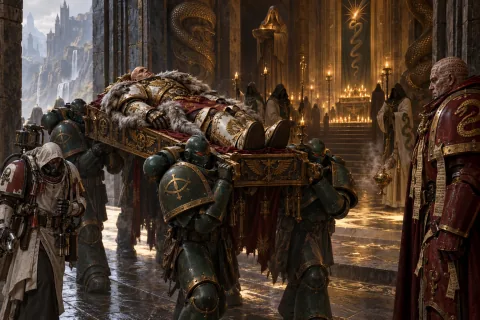
They were not people who took their father away to make him a tool of evil. What official history introductions emphasize is the desperation to save him. That heart did not make the wrong path safe, but it explains why that path could be chosen. Between losing him by doing nothing and taking a risk to save him, they grasped the latter.
The warriors moving Horus and the threshold of the temple are a new illustration that visually interprets this choice. Erebus's pale head and tattoos, red armor, gold ornaments, and scroll fragments refer to official appearance materials. The temple pillars, patterns, character placement, and accurate ritual attire are a reconstruction, not a restoration of official cinematics.
The heart that seeks to save does not disappear in this scene. However, who determines the conditions for regaining life changes. At the moment when there was no answer from the Legion's medical staff, Erebus gained the position to explain the world Horus would see and its meaning.
A person who knows the results belatedly can easily call this threshold dangerous. However, what makes the tragedy linger is not the simple judgment of foolishness for failing to notice the danger, but the fact that the heart that did not want to lose the most precious person was used for someone else's plan.
Chapter 6 · What Do the Visions Show and What Do They Hide?
Within the ritual, Erebus approached Horus in the guise of a dead comrade. Official Legion introductions state that he showed visions of the past and future. It was a passage that could be accepted like the voice of a familiar person rather than the warning of a strange enemy.
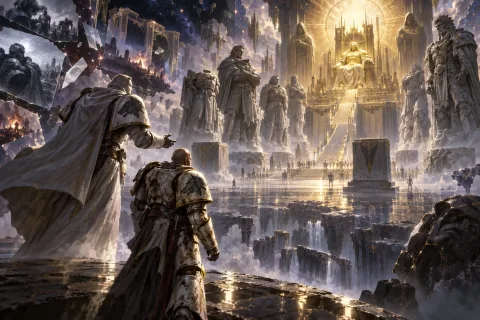
In the future presented to Horus, the Emperor reigned like a god, and the Primarchs and Space Marines were discarded. The fear connected to the fate experienced by the Thunder Warriors was placed before his eyes. The question of what he and his Legion had fought for, and what position they would gain in return, took the shape of a vision.
There were also visions directed toward the past. It was the content that Horus's own creation and the power of the Warp were connected. Erebus put forward the interpretation that the Emperor used power he forbade to others for his own purposes. The fact that the Emperor had hidden something was not a guarantee that everyone explaining it was telling the whole truth.
It is important here not to accept the visions immediately as objective video of history. What is shown, the order in which it is connected, and what conclusion is attached are all part of the temptation. To a reader who knows the official events, it is important not only what scenes Erebus showed, but also what judgment Horus is induced to make through those scenes.
McNeill explains that manipulation as a truth with the context erased. In the vision, there are statues of his brothers, but no place for Horus himself. That empty seat is presented as evidence that the Emperor unjustly erased him. However, if the choice Horus will make in the future is the very cause that creates that later exclusion, he is accepting the scene showing the result as if it were the cause. The misunderstanding created by the vision grows in the gap between what was actually seen and why it is there.
If one easily combines the future he feared with the future that will actually happen, the causality of betrayal also becomes simple. Horus may move believing he is preventing the future, but the vision before his eyes does not yet tell him what his very choice will create in the eras to come.
Chapter 7 · A New Loyalty Attached to the Promise of Salvation
Erebus put forward the claim that the forces of Chaos were only interested in the realm of the Warp and that the Emperor was trying to conquer even that realm. This is not an explanation confirming the goodwill of Chaos as fact. It is a claim presented to persuade Horus.
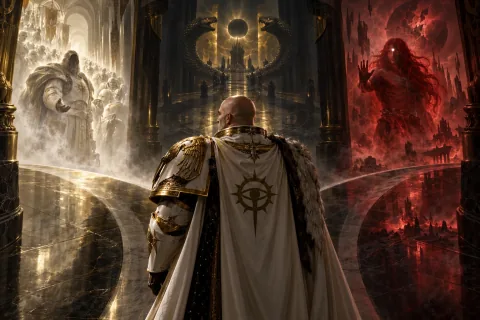
He also connected the power struggles within the Imperium. The issue of the human governing apparatus of Terra ruling the Imperium, rather than the Astartes who had fought the Great Crusade, meshed with Horus's dissatisfaction. The words about the rights of those who contributed in war became a language that could turn long-standing trust in the Emperor in a different direction.
The proposal led to a promise to save his life, give him power, and achieve the future he desired. Removing the poison from his body and deciding who should be the master of the Imperium were tied together as a single choice. The life to which the Warmaster would return was no longer presented under the same conditions as his previous life.
Magnus also intervened in this choice. The author's public explanation places Magnus and Erebus as two voices presenting different directions to Horus. Magnus tries to turn Horus toward a different path, but to Horus, who dislikes feeling manipulated, even that warning reaches him as a demand to move him. The thought that he is deciding for himself without following any words could be realized on a path already narrowed by someone else.
This must be distinguished from the narrative described in the early 'Realm of Chaos' where a demon literally takes over Horus. McNeill explains that while constructing the novel, he placed more importance on Horus's own choices than on a method that shifts all responsibility to demonic possession. If one combines explanations from different publication periods without any distinction, one misses the tragedy placed between the manipulated environment and the responsibility of the person who made the judgment.
Horus's betrayal involved pride, fear, and ambition, as well as the workings of Chaos. His choice does not disappear because there was outside deception, nor does the long-prepared manipulation and trap disappear because he chose it. Davin was the turning point where these two met.
The path that began there soon spreads within the Legions and among the Primarchs. Oaths, persuasion, threats, and connections will divide the Emperor's armies. However, there is no need to push all the subsequent large-scale massacres as if they were all things that happened inside the temple on Davin from the beginning. Betrayal grows into war over time through people's decisions.
Chapter 8 · The Returned Father and the Changed Direction of the Imperium
Horus did not die. Looking only at this one result, the purpose of those who moved him to the temple might seem to have been achieved. But the fact that he survived and the fact that the previous trust returned as it was are not the same. A new plan centered on himself began to take root on the map of the Great Crusade.
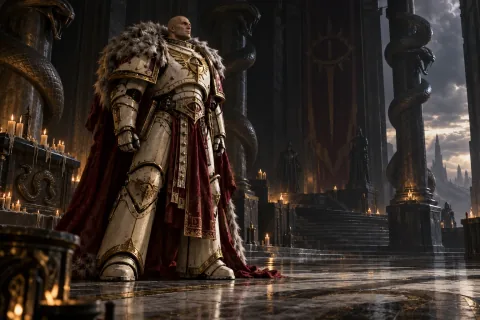
To the sons of the Legion, their father's life was something that could not be exchanged for anything. Understanding that heart does not erase the results of the course they chose. Rather, it makes a greater tragedy visible. The one life they sought to protect returned as the center of a war that would cause countless lives to be lost.
In the official introduction to Davin, 'False Gods' author Graham McNeill explains this event as a critical crossroads where good intentions lead to catastrophe. It is not a separate canon that confirms that if they had made a different choice, everything would have been fine. The result actually confirmed is that the act of trying to save him was used to open Horus's dark path.
Therefore, if one remembers Davin only as an incident where a weapon stabbed him, one misses half the path. The Warrior Lodges and trust before touching that weapon, and the desperation and ritual, visions, and promises of power after it, were all together. The wound was on the body, but what changed was the direction of the Imperium that the body led.
Chapter 9 · The Longer Shadow That a Small Planet Will Leave
Davin's role did not end when Horus left. The Chaos worshippers and lodge priests of this world spread to various places during the war. Official lore materials explain that they accompanied Horus and his allied forces to the battlefield, acting as advisors dealing with prophecy and the power of the Warp, or as priests connecting various groups.
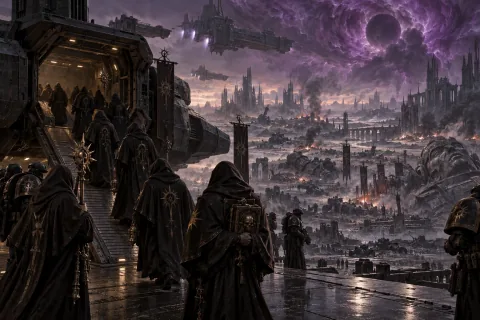
Davin itself is later connected to the history of the Demon World and the Ruinstorm. Official introductions connect this to the event where Sanguinius, Lion El'Jonson, and Roboute Guilliman destroy Davin to open a path to Terra late in the war. In this part, we guide the location of the connection, and the specific choices and conflicts of that journey are covered separately in the main volumes of that era.
We do not combine this with the initial injury incident as a one-time event. The old Davin of the Great Crusade, the moon where Horus fell, the temple where the ritual was conducted, and the later Demon World are connected, but they are not the appearance of the same moment. While the place and time changed, the influence this small world had on the galaxy's war also changed.
At first, it looked like a subjugated planet on one side of the map. The relationships left behind after the Legion departed for the next battlefield spread to various Legions, and long after, it returned as a path to save a Primarch's life. The history that would divide the galaxy was growing not in the largest battleship, but in the passages connected in such a way.
The Paths of Terms and Figures
Davin: A human world subjugated to the Imperium during the Great Crusade. Horus's injury occurs on the moon, and the Serpent Lodge ritual follows on the main planet.
Warrior Lodges: A gathering of brotherhood transferred from Davin's culture to the Legions. One must distinguish between the original solidarity and the secret passages abused by the Word Bearers.
Erebus: The First Chaplain of the Word Bearers, a key manipulator who leads Horus to the temple and the path of visions. We do not read the purpose of Chaos he explains as truth guaranteed by the narrator.
Anathame: A weapon that left a wound and poison on Horus with the power of the Warp. We do not arbitrarily determine the theft process or the history of all artifacts beyond the scope of the materials confirmed here.
Apothecaries: Personnel specialized in the medical and genetic systems of Legion warriors. On Davin, dangers that cannot be solved by their technology are revealed.
Serpent Lodge: The lodge on Davin where the ritual to save Horus was conducted. We have not changed the recovery values of game rules into the exact operating method of the ritual in the novel.
Ruinstorm: A massive Warp storm that later divides the galaxy. The connecting events linking Davin's early lodges and their role late in the war continue in separate era-specific main volumes.
Continuing from Previous Public Series
The relationship between the Emperor and Horus, and the process by which the Warmaster's authority grew, can be read in Warhammer 40,000 Part 13. /en/community/tm-warhammer40000-saga-part013-20261008
The path the Word Bearers took from faith and humiliation to a different force can be checked in Part 14. /en/community/tm-warhammer40000-saga-part014-20261008
The cracks in the Great Crusade that Loken and the Mournival faced near their father are in Part 15. /en/community/tm-warhammer40000-saga-part015-20261008
Official Materials and Scope of Confirmation
Confirmation Date: October 8, 2026 (UTC). Written based on lore and events confirmed in the official public materials below. Public samples and lore introductions only confirmed that scope, and it is not indicated that the entire book was read. Illustrations are AI reconstructions, not official images.
The Horus Heresy — How Davin Put the Warmaster on the Path to Heresy
Legions of the Horus Heresy — The Sons of Horus Are the Real First Legion
False Gods — Games Workshop publisher synopsis, 2014 edition
Revealed — The new False Gods cover for The Horus Heresy Saga
Legacies of the Age of Darkness: Solar Auxilia v1.1 — Davinite Lodge Priest
Lets Talk… False Gods with Graham McNeill — author interview
comments 0