
Operator Recommended Game Story · Warhammer 40,000 Part 5
Chapters in this story
- The Ancient Galaxy and the Dawn of Humanity · Those Who Survived the End of Beauty
- Chapter 1 · Inheriting the Garden of Stars
- Chapter 2 · The Path Where Senses Swallow an Empire
- Chapter 3 · Those Who Left Early
- Chapter 4 · Cities That Departed Among the Stars
- Chapter 5 · A Wound Opened in the Galaxy
- Chapter 6 · Survival Remaining in the Dark City
- Chapter 7 · Changing Names and Establishing Paths of Life
- Chapter 8 · Behind the Civilization That Dreamed of Eternity
- Official Materials and Verification Scope
The Ancient Galaxy and the Dawn of Humanity · Those Who Survived the End of Beauty
Spoiler Notice: This article covers the prosperity and fall of the Aeldari Empire, the birth of Slaanesh and the Eye of Terror, and the survival of the Craftworlds, Exodites, and Drukhari. Later figures and cultures are distinguished by the influence stemming from their origins. This is a novelistic commentary written based on official materials.
In a galaxy where the tomb doors had closed, the stars of other civilizations shone. The Aeldari connected distant worlds, cultivated planets, and wielded wondrous technology through the power of their minds. Long before humanity established its empire in the galaxy, they were already carving out a place for their civilization among the stars.
Great power can endure for a long time, but it does not guarantee the restraint of the society that possesses it. Prosperity beyond mere survival turned into an endless craving for new stimulation. The end of this empire did not begin solely with the scene of a fleet from the outside besieging the capital. One must look at what a civilization that enjoyed beauty had cultivated within itself, and see the end of that path.
Chapter 1 · Inheriting the Garden of Stars
After the War in Heaven, the Aeldari grew based on the technology and psychic abilities inherited from the Old Ones. In the officially released history of 'Inheritance of Embers,' they traversed the stars and cultivated planets into paradises of life. Even places devastated by war could have a future once again. The ancient galaxy did not possess only records of destruction.
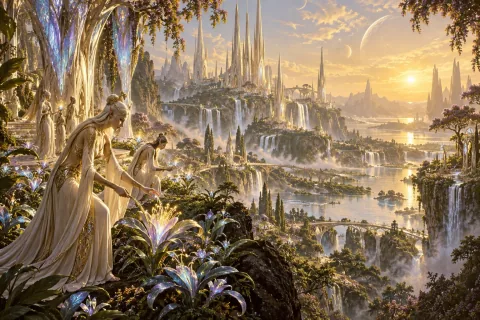
The old Aralda of Giliad, a planet humans later call Ostia, shows this difference. In the Aeldari language, the name is introduced as meaning 'Flower of the Dawn.' It may have been a newly arrived colony to humans, but to those who cultivated it first, it was a world with long memories. The changing of names for the same land is deeper than a simple replacement of place names.
When the Craftworld known as Ul-Khari returned, there were humans in the place they remembered. While we do not extend this individual case to the experience of all Aeldari in the galaxy, one can sense the foundation of the conflicts that followed. A paradise thought to be empty could be a lost home to another civilization. Someone's beginning looks like the erasure of long history to another.
Chapter 2 · The Path Where Senses Swallow an Empire
The psychic power of the Aeldari was an ability to create wonders, and at the same time, it caused their extreme desires to resonate more loudly in the Warp. A comfortable life turned into a culture chasing ever-stronger stimulation. The degradation of art and music reached the point where cruel rituals and murder were performed as part of the spectacle. The fall of society did not suddenly become an external stigma one day; it grew from choices and customs within.
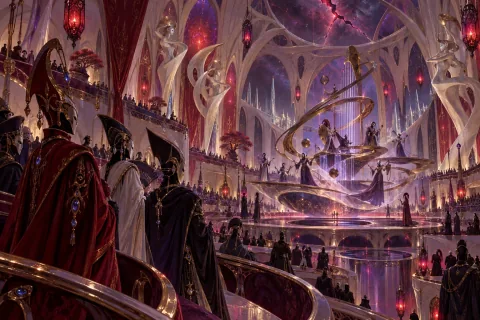
Not all Aeldari wanted that path. There were those who feared where the empire was heading. However, changing the direction the entire civilization was already moving in alone, and even realizing that direction, were different things. Some decided to leave. The history of those who survived later diverges from this choice made at different points within the same empire.
Leaving did not just mean fleeing after paradise had vanished. It was also about abandoning the remaining prosperity and turning one's back on the values of a familiar world. The ships heading far away were both a means of escape and a sign of warning left within the civilization. While life continued while ignoring that warning, the weight of the catastrophe grew in unseen places.
Chapter 3 · Those Who Left Early
The Exodites are survivors who left long before the Fall. They traveled to distant worlds via the Webway and small fleets, discarding much of the culture they deemed corrupted. Rather than the method of keeping entire cities on ships, they chose a path of living under different conditions and escaping the excesses of society.
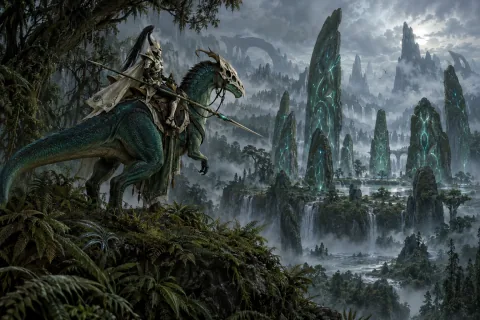
The Maiden Worlds they found were worlds that previous generations of Aeldari had slowly cultivated. However, they did not all choose to live in comfortable gardens. The Exodites chose lands where survival required effort. This choice, emphasized by the 2026 official introduction, shows what kind of cultural resolve lies behind the appearance of graceful warriors riding dragons.
Those who were far enough away when the Eye of Terror formed survived. However, distance alone did not make the danger to their souls disappear forever. The Exodites' Waystones and World Spirits are the protection that sustains their lives thereafter. In the way the souls of the dead gather in the pillars and networks of spirit crystals to hide and protect the world, there remains a relationship that does not view the land merely as a resource.
Chapter 4 · Cities That Departed Among the Stars
As the Fall drew near, there were also those who left aboard massive Craftworlds. On ships comparable to continents, technology, high culture, and a society to live together remained. Their exodus is different from the sight of a few warships moving to the next battle. The departing ship itself became the world they would live in anew.
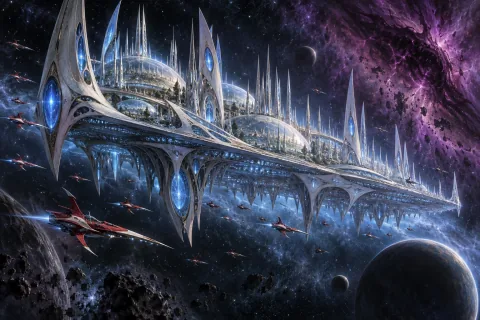
The curves, spires, and massive domes of official Aeldari illustrations show their scale. Grand architecture is not just proof that the empire was still strong. One must also see the desperation contained within the moving city, and how far they could move and preserve that beauty. The fact that the remaining heritage is vast makes the weight of the lost home deeper.
Since then, the Asuryani of the Craftworlds govern their minds and lives through the restraint of the 'Path.' A culture that polishes one field for a long time and then chooses another path, limiting oneself, was not created because of a lack of talent. It is the way a civilization that knows what kind of catastrophe too much potential led to, decides the direction of its potential itself.
Chapter 5 · A Wound Opened in the Galaxy
The moment Slaanesh awakened, the excess of the empire was no longer something that ended only within that empire. A catastrophe that shook the Warp erupted, and countless Aeldari souls were swallowed. The Eye of Terror formed, and the previous world was torn in an irreversible way. The civilization that had ruled became a civilization wandering to survive.
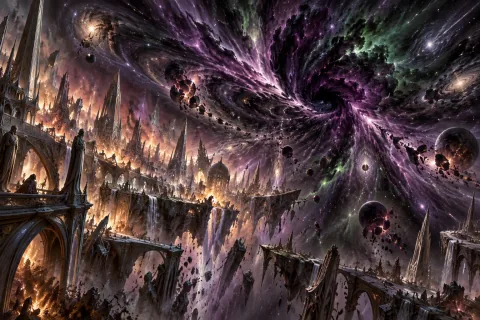
Fixing the exact scale of the sacrifice to a single number might cause one to miss the narrative differences in various official introductions. What is important here is not the impression of counting how many, but the fact that the center of the civilization and the souls who lived there were destroyed all at once. Even if the evacuated ships endured the catastrophe, the path to reclaiming everything left behind did not open.
And even the word 'survived' did not mean complete safety. Slaanesh continues to threaten their souls even afterwards. The survival of this race requires both winning battles physically and avoiding ruin spiritually. It is difficult to understand why they are so restrained and why they fear death so much later on by explaining only weapons and ships.
Chapter 6 · Survival Remaining in the Dark City
Those who were in Commorragh endured the catastrophe in a different way. The city in the Webway was not annihilated immediately at the time of the Fall, but scars remained on their souls. For the Drukhari, the consumption by Slaanesh continued. Finding a place to hide did not mean the relationship with the hungry entity was severed.
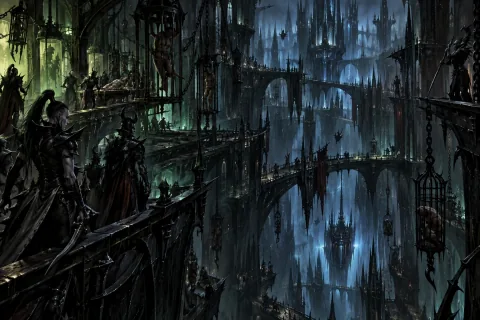
They steal the extreme pain and terror of other lives to replenish their own fading essence. Thus, raiding becomes more than just a war to increase loot in this society. The act of prolonging the pain of kidnapped victims is connected to their own survival. To the victim, it is a cruel fate that is endlessly consumed to sustain the souls of another civilization.
Let us not think of them as a race safe from Slaanesh, or place them under the same name as if everyone worships Slaanesh. A terrible way of survival by stealing pain is their characteristic. The internal politics and armies moved by Vect, the Kabals, Wych Cults, and Haemonculus Covens will be connected in detail in the separate faction section.
Chapter 7 · Changing Names and Establishing Paths of Life
Amidst the Fall, a being named Iliatin fought to survive and later met a child who would become Jain Zar. After escaping with other survivors, he established a new path of the warrior under the name Asurmen. Through the temple of the Dire Avengers and his disciple Asur, the restraint of martial arts was passed on to other temples. Not all traditions were severed together even after the empire vanished.
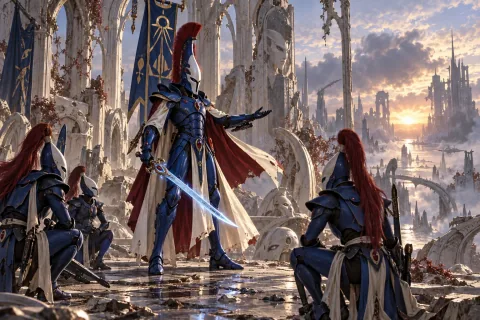
We do not combine this origin with all the battles of the current Phoenix Lords. The long stories of Asurmen, Jain Zar, and other successors will be unfolded in the character section. Here, let us remember the connection that a being who survived in a fallen world creates a path that the next survivors can follow. In the discipline born from the ruins, the memory of a civilization that tries never to go to the same ruin again remains.
Craftworlds, Exodites, the Dark City, and the later Harlequins, Ynnari, and Corsairs are not a single group living the same life. Different choices create both solidarity and distrust. Knowing the name of one race does not mean knowing all the lives within it. Just as the previous Necron dynasties were different, the surviving Aeldari also carry on their pasts differently.
Chapter 8 · Behind the Civilization That Dreamed of Eternity
Asuryani, Craftworld, Exodite, World Spirit, Commorragh, and the Eye of Terror are terms that will return when reading the stories that follow. This part connects the tens of millions of years of ancient history, long growth, and the much later Fall. One should not read it as if Slaanesh was born the very next day after the Necrons fell asleep.
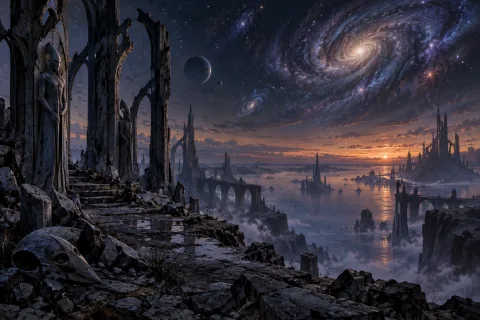
The gaze of this main story now shifts to humanity. Between the long growth and decline of the Aeldari, how far did human civilization extend, and what did it lose? The next part is not a short straight line dealing only with the aftermath of the Fall, but first looks back at the past of humanity that overlaps with it. If we start by excluding the history of other races, it will be impossible to understand why the galaxy humanity will face later is so old and scarred.
Official Materials and Verification Scope
Verification Date: October 8, 2026 (UTC). This was written based on settings and events confirmed in the official public materials below. Public samples and setting introductions were checked only for their respective public scope, and it does not indicate that the entire book has been read. Illustrations are AI reconstructions, not official images.
Wrath & Glory: Inheritance of Embers — licensed public sample
Lore of the Exodites: Reject Decadence and Ride Dragons
The Big Summer Preview — Exodites revealed
Starting a Drukhari Army — official faction background
comments 0