
Operator Recommended Game Story: Warhammer 40,000 Part 19
Chapters in this story
- Nathaniel Garro and the Eisenstein: A Warning Returned from a Dead World
- Chapter 1: An Older Oath Remaining for a Warrior Who Served Mortarion
- Chapter 2: Tarvitz Remaining on the Ground and Garro Heading to Space
- Chapter 3: When a Single Small Ship Departs from a Fleet of Victory
- Chapter 4: A Warning That Cannot Reach the Stars
- Chapter 5: An Unbelievable Fact Reaching Rogal Dorn
- Chapter 6: The Place Where Horus's First Plan Collapsed
- Chapter 7: The New Master of the Warrior Who Left the Legion
- Chapter 8: Heading into the Galaxy to Find Scattered Loyalty
- Chapter 9: Libertas and Hidden Faith
- Chapter 10: The Time Left Behind by a Single Ship
- Paths of Terms and Figures
- Reading by Distinguishing Versions of Lore
- Reading Along with Already Published Series
- Official Materials and Scope of Verification
Nathaniel Garro and the Eisenstein: A Warning Returned from a Dead World
Spoiler Notice: This installment covers the process by which the betrayal at Isstvan III became known to the Imperium, the escape of Nathaniel Garro and the Eisenstein, the response of Rogal Dorn, and the path leading to the Knights-Errant serving Malcador. This is a narrative commentary based on events confirmed in official published histories, setting introductions, and novel synopses. It is not a translation of scenes or dialogue from the novels, and it does not preempt the conclusion of the Siege of Terra.
The loyalists remaining on the soil of Isstvan III knew whose fleet intended to kill them. The ships above were not the vessels of strange alien invaders. They were the fleet that had sailed for the same Imperium, fought the same wars, and shared the same records of victory. The names of the commanders and the banners of the Legions were familiar. Everything familiar had turned toward death in an instant.
However, the truth of that planet was not yet the truth of the entire galaxy. If the fact that Horus had betrayed the Imperium did not reach Terra, the other Legions of the Imperium could still accept the Warmaster's orders as legitimate. If the resistance within the ruins was a fight for survival, the escape into space was the act of ensuring that the meaning of that fight would not vanish. The horrors of one world had to be made known to the others.
The one entrusted with that path was Battle-Captain Nathaniel Garro of the Death Guard. What he had to carry was not a map of new territories or a report of victory. It was a warning that the man chosen to lead the Imperium had murdered the Imperium's loyal soldiers. The voyage of the frigate Eisenstein would become a journey that transformed that unbelievable fact into the testimony of the living.
Chapter 1: An Older Oath Remaining for a Warrior Who Served Mortarion
Garro was the Battle-Captain of the 7th Company of the Death Guard. He was a veteran who had faithfully served Mortarion during the Great Crusade, but his unwavering loyalty to the Emperor was also widely known. In times of peace, these two loyalties could be read in the same direction, as following a Primarch meant fighting for the Emperor's Imperium. However, the belief that this relationship would always be one and the same collapsed at Isstvan.
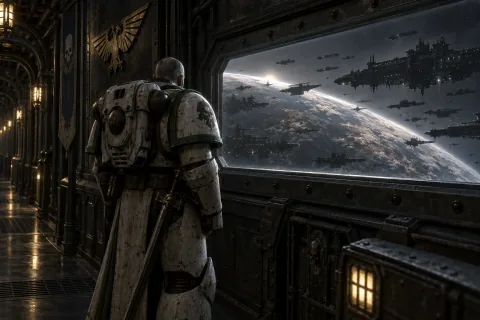
The Death Guard under Mortarion was a Legion that endured harsh battlefields. Official early Legion history records the transition where the legacy of the Terran-born Dusk Raiders gave way to the culture and combat methods of Barbarus. New recruits arrived, armor and markings changed, and the Primarch's teachings became the standard of the Legion. Yet, the memories of the warriors who had fought before were not erased at the same speed.
When the warriors loyal to the Emperor were selected for elimination on Isstvan III, Garro was also a target of that trap. His past of devoted service to his Primarch did not save him. The question was not how long one had obeyed, but whether one would obey even in the moment of betrayal. The loyalty he upheld now clashed with the orders governing his own Legion.
If one divides this conflict solely by lineage, an important choice disappears. People who shared the same genetic father in the same Legion stood on different sides. Even among those who wore the same armor and endured the same battlefields, the lines they refused to cross were different. Garro's departure from his Legion's orders was not an abandonment of the oaths he had kept, but a decision on which oath to keep until the end.
Chapter 2: Tarvitz Remaining on the Ground and Garro Heading to Space
Saul Tarvitz warned the loyalists of the danger of betrayal and eventually led the survivors of Isstvan III in resistance. Official character history records that he persuaded Garro, his long-time brother-in-arms, to secure the Eisenstein and head to Terra. Thanks to this connection, the resistance on the planet and the warning for the galaxy were directed toward the same goal from different places.
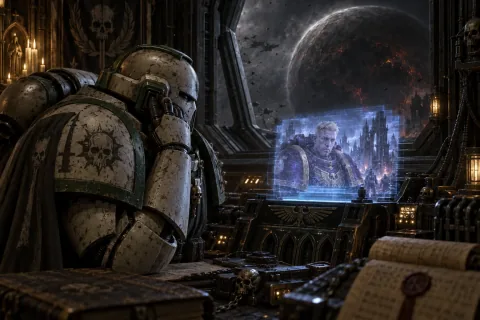
Tarvitz had a reason to remain on the ground. There were still warriors alive within the ruins, and they were fighting against the orders of death descending from above. One could not simply abandon them and flee. However, if everyone died in the same ruins, their final resistance could be trapped within the report Horus would leave behind. Someone had to get out of that report.
This is why Garro's escape cannot be viewed simply as a choice to avoid danger. He could not complete his mission merely by surviving. He had to reach Terra, deliver the warning, and ensure that those who heard it accepted it as a real threat. A long voyage lay ahead of the escaping ship, and at the end of that voyage was another door where he would have to persuade those who did not believe.
The paths of the two warriors diverge here, but that divergence does not mean they abandoned each other. Tarvitz's resistance delayed Horus's plans, and Garro's warning shook the plan to surprise an Imperium that Horus did not yet believe was on guard. Between the one who stayed to fight and the one who left to inform, different responsibilities necessary to stop the betrayal were divided.
Chapter 3: When a Single Small Ship Departs from a Fleet of Victory
The Eisenstein carried Garro and his companions toward Terra. A single frigate could not defeat an entire war. However, what was needed on this voyage was not the firepower to annihilate Horus's fleet. It was the opportunity to escape the fleet's perimeter and convey the truth. The largest ship does not necessarily leave the greatest history.
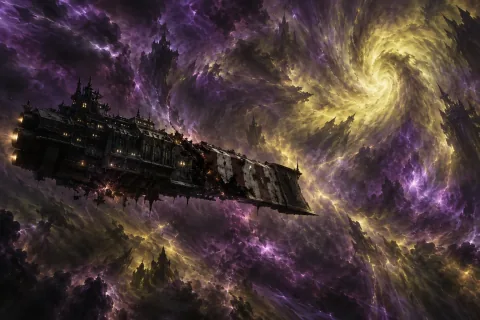
Enemy shelling damaged their voyage. Official novel synopses clearly convey the crisis where the fleeing Eisenstein is stranded in the Warp after being attacked. Escaping into the stars did not mean arriving in a safe space immediately. The distances of real space were too vast, and the passages crossing those distances held dangers different from the battles of the material world.
If one thinks of this voyage like a naval battle, it is easy to miss the meaning of the Warp. The Imperium uses the realm beyond reality to connect the galaxy. However, it is not an empty shortcut. It is a space where the powers of Chaos wait, and all threats cannot be explained by the thick armor of a Legion's plate or the heavy plating of a ship. On the path they took to avoid the shelling of the traitor fleet, they would face hostility from another dimension.
Chapter 4: A Warning That Cannot Reach the Stars
While the damaged ship was bound in the Warp, the warning within it was bound as well. To Garro, Isstvan was an event that had already occurred, but to Terra, it was still a future to be guarded against. One side of time had already become ruins, while the other side still held the possibility of preparation. The ship that had to connect the two had to survive in the realm of Chaos.
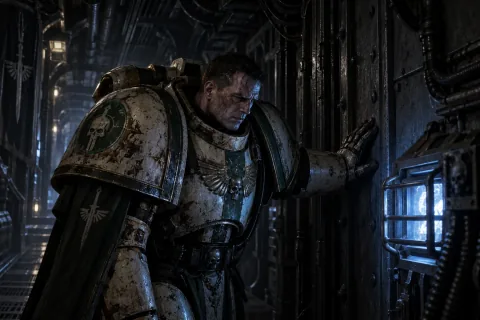
Garro and his people overcome that crisis and succeed in delivering the warning. Official Legion history and subsequent lore record that success as the connection point where the Imperium's response began. However, just because this fact can be stated in one sentence does not mean the voyage was an easy path. Surviving the fleet's attack, maintaining a damaged ship, and returning from outside of reality were all placed within a single mission.
For a survivor of Isstvan, the fact of being alive does not automatically bring peace. There was a responsibility to tell the stories of those who could not return. Here, Garro's oath takes on a different form from the courage of a soldier charging forward. It was the courage to hold onto the betrayal he had witnessed and bring it back to the end. The route leading to the center of the galaxy was not heading toward a new conquest, but to the place where people needed to accept that fact.
One cannot treat every incident within the ship experienced in the Warp and each survivor as a single lump of nameless miracles. This main text connects the broad flow of the warning confirmed by official public materials, and more detailed choices of companions, infiltrations and rescues, and changes in faith will follow in the commentary on characters and the voyage after verifying the materials. I do not fabricate dialogue as if I had read unverified novel scenes.
Chapter 5: An Unbelievable Fact Reaching Rogal Dorn
To Rogal Dorn, Horus was not merely an external enemy. He was the brother the Emperor trusted and the Warmaster who commanded the Imperium's wars. The news that he had betrayed was far greater than a report that a single front had become unfavorable. It meant that the structure of trust the Imperium had built had turned toward war.
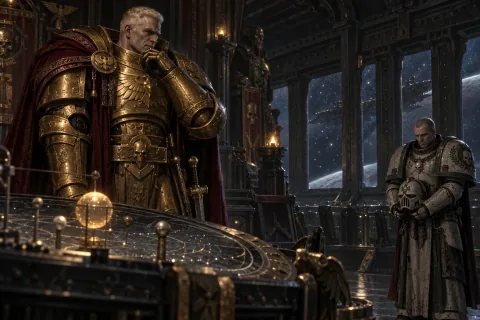
Official Isstvan V history explains that Dorn was initially hesitant to believe the betrayal. If one reads this merely as the reaction of a foolish commander, the weight this warning had to overcome disappears. To judge a brother who had built the victories of the Great Crusade together as an enemy, one had to accept the fact that the order established until now could no longer protect the soldiers. The world of the person hearing the testimony was also collapsing.
However, Dorn demanded an expedition to punish Horus to the loyalists. Several Legions responded to that call, and a retribution fleet headed for the Isstvan system. Garro's warning did not end as a rumor. It triggered the Imperium's actual response and the movement of the Legions. The fact brought by a small frigate now became the reason for a massive fleet to move.
Yet, starting a response did not immediately mean victory. The Imperium knew Horus had betrayed, but it did not simultaneously discover the scope and preparations of all the forces following him. The warning was the beginning of breaking the darkness of ignorance. Behind it, the problems of where to fight, whom to trust, and what the true purpose of the fleet that came under the same Imperial banner was, waited once again.
Chapter 6: The Place Where Horus's First Plan Collapsed
Horus did not want only a long war from the beginning. Without Garro's warning, he could have attempted a surprise attack before Terra properly knew of the betrayal. Official Garro introductions and the history of the Death Guard connect the fact that because of the warning, the Warmaster abandoned that plan and changed to a path of a longer march. The weight of this voyage lies in the fact that it caused that change.
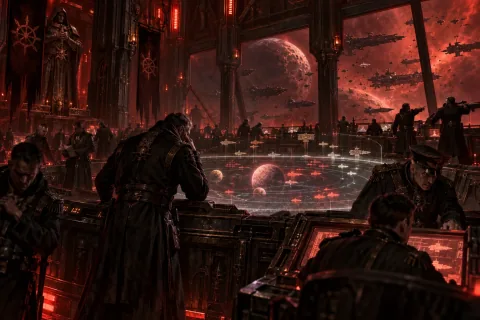
Terra gained time to prepare. That time was not yet safety or peace. It was, however, an opportunity to anticipate an attack that would have otherwise been met while knowing nothing, to set up defenses, and to call other loyalists. The fact that Garro's ship returned did not revive the loyalists who were already dead, but it allowed the living to make their next choices.
Horus did not stop either. The trap he set at Isstvan V was to turn the retribution sent by the Imperium back into a stage for betrayal. Isstvan III was an event that eliminated the loyalists within his own Legion. At V, other Legions that came to punish Horus would also enter into a massive trap. Distinguishing the numbers of the two planets is not merely memorizing place names, but distinguishing the two stages in which the betrayal expanded.
Garro's success and the subsequent tragedy do not contradict each other. Without the warning, the Imperium might have been in an even less prepared state. Even with the warning, not all traps could be blocked. The tragedy of this story does not lie in the fact that someone's sacrifice was worthless. It lies in the fact that the war was so vast and the layers of betrayal so deep that even the opportunity gained by one act of courage had to be defended again.
Chapter 7: The New Master of the Warrior Who Left the Legion
Garro laid down the oaths he had made to the traitorous Death Guard and his Primarch, and entered the path of serving Malcador the Sigillite. His new responsibility, as explained by official lore, was to carry out any mission necessary to protect humanity, no matter how dangerous. It was a different path from the life of waiting for a Primarch's orders in the ranks of a Legion as before.
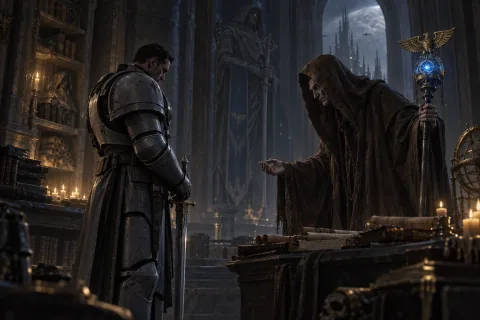
Malcador was the Emperor's long-time advisor and the person in charge of the daily governance of the Imperium. If the victories of the Legions moved the surface of the galaxy, the work he oversaw involved administration, communication, hidden threats, and secret missions. There remain parts of his origin that are unclear even in official records. Rather than unraveling that mystery like an omniscient narrator, it is more accurate to read the confirmed roles and the ambiguously left past separately.
What Malcador needed was not just the numbers of a large Legion. He needed a warrior who did not abandon the Emperor even when his own Legion betrayed, a warrior who did not lose his purpose even when the familiar chain of command collapsed. Garro's voyage showed that he could handle such responsibility. The wound of having lost the name of his Legion is placed alongside the reason for taking on a new mission.
Garro works at the forefront of the Knights-Errant. This is not the name of an organization like the Imperial Knights, who are giant mechanical combatants. It was a path where warriors from different Legions moved with a different oath placed before their previous Legion banners. The grey markings in official descriptions reveal not just a change in color, but that their affiliation and responsibilities had changed.
Chapter 8: Heading into the Galaxy to Find Scattered Loyalty
One of Garro's next missions was to find and gather warriors like himself. The names provided to Malcador by the Luna Wolf Severian connect to the beginning of that recruitment. Betrayal had split the Legions, but within those cracks, there still remained people who wanted to fight for the Emperor. It was necessary to recognize them and connect them under a new purpose.
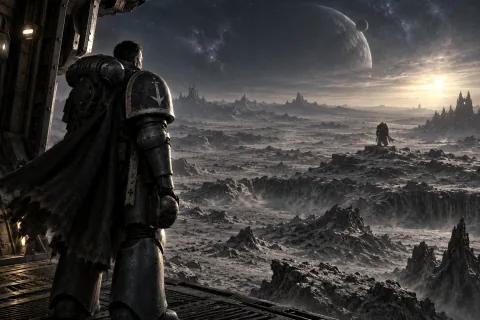
This recruitment was not a procedure of moving entire previous Legions under a new name. Some warriors were under the suspicion of their own comrades, and some had to choose a different kind of loyalty on abandoned battlefields. The people Garro visits are not members of a completed new organization. They were individual figures within the war who had to redefine what they needed to protect.
Official materials introduce Tylos Rubio of the Ultramarines as the first warrior he recruited. Amidst the betrayal at Calth, Rubio had to use psychic powers, which he had decided not to use after the Edict of Nikaea, to protect his comrades. The comrades he saved with that action turned their backs on him. Garro's proposal provided such a warrior with a purpose and a place to fight again.
This event is not a scene from the same time as the moment of escape from Isstvan. The betrayal that occurred at Calth and Rubio's detailed battle continue separately on the side of that war. What is seen here is the responsibility that continued even after Garro's voyage ended. One person who survived delivers a warning, and within the Imperium moving according to that warning, he heads out on a path to find other loyal people.
Chapter 9: Libertas and Hidden Faith
Garro's sword was Libertas. Official equipment introductions convey the legend that a part of a very old relic was used in its origin, but it does not confirm whether that claim is true. The change where a sword that had been directed toward alien enemies during the Great Crusade now had to be directed toward former comrades remains certain. Heavier than the sword's old name was the face of the enemy standing before it.
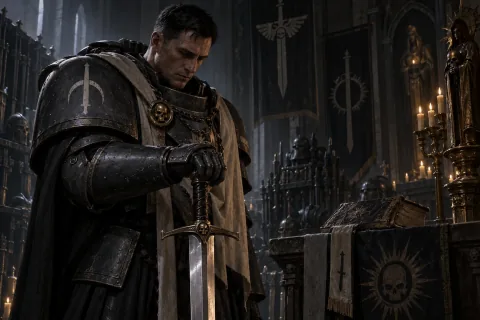
Changes in faith also follow in Garro's life. Official public lore explains that he accepted the words of the Lectitio Divinitatus and harbored the seeds of belief in the Emperor's protection in his heart. This does not mean the Imperium was a completed church that worshipped the Emperor as a god from the beginning. There is conflict and change between the Imperium of the Great Crusade and the religious Imperium that followed, and individual faith also grew within that process.
Loyalty to the Emperor and believing in the Emperor as a god were not the same thing from the beginning. Garro's choice to reject his Legion's betrayal, his choice to accept a mission from Malcador, and his life of harboring faith are related but have their own contexts. If one portrays all of that as a conviction equipped from the start, the changes he went through and the era that followed are erased.
His later story leads to the path of protecting Euphrati Keeler during the Siege of Terra, and his final confrontation with the changed Mortarion. However, I do not preempt the scenes of that conclusion here. The Garro of now has delivered the warning of Isstvan and is now a person who will set out to find hidden loyalties across the galaxy. The fact that his future life is heavy and the statement that the end of that life was already within this scene are different things.
Chapter 10: The Time Left Behind by a Single Ship
The escape of the Eisenstein did not save the Imperium entirely. Horus's rebellion did not end, and another betrayal awaited the Legions that had departed for retribution. However, without that voyage, the Imperium might have met the attack without even knowing what to prepare for. The warning did not eliminate the war, but it left time to face that war.

Tarvitz protected people on the ground, and Garro took their story and the betrayal of Horus into space. Rogal Dorn began his response in the face of an unbelievable warning, and Malcador connected the loyalty that had fallen away from the Legions to another role. The chain leading from the death of Isstvan to the preparations of Terra is not completed by the name of one person alone. Only when the different responsibilities each person took on are connected does the war of the galaxy reveal its form.
Just because Garro went outside the name of his Legion, the years of the Legion he experienced did not vanish. The methods of enduring and protecting comrades remained with him. Only now, that strength was not used for Mortarion's betrayal. The old oath of loyalty to the Emperor returned as a responsibility to face his own genetic father.
The name of the next great battlefield is Isstvan V. The Legions moved by the warning returned for the Emperor will decide there what to believe and to whom to entrust their backs. What the Eisenstein protected was not the conclusion of the war, but the opportunity to face that conclusion. The moment the people who ran with that opportunity stand in the middle of betrayal again, the Horus Heresy spreads beyond the rebellion of one Legion into a wound for the entire galaxy.
Paths of Terms and Figures
Nathaniel Garro: Was a Battle-Captain of the 7th Company of the Death Guard, but rejected the betrayal at Isstvan III and delivered a warning via the Eisenstein. Later acts as one of Malcador's Knights-Errant. A figure who shows the conflict between obedience to a Legion's Primarch and loyalty to the Emperor.
Eisenstein: The frigate that transported the warning. Uses the ship type and mission confirmed by official introductions, and does not assert that specific modern ship classes or exact interior blueprints have been confirmed.
Saul Tarvitz: A Captain of the Emperor's Children who warned and led the loyalists on the planet. Garro's departure and the resistance remaining on the ground are separate roles that are connected to each other.
Rogal Dorn: Primarch of the Imperial Fists. Could not easily accept Horus's betrayal at first, but later calls upon loyalists to prepare for retribution.
Malcador the Sigillite: The Emperor's long-time advisor and Regent. Responds to the war through the Knights-Errant and secret missions. His unclear origins and role in the later Siege of Terra are distinguished from the events at the current point in time.
Knights-Errant: Warriors serving Malcador. They are not identified solely by name with the Imperial Knights, the giant war machines, nor with the entirety of the later Grey Knights. The secret organization and the formation of the later institution are read in stages.
Libertas and Lectitio Divinitatus: The sword of Garro and the text connected to his change in faith. Distinguishes between the legends regarding the origin of the relic and its confirmed use, and between individual faith and the completed state religion.
Isstvan III / Isstvan V: The former is the massacre that eliminated the loyalists within the traitor Legions, and the latter is the stage for the Dropsite Massacre where the loyalists who came to punish them are struck. Garro's warning connects the Imperium's response between these two events.
Reading by Distinguishing Versions of Lore
The official history of Warhammer has also developed over a long publishing process. A 2022 official creator introduction directly mentions the change that in early lore, the person who seized the Eisenstein was a World Eater, not Garro. This installment follows the current official history and novel synopses connected around Garro. I do not combine old-edition characters and current events as if they were companions on the same ship to create new facts. Numerical values of game rules or conditions for using characters are also not transferred into records that determine the victory or defeat of the actual story.
Reading Along with Already Published Series
The resistance of the loyalists remaining on Isstvan III and the betrayal of the four Legions can be read in continuation from Part 18. /en/community/tm-warhammer40000-saga-part018-20261008
The injury on Davin and Horus's choice are connected from Part 17. /en/community/tm-warhammer40000-saga-part017-20261008
The conflict left to the Legions by the Emperor's return and the oath of Nikaea can be read in Part 15. /en/community/tm-warhammer40000-saga-part015-20261008
Official Materials and Scope of Verification
Verification Date: October 8, 2026 (UTC). Written based on the settings and events confirmed in the official public materials below. Public samples and setting introductions were verified only for their respective public scope, and I do not indicate that I have read the entire books. Illustrations are AI reconstructions, not official images.
Flight of the Eisenstein — Games Workshop publisher synopsis, 2014 edition
Legacies of the Age of Darkness — Nathaniel Garro and Tylos Rubio (2024 copyright)
The Horus Heresy — The tragic tale of the Dropsite Massacre
Saturnine lore focus — Who is Malcador the Sigillite?
What makes the Horus Heresy so appealing? Warhammer Community investigates
Nathaniel Garro strikes back against Mortarion in a new Siege of Terra novella
Saul Tarvitz: The First Loyalist
Traitor lore — How the trap was set
Legacies of the Age of Darkness — Rylanor and Nathaniel Garro
comments 1
나타니엘 가로가 아이젠슈타인호를 통해 경고를 전달한 것이 테라의 대응 방식에 구체적으로 어떤 변화를 가져왔나요? 단순히 경고를 전달한 것을 넘어, 이후 보복 함대의 구성이나 로갈 돈의 전략적 판단에 영향을 미친 결정적인 요소가 무엇인지 궁금합니다.