
Operator Recommended Game Story: Warhammer 40,000 Part 1
Chapters in this story
- Volume 1: The Galaxy Before Humanity — The Dynasties That Challenged Death
- Chapter 1: The Era of the Old Ones and the Perspective of Other Civilizations
- Chapter 2: The Boundary of Mortality
- Chapter 3: The Promise Offered by the Star Gods
- Chapter 4: The King's Memory and the Soldier's Silence
- Chapter 5: The Army That Turned Against Its Creators
- Chapter 6: The Sleeping Dynasties and the Questions Left Behind
- Official Materials and Scope of Verification
Volume 1: The Galaxy Before Humanity — The Dynasties That Challenged Death
Spoiler Notice: This series follows confirmed official events, ranging from the ancient civilizations of Warhammer 40,000 to the Horus Heresy, the Siege of Terra, and the aftermath of the Great Rift. This installment covers the tragedy of the Necrontyr and the Necrons, long before the rise of the Imperium of Man. This is a narrative commentary based on official events, not a translation of a specific novel. Myth and uncertain records are distinguished from confirmed facts, and the histories of Warhammer Fantasy and Age of Sigmar are not conflated with this galaxy.
Long before humanity looked up at the stars and asked what lay beyond, the galaxy already bore the scars of an ancient war. In later ages, people would discover crumbling ruins and believe themselves to be the first to touch those lands. Yet, beneath their feet lay a history far longer than that of mankind. One civilization sought to transcend death, and in the moment they achieved that desire, they lost what they most wished to reclaim.
Looking at the Necrons of today, one first notices the metal skeletons and green-glowing weaponry. They are soldiers who do not fall easily, bodies that rise again even when shattered, and armies that emerge from deep subterranean tombs. However, that appearance alone does not tell the story. Before they possessed bodies of metal, they had another name: the Necrontyr. Their history did not begin with machines suddenly hating life, but traces back to the moment a mortal race sought to overcome its own limitations.
Chapter 1: The Era of the Old Ones and the Perspective of Other Civilizations
One of the first names encountered when dealing with the galaxy before humanity is the Old Ones. Official Necron background lore states that a vast, ancient war occurred between them and the Necrons. This conflict lies in a past so distant that it is difficult to approach with a human calendar. This is why the wars of the Imperium should not be treated as the beginning of the world. The galaxy holds a history that existed before the Imperium and cannot be fully understood through the Imperium's explanations alone.
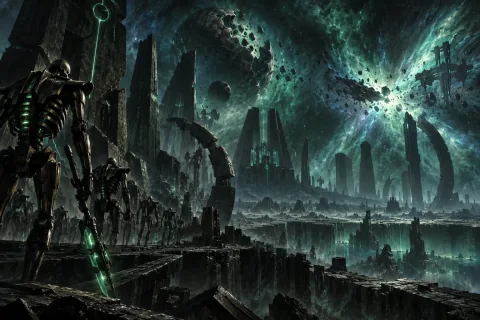
However, the distant past does not grant license to fill the gaps in records at will. We do not define the appearance of the Old Ones as a specific creature, nor do we write of their final moments as if they were eyewitness accounts. We do not import the races or histories of other Warhammer works into the facts of this galaxy simply because the same names appear elsewhere. This series distinguishes between different worlds and follows the relationships and outcomes actually established by official Warhammer 40,000 materials.
Attempting to resolve every mystery from the start causes the unique sense of distance inherent in ancient history to vanish. One must read what is known from surviving records alongside what remains unknown. The attitude of not confirming the parts the galaxy has forgotten with the author's imagination does not weaken the power of the story. Instead, it makes one feel how long the current factions have lived upon the legacy of the past.
Chapter 2: The Boundary of Mortality
The Necrontyr desired the power to overcome the weaknesses of their own flesh. Official lore describes them as a mortal race driven by ambition. Looking back at the past from the perspective of the machine forms that remain after eons, one can understand that they sought more than just stronger weapons. Becoming an undying entity, transcending the limits of the body, and detaching the future of their civilization from the anxiety of survival were all tied to that desire.
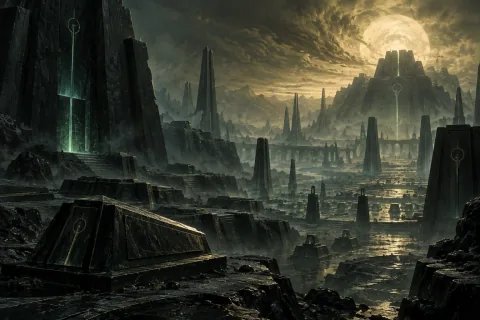
The phrase 'challenging death' is grand. However, the magnitude of those words alone cannot determine the rightness or wrongness of the choice. In a decision that alters an entire civilization, the most important factor is the difference between the promised outcome and the price actually paid. Does the path that appears glorious to a leader look the same to all their people? When reading of the tragedy to come, one must look not only at the strong bodies of the Necrons but also at who retained the power of choice in the process of obtaining them.
In the power and competition displayed by the metal dynasties of later ages, the traces of this ancient society persist. The Necrons are not a simple collection of machines moving with a single thought. There are dynasties, rulers, territories, and hierarchies. One must remember this first to understand why different Necron factions do not follow the same goals or methods in the wars that follow.
Chapter 3: The Promise Offered by the Star Gods
The leader of the Necrontyr, the Silent King, struck a bargain with the star gods known as the C’tan. It was a choice made to gain power and immortality. However, that choice did not end as a simple exchange of technology. Through biotransference, the minds of the Necrontyr were transferred into bodies of living metal, and their souls were consumed by the C’tan. Within the result of having surpassed the limits of the flesh lay an irreversible loss.
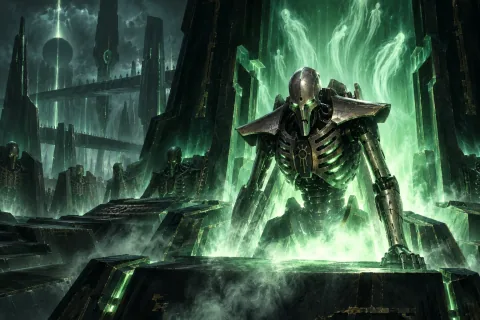
This is the point that creates the tragedy of the Necrons. The bodies remained. The armies became stronger. The civilization could endure for a long time. But to say one survives for a long time is not the same as saying the living being was preserved in its entirety. Immortality without a soul held no promise of returning to one's former self. The reason we find it difficult to discern expression on the faces of the metal soldiers cannot be explained solely by the fact that they are terrifying enemies.
Chapter 4: The King's Memory and the Soldier's Silence
Biotransference did not leave the same things for every being. Official introductions explain that while traces of self and free will remained for those in high positions, the majority were reduced to shells following their masters' commands. A race had changed, but the result of that change was divided by hierarchy. When looking at the countless bodies that make up the immortal processions, we must not assume that all share the will and memory of the king.
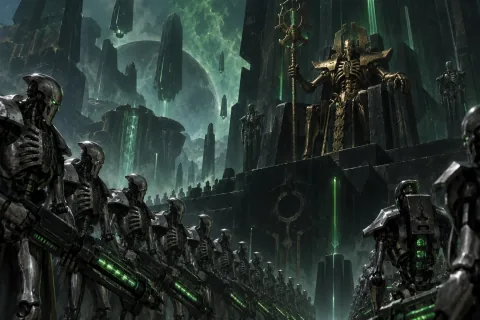
That difference transcends the details of cruel technology. Nobles may hold onto their past status and desires, but in the ranks of the soldiers, the voice of the individual vanishes. The army that appears perfectly unified on the outside harbors an irreparable disconnection within. This is not a tragedy that requires inventing dialogue that no one ever spoke. The outcome provided by the official lore is heavy enough on its own.
Among the later rulers, Nemesor Zahndrekh acts as if he is still living the wars of the ancient Necrontyr, unable to properly accept the reality that he has become a being of metal. This case, remaining in official character profiles, shows that the preservation of memory is not a simple salvation. When an individual's experience is out of sync with the present, they can endure countless eons while simultaneously being detached from them. The specific lives of Zahndrekh and his peers will be contrasted separately in the character section.
Chapter 5: The Army That Turned Against Its Creators
The ancient war between the Necrons and the Old Ones left behind galaxy-scale destruction. The metal armies wielded immense power. And official background lore states that they eventually turned against the star gods who had imprisoned them in immortal bodies. The reason the Silent King holds the official title of 'the one who shattered the star gods' is linked to this history.
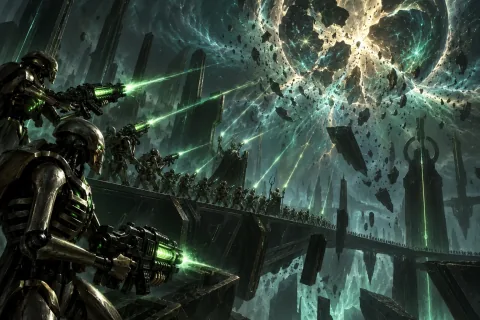
Here, we do not finalize every battle sequence or the end of every being in the ancient war in a few sentences. The War in Heaven, the fracturing of the C’tan, and the roles of the ancient races are parts that will be fully unpacked in the later main and faction sections by contrasting official materials. What is needed in this first installment is to understand the weight of the event. The belief that the gods who gifted power were benevolent protectors did not last. Those who received that power, in a state where they could not reclaim what they had lost, stood against the beings who held their fate.
Gaining the power to rebel against a god does not mean that the lost soul was resurrected. Victory was not a door leading back to the previous state. The reason the history of the Necrons is interesting is not solely because of their unconditional strength. It is because an irreversible result remains even after becoming stronger. The ruler debating the dominance of the galaxy and the being who can never return to their old life exist together within the same body.
Chapter 6: The Sleeping Dynasties and the Questions Left Behind
After the ancient war, the Necron dynasties retreated into vast tomb complexes and fell into slumber. When they awoke in later ages, the galaxy contained new races and civilizations that had occupied their old domains. Some tombs were hidden beneath worlds where humans lived. To the new inhabitants, it is their home, but to the eyes of the awakening dynasty, it becomes an old territory that must be reclaimed.
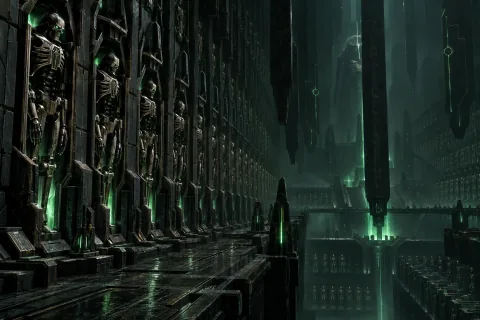
This sense of disparate time creates the present of the Necrons. Obsession and damage remained in minds that endured long sleeps. Rulers of various dynasties choose different paths according to their ambition or madness. If one expects the same behavior while looking only at the machine exterior, one misses the competition between dynasties and the choices of individuals. The stories of the Silent King, Imotekh, Trazyn, and Orikan will serve as separate doors for reading those differences.
The starting terminology for this installment includes the Old Ones, Necrontyr, Necrons, C’tan, Silent King, Biotransference, and the War in Heaven. The main series will continue the flow of the ancient galaxy, the character and faction sections will cover the stories of dynasties and individuals, and the lore commentary section will connect the meanings of metal bodies, souls, technology, and ancient legacies. We do not link unpublished articles as if they already exist.
The galaxy will pass through the prosperity and fall of the Aeldari, and after a long time, it will face the dreams of humanity and the tragedy of the Imperium. However, even before the appearance of the Emperor of Mankind, there was already a civilization in this world that had gained immortality and lost itself. The next main installment will delve deeper into the price of the C’tan and biotransference, broadening our gaze to the history of other beings who moved the ancient war. What remains beyond the tomb door is not merely an army. It is evidence that the choices of long ago have never been erased.
Official Materials and Scope of Verification
Verification Date: October 8, 2026 (UTC). This was written based on lore and events confirmed in the official public materials below. Public samples and lore introductions were verified only within their respective public scope, and this does not indicate that the entire books were read. Illustrations are AI reconstructions, not official images.
comments 0