
Operator Recommended Game Story: Warhammer 40,000 Part 21
Chapters in this story
- The Flames of Prospero · A City Fallen in the Name of Brotherhood
- Chapter 1 · Two Worlds Under the Same Emperor
- Chapter 2 · The Purpose of Bringing Them Back and the Burning Result
- Chapter 3 · A Scale That Cannot Be Hidden by the Name of a Thousand
- Chapter 4 · Golden Armor and Human Footsteps
- Chapter 5 · When a Garden Can No Longer Be a Garden
- Chapter 6 · The Last Guardian of the House That Remembers the Dead
- Chapter 7 · The Power Believed to Be Controlled and the Battlefield Where Control Collapses
- Chapter 8 · Two Brothers Met in the Ruins of the City
- Chapter 9 · When the Remaining Thousand Does Not Mean Everything
- Chapter 10 · The Enforcer Also Could Not Entirely Leave the Battlefield
- Chapter 11 · How to Read Old Records and New Materials Together
- Chapter 12 · The Flames Spread Outside the Pages of the Book
- People Connected to Terms
- Already Published Related Parts
- Official Materials and Confirmation Scope
The Flames of Prospero · A City Fallen in the Name of Brotherhood
Spoiler Notice: This article covers the Horus Heresy's Prospero campaign, the battle between the Space Wolves and the Thousand Sons, the intervention of the Custodians and the Sisters of Silence, the clash between Magnus and Leman Russ, and the subsequent schism. This is a narrative commentary based on public excerpts of official lore and developer introductions. It does not transcribe unpublished novel passages or dialogue. It does not fabricate precise rituals, communications, battle maps of the city, or unverified details.
Table of Contents: Chapter 1 The Longstanding Rift Between Two Legions → Chapter 2 The Path from Censure to Massacre → Chapter 3 The Scale of the Expedition and the Homeworld → Chapter 4 The Emperor's Golden Warriors → Chapter 5 Battle in the Gardens → Chapter 6 The Home Guarded by Dead Brothers → Chapter 7 Silence and the Power of the Mind → Chapter 8 The Clash of Brothers → Chapter 9 The Remaining Thousand and the Scattered → Chapter 10 Wounds Left Even in Victory → Chapter 11 Records Changing with the Era → Chapter 12 The War Left by Burned Knowledge.
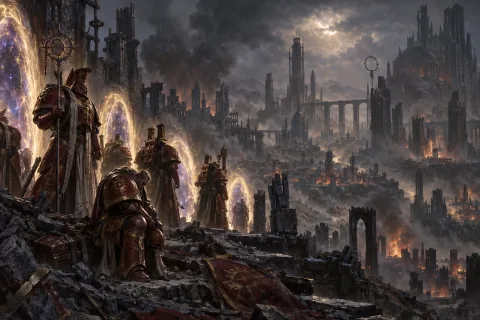
Tizca was a city where massive crystal pyramids looked out over the sea. Snow-capped mountains formed the boundary of the distant sky, and buildings housing ancient learning gathered between them. While some in the Imperium might have thought of this city only as a fortress of the Thousand Sons, the history of Prospero was far older. It was a place where humans who survived catastrophe learned the power of the mind to protect their lives.
Now, the Imperial fleet appeared in that sky. The warriors heading toward the city and the warriors defending it were all brothers who had fought in the name of the Emperor. The attackers carried out their mission in that name, and the defenders lost the home they had built under that same name. The tragedy of Prospero is not a war that began at the boundary between human and alien civilization. It was an event where orders, distrust, and hidden betrayal turned against each other within the same Imperium.
Chapter 1 · Two Worlds Under the Same Emperor
The Space Wolves, the VI Legion, were not a group easily understood by other Legions. Official excerpts from Inferno state that there were many secrets even in their early founding. Warriors drawn from the various harsh and violent cultures of Terra underwent isolated training to become a single military organization. It is not the case that every member was from Fenris from the beginning, nor that the wolf culture of later days was fully formed from the start.
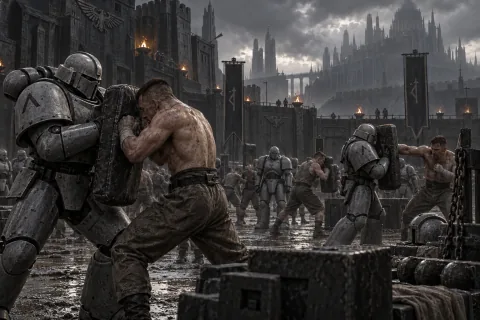
When Leman Russ returned and the Legion united with Fenris, their identity became more distinct. They gained fear through fierce assaults, pursuits, and harsh punishments. The Emperor's court closely controlled their missions, and the Wolves also performed the role of punishing those who broke the Imperium's promises. That role widened the distance between them and other Legions. To some, they were trusted enforcers, but to others, they were a threat that could be unleashed upon them as well.
The authority built by the Thousand Sons, the XV Legion, came from a different direction. Under the tutelage of Magnus, they developed psychic abilities and knowledge. They explored records, artifacts, life, and the mind even outside of the battlefield. However, their complex order and secrets fueled the suspicions of other Legions. There was an old rift between those who thought they knew more and those who knew what they absolutely had to perform.
If one simplifies that difference into a confrontation between rational scholars and ignorant barbarians, one misses both sides. Behind the furs and runes of the Wolves lay a sophisticated combat culture and duty, and behind the scholarship of the Thousand Sons lay the martial power and absolute command of a conquering Legion. Both Legions encountered an outside world that did not fully understand their own. Now, that outside had become the opponent on the battlefield.
Chapter 2 · The Purpose of Bringing Them Back and the Burning Result
In the previous 20th part, Magnus tried to inform the Emperor of Horus's danger. He defied the edict of Nikaea and reached Terra through a projection of his mind, causing a catastrophe for the Webway project beneath the Imperial Palace in the process. The intent of the warning and the actual result were not the same. On Terra, apart from the coming civil war, a front emerged that the Imperial Palace itself had to endure.
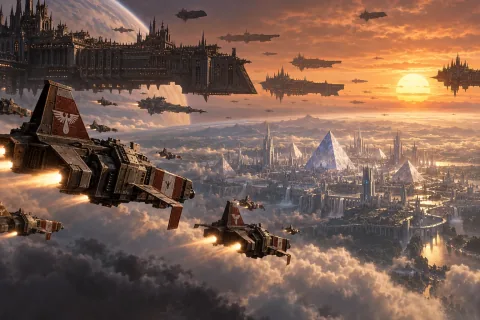
The Emperor's censure was directed at Prospero. Recent official loyalist history introductions clearly distinguish between the mission for Russ to bring Magnus to Terra to answer for his actions and the result where the expeditionary force actually destroyed the homeworld. The Inferno excerpts regarding the Wolves also place Horus's manipulation in the connection that turned the expedition for censure and arrest into a massacre. One cannot combine the two results as if they were the same order from the beginning.
Horus's betrayal was not revealed to everyone at that time. The authority of Warmaster was still a position granted by the Emperor. It was a separate matter for the Wolves to follow that position and for them to know Horus's true intentions. A sudden attack by an unknown enemy was not the only thing needed to twist the purpose of an expedition. Even within the Imperium's most familiar command relationships, the path could be changed.
That does not, however, erase the actual actions of Russ and the expeditionary force due to Horus's intervention. The army that destroyed the city was there, and the brothers who took up arms against each other stood under the same name. Official excerpts state that this expedition nearly wiped out the Thousand Sons and also weakened the Wolves. While the interpretation of the motive that Horus intended to neutralize both Legions together remains a layer of speculation, it is clear that the result left wounds on both sides.
Chapter 3 · A Scale That Cannot Be Hidden by the Name of a Thousand
The Thousand Sons were not a Legion that always consisted of only a thousand men, as their name suggests. Official lore estimates that their strength just before the destruction of Prospero may have been around 80,000 to 85,000. Even this number is not a confirmed attendance roster. While a significant portion was near their homeworld, there were also forces out on separate conquest missions. One cannot calculate the personnel of all eras with a single name.
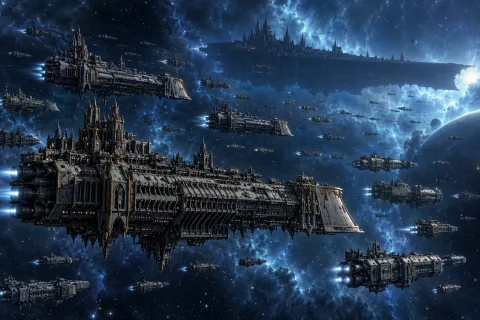
Their fleet had approximately 40 capital ships and more smaller vessels on record, and Magnus's flagship, the Photep, is introduced as a modified Gloriana-class ship. There are records that psychic defenses and weapons were added, but that claim is not a blueprint that has verified every interior part of the ship. This world was not a small, isolated dwelling with only warriors and books. The industry and fleet of a Legion to carry out the Imperium's wars were present together.
The Wolves' expeditionary force was also large. The same public lore estimates that about 75,000 were assigned to the attack on Prospero, explaining that about 20,000 to 25,000 were scattered on other fleets and missions or remained on Fenris. This number allows one to distinguish between the entire Legion and the field forces. One should not create new, precise combat personnel or casualty counts for any single moment by adding up estimates.
Russ's flagship, the Hrafnkel, was a massive Gloriana-class battleship, and the Legion also operated heavily armed ships used for independent long-range missions. The expedition toward the city was a much larger movement than a dispute between a few brothers. The power extending to ship space, logistics, human troops, and armored vehicles was directed toward one world. Where that power descended, there were someone's gardens and archives.
Chapter 4 · Golden Armor and Human Footsteps
It was not only the Wolves who came to Prospero. The Emperor's Custodians and the Sisters of Silence are also linked to this expedition. The developer's introduction of The Judgement of Valdor, released in August 2026, explains that it supplements the destructive operations carried out by the Custodians in Tizca on top of the existing events of Inferno. This is a confirmation of that public introduction, and it does not add detailed operations as if the entire new lore book had been read.
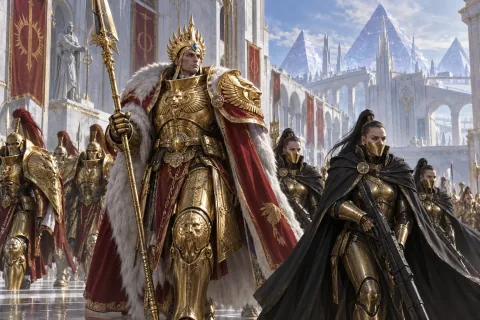
That event was a turning point where the Emperor's Custodians were unleashed against the Legiones Astartes, not just large-scale bloodshed between Legions. The Emperor's golden warriors were not beings who always only faced the same external enemies alongside the sons. The fact that their power could operate even within the Imperium was revealed on the battlefield of the city.
Constantin Valdor was the figure who commanded the Emperor's guardians. If one portrays his role only as a massive bodyguard standing next to the throne, the weight of this expedition is diminished. The Custodians connected to him were a military force that actively executed orders. However, I do not create dialogue for this article such as communication phrasing or precise conversations with Russ that have not been confirmed by public materials.
Beside them were also humans of smaller stature. The Sisters of Silence were women who hindered the power of the Warp due to their nature as psychic blanks. They are neither Astartes with the physique of the Emperor's superhuman warriors nor emotionless machines. The official character introduction of Jenetia Krole conveys her activities on Prospero and in the Webway together. In an expedition toward a city with great psychic power, their presence influenced the very conditions of the battle.
Chapter 5 · When a Garden Can No Longer Be a Garden
If one follows the small character introductions in official records, the places where massive events actually passed are revealed. Hruga, belonging to the 8th Great Company of the Wolves, faced human troops in the Palatinate Mansions district early in the battle. These were not just defenders in the same condition as the lightly equipped Spireguard. Within the walls of the mansions were Imperial Army troops equipped with the full armored vehicles and artillery of the Great Crusade.
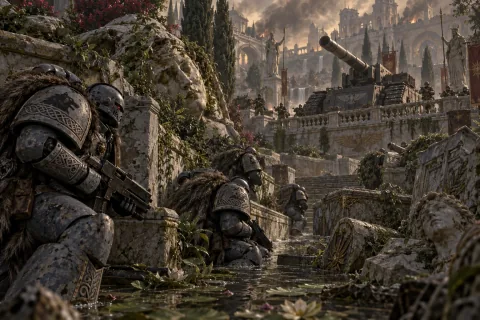
The mission assigned to Hruga and his comrades was to neutralize the self-propelled guns and tanks. However, the 8th Great Company lacked the heavy weapon support to easily resolve that mission. Even if they were superhumans, they do not erase the enemy's armor with will alone. In the place where the professionalism of the troops and the limitations of equipment met, they had to find another way.
The decorative fences, culverts, and garden waterways of the mansions became that path. Official character records state that they used this terrain to approach enemy positions and used melta bombs and improvised explosives. The Medusa self-propelled guns and the Leman Russ tanks, which shared the name of the attacking Primarch, were the targets. The city's spaces, created for beauty, became approach routes and cover for war.
His Mark IV armor had detection devices useful for reconnaissance and skirmish missions, and local modifications were made with sturdier Mark III shoulder guards and inscribed knot patterns. Records estimate those patterns as talismans with the meaning of protection, but it does not prove that it was magic that actually blocked every attack. The equipment worn by one warrior overlapped with factory production, battlefield repairs, and the culture of his homeworld.
What this small record conveys is not a story that the Wolves simply brought down the entire city with a single roar. They had to pass through buildings and waterways while facing the military equipment of another part of the Imperium. The battle of Prospero had places where human defense forces and superhuman assault forces faced each other under different conditions, not just a confrontation between Legions. To the people there, the tanks and weapons before their eyes reached them sooner than the words of brothers from the sky.
Chapter 6 · The Last Guardian of the House That Remembers the Dead
On the western edge of Tizca's central district was the House of the Jackal. It was a massive space of funerals and remembrance that guarded the memories of the dead. The Jackal Order of the Thousand Sons was responsible for both the past of the warriors and the next generation. They preserved genes, examined new applicants, and judged whether a warrior who had suffered heavy wounds was worthy of being accepted into a Dreadnought.
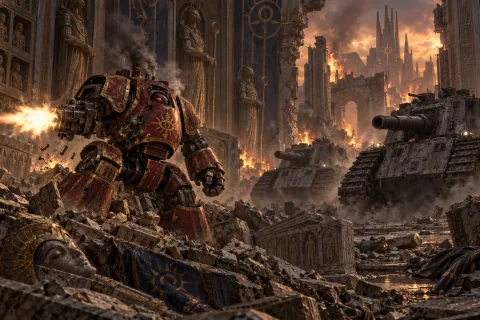
Hedara Ptomalac was one of the nine Dreadnoughts who slept while guarding that house. He was of the first generation of Thousand Sons accepted on Prospero and left a record of merit by commanding a heavy weapons squad in the relief battle of Keene's Landing. Later, after being heavily wounded in the last stand of Rakotis, he was interred in one of the first Contemptor Dreadnoughts to enter the Legion. His memory continued within the war machine, beyond the limitations of a living body.
When the exterior structure of the house collapsed due to the Wolves' bombardment, Ptomalac and the surviving brothers emerged from the rubble and counterattacked. What they headed toward were the enemy's heavy armored vehicles. Records state that Ptomalac destroyed two Typhon siege tanks before he was destroyed. What is confirmed is that battle record and the flow of the last stand. I do not insert his final thoughts or dialogue at the moment of his collapse into the gaps of the record.
However, even from those facts alone, one can see what was lost. In the place where warriors remembered their dead brothers, a brother who had endured battles long ago awoke again to guard the house and then vanished. The machine made to fight one more time guarded, for the last time, not a future conquest, but the space where the dead of his own Legion resided. The destruction of Tizca was not just a matter of reducing the number of buildings. It collapsed together what could be remembered and passed on to the next generation.
The attacking force also deployed Dreadnoughts. Har Skrinn of the Wolves was an ancient warrior of the 13th Great Company, belonging to the type of war machine awakened when extreme destruction was needed. He was destroyed while facing a Canis Vertex Titan on Prospero. It is not a story where one Legion's machines were immortal and the other's were helpless sacrifices. The ancient warriors of both sides vanished before the scale of the war.
Chapter 7 · The Power Believed to Be Controlled and the Battlefield Where Control Collapses
The Thousand Sons were not just a gathering of wizards who could not shoot guns. Official public lore explains that they operated the various firepower and mobile equipment of the Legiones Astartes. In addition to heavy weapons, reconnaissance, tanks, and aerial equipment, there was psychic power. That power was not a single secret spell that replaced normal military operations, but permeated the various activities of the Legion.
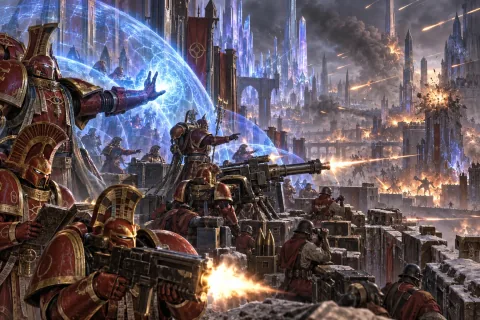
Warriors of the five cults saw the battlefield in different ways. The powers of flesh, telekinesis, the possibilities of time, thought, and fire are not the same role. However, even that sophisticated system could not guarantee the same safety as before if the external conditions changed. On a battlefield where the empty presence of the Sisters of Silence and the martial power of the Custodians entered, there was no guarantee that the power that was usually advantageous would operate in the same way.
When understanding the flow that the existence of Chaos and the Warp intervened in this event, one must separate the knowledge of the people at the time from the classifications of later generations. The developer's daemon lore explanation from August 2026 states that unclear shapes and more distinct shapes existed together during the Heresy. In that introduction, the name of Tzeentch's daemons is explained as a classification applied in reverse by those of later generations who store dangerous knowledge. One should not assume that all Imperial forces on the battlefield knew the same terminology table as today's readers.
Therefore, one cannot place every daemon unit and new human unit found in the latest game rules at specific crossroads of this battle. That the rules allow for the construction of an army is different from which unit killed whom in a certain event. This article follows the city through confirmed battle records, and the problem of changing shapes and names is left as background for reading the era. In a story where the certainty of knowing everything becomes dangerous, the article itself does not add unverified certainty.
Chapter 8 · Two Brothers Met in the Ruins of the City
The war between the two Legions surrounding the city is also linked to the clash of the Primarchs. The event where Leman Russ and Magnus faced each other on Prospero is also specified in the official developer's model production explanation. The models of the two figures were designed to form the same scene, and the composition of Russ's charge and Magnus's stone and arcane flames clashing is explained. This confirmation is the basis that the confrontation of the brothers took place, not a record that replaces every attack sequence of the entire novel.
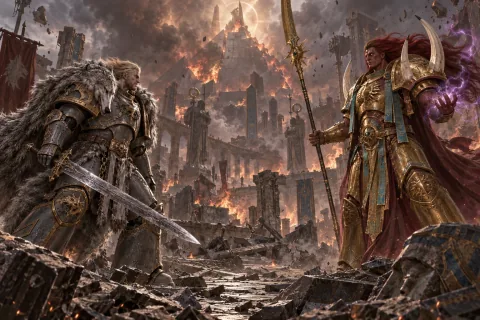
Russ's gray armor had the runes of Fenris and the symbols of the wolf. His appearance, wearing blonde hair and furs, contained the power of a superhuman warrior that could not be explained by his primitive exterior alone. Magnus, on the other side, was not yet the winged Daemon Primarch. He was a massive Primarch of the human era with red hair, one eye, and golden armor. If one puts the later appearance on the body of this time, one loses the meaning of corruption and change.
This confrontation is heavier than a spectacle comparing the power of the body and the power of the mind. While the two fought, the Legion and the homeworld were already in the midst of war. The son who tried to reach the Emperor and the son who came to execute the Emperor's orders became threats to each other within the Imperium of the same father. Horus used their differences, and the result spread outside the bodies of the two brothers.
This article does not fill in the sequence of sword strikes, the final spells and exact words of contracts, or specific moments of injury with new dialogue and scenes that have not been confirmed. The clear, large flow leading to official introductions is that Magnus escapes amidst the destruction of the expedition, and the remaining Thousand Sons vanish into the Warp to return later. The possibility of defending the Prospero homeworld collapsed. What remained was the question of where to go and how to survive.
Chapter 9 · When the Remaining Thousand Does Not Mean Everything
The record of the public Inferno estimates the Thousand Sons who survived the planetary attack to be as low as about a thousand. The number in the Legion's name appears again, but one should not change that number into an accurate final survivor list for all situations. There were those who were out on missions outside before the attack, and there were those who could not return to their homeworld due to the uncertainty of communication and Warp travel.
Some of them were tracked down later, and some vanished without leaving a trace. The fact that Imperial records did not know the location of a certain fleet does not lead to the conclusion that every warrior within it died immediately that day. The destruction of the Legion was real, but it did not simultaneously determine the fate of every individual scattered across the galaxy.
In the developer's Thousand Sons introduction, there are figures like Revuel Arvida who remained loyal to the Imperium even after the Legion's stigma. Just because a Legion gained the name of traitor in later generations does not mean that every member made the same choice from the beginning. The event of losing their homeworld and the process of every individual who chose Chaos are connected, but they are not the exact same list.
The remaining Legion vanished into the Warp and reappeared on the side of the traitors during the war of the Heresy. The recorder of the old lore leaves the question that they do not fully know where they went and what they experienced. I do not adopt that question as a confirmed fact that there were no living warriors and only ghosts of vengeance returned. I leave the rhetoric of the records and the layers of rumors, and continue reading the confirmed reappearance and the subsequent war.
Chapter 10 · The Enforcer Also Could Not Entirely Leave the Battlefield
Prospero collapsed, but the Wolves did not achieve a victory without loss. Official excerpts record their weakening along with the destruction of the Thousand Sons. The hostility of the two Legions did not end as a misunderstanding that easily vanished in the subsequent war. The dead comrades and the collapsed homeworld became reasons to look at each other.
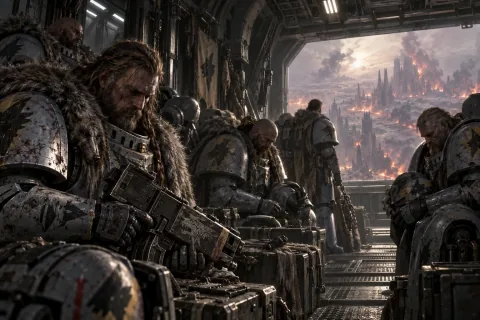
Russ and the Wolves, who learned of Horus's betrayal, swore to track down the Warmaster and his allies. However, the fact that they come to know how their expedition was used does not turn back the already burned city. Knowing the identity of the enemy anew and the result of the past vanishing are different things. The Wolves' war continued, carrying that realization and the wounds together.
The subsequent Alaxxes Nebula, Vanaheim, Daverant Reach, and Yarant are names of other battlefields. Official records link these to the subsequent war where the Wolves face the traitor Legions. Here, I do not yet bundle every detail of each battle into scenes of the same day. The Legion that left Prospero enters a wider civil war, and the figures and each battlefield of that process remain as separate, continuing stories.
The Thousand Sons who vanished toward the Warp were also not a finished existence. The relationship between their knowledge, survival, vengeance, and new power reappears later following Magnus and Ahriman. The flames could not erase the Legion from history. Instead, it changed the reason for that Legion to return. The Imperium should see what kind of hostility this event created, rather than thinking it had surely eliminated one enemy.
Chapter 11 · How to Read Old Records and New Materials Together
The details of the major battles actually confirmed in this part are based on official public excerpts of Inferno and developer history introductions. The printing copyright notice of the public PDF is 2016, and the time when the free excerpts are currently provided and the time of the original lore book's publication are not the same. I do not indicate that I have read the entire book or every chapter of the two official novels just because I have read the excerpts.
The developer's introduction of 2026 supplements the fact that there are materials to examine the Custodians' Tizca operation by adding it to existing events, and how the names and shapes of daemons were understood at the time of the Heresy. The scope that can be confirmed in public explanations is the scope of those explanations. I do not transcribe the new organization and point rules of the tabletop game into the battle results of the actual troops at the time. Just because different materials look at the same event does not mean their perspectives are all the same.
Official introductions of the Wolves and the Thousand Sons also have jokes mocking each other and the perspectives of the factions. If one turns such sentences into objective verdicts literally, one makes contradictory evaluations into facts. Keeping confirmed events such as the purpose of arrest, Horus's intervention, the destruction of the city, and the movement of the remaining Legion at the center, I left the recorder's tone and insufficient information in those layers.
Detailed lore should be a passage that goes deeper rather than a barrier that blocks the story. The organization and runes of the Legion, the cults and Dreadnoughts, the language of the Sisters of Silence, and the Emperor's command system are backgrounds to be examined further. What the small battles of this part show is that they were not just decorations. The way of protecting organization, equipment, and memory is actually connected to who fights how and what is lost.
Chapter 12 · The Flames Spread Outside the Pages of the Book
The destruction of Prospero cannot be closed with a single line about which of the two brothers is stronger. There was a house guarding the merits of warriors and the memories of the dead, and there was a city of humans who learned the power of the mind to survive. The Legion that attacked it also had people who performed ancient duties while changing armor from factories into their own culture. It is not a story that everyone made the same mistake, nor that everyone fought for the same reason.
Horus turned that difference and distrust toward the inside of the Imperium. In the place where Magnus's warning could not prevent catastrophe, Russ's expedition created another catastrophe. One side lost its homeworld and vanished into the Warp, and the other side headed to the next battlefield with weakened troops and new hostility. The Warmaster in the distance was able to use that result for his own war.
The flames of Tizca did not end with burning books. What people were trying to protect, whose orders they trusted, and at what moment the purpose and result diverged remained in those ashes. The hostility of the next era grows carrying those traces. Therefore, reading the end of this city is not looking at a defeat that has already ended, but seeing the roots of a civil war that is still growing.
People Connected to Terms
Tizca: The central city of Prospero's learning and the Legion. The environment between crystal pyramids and the sea/snowy mountains is introduced in public lore. The illustration in this part reconstructed that atmosphere and is not a confirmed battle map.
Prosperine Censure Host: The expeditionary force that headed to Prospero to censure Magnus's actions. Read by distinguishing the purpose of arrest and the destructive result behind Horus's intervention.
Leman Russ: The Primarch of the Space Wolves. The official model of this era shows blonde hair, wolf furs, decorated Mark IV armor, and a sword. It does not mean he is the same person as the tank of the same name.
Magnus the Red: The Primarch of the Thousand Sons. The image in this part referred to the red hair, one eye, and golden armor of his human period, which is distinct from his later winged Daemon appearance.
Constantin Valdor and Jenetia Krole: Major command figures of the Custodians and the Sisters of Silence. The city illustration in this part is a reconstruction of unnamed participating forces and does not claim their exact field locations.
Palatinate Mansions and Hruga: The place and figure where an 8th Great Company warrior faced Imperial Army troops equipped with armored vehicles and artillery. Garden waterways, culverts, and fences became approach routes for the battle.
House of the Jackal and Hedara Ptomalac: A memorial space and its guardian Dreadnought. Official excerpts connect past military service, internment in a machine, and the final counterattack on Prospero.
Har Skrinn and Canis Vertex: A Dreadnought of the Wolves and the Titan he was destroyed while facing. I do not indicate that I have confirmed every pilot or battle sequence of the Titan.
Revuel Arvida: A Thousand Sons warrior who appears in official introductions as an example of one who remained loyal to the Imperium even after the Legion's exile and stigma. The Legion's later affiliation does not explain the choices of every individual.
Gloriana-class and Photep/Hrafnkel: The lineage of massive warships and the flagships of the two Legions. Read the personnel and fleet numbers of public records as estimates by time period and do not mix the numbers of different fields and eras.
Already Published Related Parts
Nikaea and the ban on psychic power within the Legions are connected in Part 15. /en/community/tm-warhammer40000-saga-part015-20261008
The event where Horus eliminated the loyalists of his own Legion on Isstvan III can be read in Part 18. I do not determine the exact chronology of the Prospero expedition and every moment solely by the post number. /en/community/tm-warhammer40000-saga-part018-20261008
Magnus's warning and the Webway catastrophe beneath the Imperial Palace continue in Part 20. /en/community/tm-warhammer40000-saga-part020-20261008
Official Materials and Confirmation Scope
Confirmation Date: October 8, 2026 (UTC). Written based on lore and events confirmed in the official public materials below. I have only confirmed the scope of the public samples and lore introductions, and I do not indicate that I have read the entire books. The illustrations are AI reconstructions, not official images.
Designer’s notes — Creating the Judgement of Valdor
Designer’s notes — Tzeentch Daemons in the Age of Darkness
We Asked Forge World How They Designed All 18 Primarchs — Russ and Magnus sections
Pages from the Black Books - The Space Wolves
Pages from the Black Books - The Thousand Sons
Legions of the Horus Heresy — The Thousand Sons Know More Than You
Legions of the Horus Heresy — The Space Wolves are the Best Boys, Yes They Are
comments 1
프로스페로의 비극은 정말 읽을 때마다 마음이 아프네요. 특히 정원과 도서관이 전장이 되어버린 묘사가 인상적입니다. 늑대와 마법사들의 대결이 왜 이렇게까지 어긋나야 했는지 다시 생각하게 되네요. 🐺✨