
Recommended Game Story · Cyberpunk 2077 Part 5
Chapters in this story
Spoiler Alert: This is a commentary series covering major events, companion stories, branches, and endings of the main game and Phantom Liberty. Each ending is the result of different choices and does not all happen at once. I do not transcribe original dialogue or reenact every scene. Unstated inner thoughts are distinguished as interpretations. AI illustrations are symbolic reconstructions, and V's appearance, gender, and relationships vary depending on the playthrough.
Chapter 1 · Seeing the past does not mean knowing the whole truth
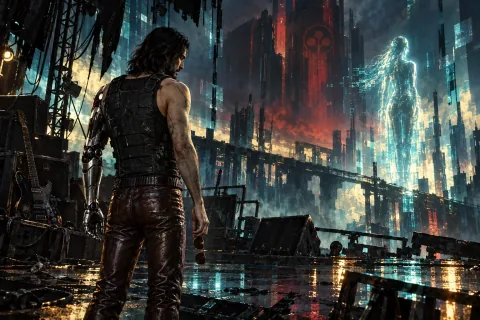
V encounters the Arasaka of the past and Alt Cunningham through Johnny's memories. Johnny is the face of the rock band Samurai and a figure who resisted the corporation. However, the screen showing his memories does not mean it is an objective historical record. The conversation with Alt particularly reveals this limitation. There is a gap between the way Johnny centers himself and the events as understood by other beings.
Understanding this device allows one to read Johnny's arrogance and wounds together. While remembering those he could not protect, he risks possessing their stories as part of his own guilt. Feeling sorry does not mean one accurately understands the other person. This is why it is necessary to accept Johnny as a charming rebel while not taking his perspective as absolute fact.
Alt is a character who connects Soulkiller with the issue of digitizing the human spirit. The entity encountered beyond the Blackwall later cannot be treated in the exact same way as Johnny's past lover. The side with memories of the relationship wants to believe that the relationship remains intact. However, the other party may have already moved to a different mode of existence. This gap most coldly shows that the world has continued to change even after Johnny died.
A more difficult problem arises for the player. As V comes to understand Johnny, it becomes easy to be emotionally persuaded by his memories. Empathy is a starting point for valuing others' experiences, but it does not replace fact-checking. The fun of reading the past scenes in this work does not end with knowing what happened. It makes one ask why the person showing those scenes places themselves in such a position.
Chapter 2 · Faith in the corporation and debt to people
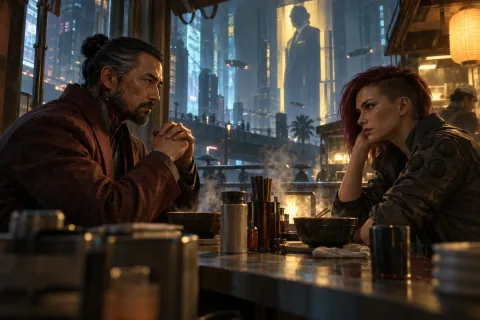
Goro Takemura is a figure pushed out of the center of power after Saburo's death. He is involved in saving V and needs them as a witness to uncover Yorinobu's crime. This relationship involves both actual help and instrumental necessity. The fact that there is something to be grateful for does not mean one must accept his political goals. Conversely, one cannot dismiss every human attitude he shows as a lie just because he is loyal to the corporation.
For Takemura, Arasaka is more than a giant company. It is a system that gave him a place, order, and meaning. This is why the corporate violence V sees on the streets clashes with the memories of salvation Takemura speaks of. Regarding the same organization, one person recalls oppression, while the other recalls the path that allowed them to live. Understanding this difference makes Takemura's loyalty more complex than simple brainwashing. At the same time, the harm that system caused to others remains.
During the times the two share food or observe the city, an intimacy that transcends calculation brushes by. The affection the player feels here is intentionally tricky. This is because someone whose good side you have discovered might offer you a bad contract. If you cannot distinguish between personal trust and trust in an institution, you will face the same confusion even when accepting offers of help later on.
Johnny and Takemura are superficially on opposite sides. One tries to bring down Arasaka, while the other tries to restore its internal legitimacy. However, both suggest that V help them solve their unfinished tasks. No matter how much V empathizes with each, they have no obligation to surrender the purpose of their own life. Remembering this when meeting the next characters makes it clear that this is not a world where companions and clients are always clearly distinguished.
Data and Writing Guide
This is an original commentary and critique written by the TroubleMaker operations team, referencing public data and with the help of AI. Official introductions and visual materials are from the developer, and the separately marked walkthroughs are community data comparing events and branches. This is not a full reproduction of all dialogue, quests, or choices, and the content distinguished as interpretation in the text is not a definitive explanation of official lore.
Data verification date: 2026-10-17.
CD PROJEKT RED official work introduction
comments 0