
Recommended Game Story: Cyberpunk 2077 Part 4
Chapters in this story
Spoiler Warning: This is a commentary series covering major events, companion stories, branching paths, and endings of the main game and Phantom Liberty. Each ending is the result of different choices and does not all happen at once. This does not transcribe original dialogue or reenact every scene. Unstated inner thoughts are distinguished as interpretation. AI illustrations are symbolic reconstructions; V's appearance, gender, and relationships vary depending on the playthrough.
Chapter 1: Who Did the Relic Save?
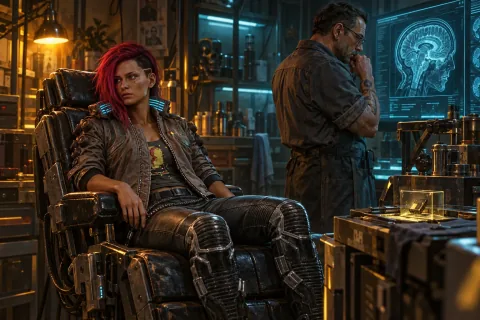
After the operation, Dex does not protect V. V is left for dead due to his betrayal and later returns to Viktor through Takemura's intervention. If you look only at the fact that V survived, it is a miracle. However, the Relic that made that recovery possible begins to alter V's nervous system to match Johnny Silverhand's personality data. The process of surviving and the process of losing oneself are happening within the same device.
An engram refers to an entity that implements a personality as digital information. This work does not conclude that it is exactly the same as a soul. Johnny appears as a voice with memories, attitudes, and desires, but what continuity that voice has with the original human remains a philosophical question. A more urgent problem for V is not an abstract definition. It is the fact that a stranger whom only they can hear and see threatens the autonomy of their own body.
The condition Viktor describes is different from the empowerment that starts a long adventure. V loses the certainty that they can continue their established daily life. However, there is no need to confuse the limited prognosis mentioned in the story with a strict countdown of actual playtime. The game leaves space for exploration and side missions. Thanks to that margin, players think about who they want to spend time with if they have any left, even while doing things to survive.
In this situation, V's reactions of getting angry at others or urgently demanding help can be expressed in many ways. It is not fixed that every V goes through the same psychological process. However, if the stability of the body and the belief in time collapse at the same time, it is understandable that it is difficult to act like one's usual self. A perspective is needed that does not treat illness and fear only as weaknesses that a strong protagonist must overcome.
Chapter 2: Can You Call the Enemy in Your Head a Companion?

Johnny does not start as a kind guide. He is hostile, abrasive, and prioritizes his anger toward Arasaka over V's circumstances. V develops a fear that their home and body are no longer personal spaces. Johnny also experiences a disconnection from the world after his death and being trapped in another person's body. The two are placed close together in an inseparable way without immediately understanding each other's pain.
If you explain this relationship only as a process of becoming friends, the violence is erased. Even if Johnny's words are witty and charming, the moments where V's consent is omitted must remain uncomfortable. If trust is built later, the core lies not in Johnny's eloquence, but in acknowledging that the other person is a separate individual. V can also view Johnny as someone to talk to rather than someone to chase away, but that change takes on different textures through player choices.
The convergence of the two people's memories and emotions means empathy and extinction at the same time. If you come to understand someone deeply but the process breaks down your own boundaries, can you call that a good change? The game does not easily cover up this problem by creating a common enemy. The fact that they dislike Arasaka and the fact that V must live sometimes overlap, but they are not the same until the end.
The path forward splits in the direction of finding the person who made the Relic, the person who wanted the chip, and the person who knows the inside of the corporation. Which path to investigate first can vary. While following the memories of various characters, V re-asks not only about the cure but also about the meaning of survival. Is the heart just beating, can I make my own decisions, and does the me who made a promise to someone still remain? Every time Johnny appears in the mirror, these questions return together.
Data and Writing Guide
This is an original commentary and critique written by the TroubleMaker operations team, referencing public data and with the help of AI. Official introductions and visual materials are from the developer, and the separately marked walkthroughs are community data comparing events and branches. This is not a full reproduction of all dialogue, quests, or choices, and the content distinguished as interpretation in the text is not a definitive explanation of official lore.
Data verification date: 2026-10-17.
CD PROJEKT RED official work introduction
comments 0