
NieR Chronicles 32 — Ending E, Pods Preserving Memory and Help from Strangers
Chapters in this story
- Ending E, the Pods That Refuse to Erase Lives and Help from Strangers
- 1. The final order: erase everything
- 2. A small target becomes the last protagonist
- 3. Words from someone with no connection to you
- 4. Passing through the credits together
- 5. After receiving help, whom will you help next?
- 6. Pods gather parts, three bodies may begin again
- 7. Where the game stops and other works continue
- 8. From the empty memory at the beginning to preservation at the end
- Sources and verification scope
Ending E, the Pods That Refuse to Erase Lives and Help from Strangers
Spoiler notice: This installment covers all of Ending E after C and D, the credits battle, assistance from other players, and the optional donation of save data. It distinguishes the game's final scenes from the later stories told in performances, novels, and the anime. Song lyrics are not reproduced.
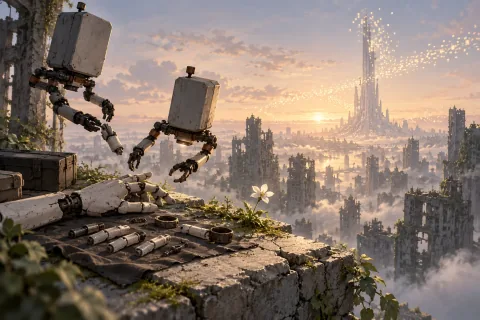
1. The final order: erase everything
The Pods remain even after the final endings. They have a procedure for closing the YoRHa project: organize and delete the data the soldiers left during their operations, together with information about their bodies. If the combatants die and their records disappear too, the traces connecting the belief that humans remain on the Moon to the truth about YoRHa will no longer remain in the same form.
Pod 153 intends to proceed according to that procedure. Until now, the Pods have analyzed the soldiers' conditions and offered judgments useful for their missions and survival. From the perspective of support units carrying out orders, deletion is simply the last stage of their assigned work. Yet those records contain more than weapon specifications and enemy counts. They also hold the time spent with the people they accompanied.
When personal data leaks through during deletion and noise is detected in the flow, the Pods briefly stop to investigate. If the player accepts that request to check, the records of 2B, 9S, and A2 become an issue once more. Pod 042 cannot accept their deletion. It supported 2B, received her final instructions and traveled with A2, and was involved in the path by which 9S could be saved. It questions whether their lives should end with the single act of erasing a record. A unit that analyzed soldiers forbidden to express emotion must now confront emotion and choice for itself.
Pod 153 warns that they lack the authority to act in this way and that trying to rescue records guarded by subordinate systems could erase their own consciousnesses as well. If the choice to wish for survival is made despite that danger, Pod 153 joins the question too. If it is possible to preserve the three individuals' remaining data and give them a chance to live again, it wants to try. They do not reject their orders only after receiving a guarantee of what success will produce. Even if they fail, or the same tragedy occurs again, the decision not to complete the prescribed deletion comes first.
2. A small target becomes the last protagonist
The game shifts its viewpoint to the credits. Names that would normally scroll past as a sign that the story is over become a barrier to fight through. The player moves a small craft, dodges barrages, and attacks obstacles on the screen. There is no soldier's sword or large body. The shooting format seen during the opening descent returns as another final action.
This battle does not harm the actual developers or attack systems outside the game. It represents resistance to a predetermined end and the procedure that erases data through names and projectiles inside the game. The preservation the Pods attempt is not instantly approved and completed through dialogue alone. The player must also move and overcome the barrier.
At first, familiar shooting and evasion can keep the craft alive. As the battle continues, however, attacks fill the screen more densely, and situations in which a single mistake demands another attempt repeat. Reading and passing each name overlaps with the act of trying to survive. A story the player thought had ended makes room for more failure and more time spent moving again.
The game asks a player who has failed whether to continue. It is a point where one could accept the judgment that the struggle seems difficult and meaningless, and stop. This is not an exact reproduction of 9S's loss of purpose or the suffering Pascal could not endure. It does, however, bring the decision of whether to try once more, without knowing what reward is guaranteed ahead, into the player's present actions.
3. Words from someone with no connection to you
During repeated attempts, encouragement left by other players appears. Names and short messages from people in different countries and languages arrive one by one. These are not only the voices of soldiers inside the game who have formed direct relationships with its characters. A brief expression of care left by someone who fought the same battle somewhere else reaches the current screen. That person may not know who the present player is, what language they think in, or which scene in the game they love most.
Help comes anyway. When network assistance is available, the player can accept support from others and continue the battle. Several craft fire together and protect the surrounding space, creating conditions in which it is easier to endure than when alone. The barrage is the same, but other presences now exist outside the small body under the player's control.
Supporters' names appear, and the game also represents that support being consumed in danger. Behind this action is time when someone who had already crossed the barrier chose to help another person. These are not partners the current player first paid or contracted with by offering terms of exchange. A choice left for someone the donor does not personally know arrives as a function of the game.
The three characters the Pods are trying to save are connected to the result of this help as well. 2B, 9S, and A2 do not objectively prove through a score that they deserve to live, eliminate every risk, and only then receive assistance. Players who have witnessed their failures, their mistakes, and the time they spent hurting one another still want to create another possibility. The wish not to end someone's life after coming to know it overlaps inside and outside the story.
4. Passing through the credits together
With support, the impression made by both the music and the screen changes. Voices overlap, and movement that once held out alone with little firepower becomes an attack made together. Without reproducing the exact lyrics through which the song expresses that feeling, it is possible to follow the experience of solitary time being transformed by the presence of other people.
This should not be described as a rule that accepting help is the only way a player can see E. Other players' assistance is an enormous help in clearing the battle and makes its central idea tangible, but completing the preservation attempt and being required to accept assistance are not the same condition. What the scene expresses can be distinguished from the choices involved in playing it.
Once the barrier is finally crossed, a path to preserving and recovering the data opens. The small victory on screen is more than a record of a bonus battle. The Pods' choice to keep the memories of people who would have been erased under the original procedure produces a real result. Help from other beings and the player's actions intervene in a system that has already decided the end.
In Replicant's final branches, the protagonist gave up his existence and memories to save someone, while another branch tried to reach that vanished existence again. Automata's ending likewise refuses to leave saving and memory as abstract lore outside the act of playing. It connects decisions about what to lose and what to keep to actual save data and time spent in play. The choices and progression conditions required by the two games are nevertheless different.
5. After receiving help, whom will you help next?
After seeing Ending E, the player is offered the option of giving up their own data to help someone else. The game asks whether they can relinquish their progress, collections, upgrades, and the traces of many hours. The more time invested in gaining levels and weapons, the heavier that choice may feel compared with a small kindness expressed only in words.
The donation is not a mandatory price for seeing Ending E. The player can also choose to keep their data after watching the ending. Refusing to surrender the saves does not undo the result of saving the three characters or turn the E already witnessed into a false ending. While giving meaning to the act of helping, the game still leaves room for the present player to choose what they wish to preserve.
Choosing to donate leads through several confirmations before all of the player's save data for the game is deleted. It is not presented as giving up only one slot's record of the last battle. This is a choice about the player's own records as explained by the game, not a function that changes other platforms or someone else's account. The question at its center is whether one can set aside present achievements to help an unknown future player. It does not require the current player to like that person or already understand them.
Declining does not make the assistance already received into something that never happened. One can remember that help, keep the data, and make another choice. The story does not need to forcibly take the player's time away under the demand to save someone for its meaning to become complete. Deciding for oneself what to give is precisely what distinguishes that action from obeying another person's order.
6. Pods gather parts, three bodies may begin again
At the end of the game, the Pods try to restore the bodies of 2B, 9S, and A2. They gather parts and data left after the fighting to make it possible for them to exist again. On screen lie bodies prepared again after damage and death. 2B and 9S lie side by side, while A2 sits leaning by an open window with a dove nearby. The Pods confirm that the parts gathered follow the same designs as before and that past memories have also been recovered. These scenes do not show every detail of the next several decades of the three characters' lives. What exists now is data that was not erased, parts that have been gathered, and actions by other beings that connect them.
The Pods do not guarantee that the result is perfect. Reviving the same memories and the same bodies leaves the question of whether they may experience similar suffering again. The disappearance of YoRHa's orders has not instantly removed every conflict on Earth. If they can live again with their original wounds, they may also have to learn how to make new choices.
There are nevertheless different conditions now. The YoRHa system that made 2B monitor and execute 9S has collapsed, and the Pods have refused the final deletion order. The constraint that the three characters' next actions must remain entirely bound to their former missions has changed. Even without a guaranteed outcome, room to choose a different future is returned to them.
Pods 042 and 153 remain in these scenes after the restoration in the game. The different fate the two Pods meet at the end of the anime should not be imported into the game's ending. The fact that these small support units continue speaking and asking questions is itself part of the conclusion. Units that once analyzed emotion have become beings that make their next choice from the experiences they have accumulated.
7. Where the game stops and other works continue
Other media explore further the next possibility shown by the game's E. Epilogues such as the concert reading Farewell tell of circumstances after restoration and time involving the two characters. Reading that material does not justify saying all those events already appeared in detail on the game's final screen. It is a separate narrative for which even differences between the performance script and the actual reading must be checked.
The anime NieR:Automata Ver1.1a does not reproduce every scene of the game unchanged either. The roles of Anemone and Lily, the ends of Adam and Eve, and the fates of Pascal's children and the Pods include different developments. Replacing names and outcomes encountered in this series' account of the game with anime scenes would mix different chains of cause and effect.
NieR Re[in]carnation expands understanding of this world's records and the materials on the Moon, but it does not automatically replace a scene from the main story in which 2B and 9S walked together on Earth. The additional DLC's arenas and separate machine story, crossover works, and weapon records have their own scopes too. Encountering those materials after reading the main story and important character quests covered here makes it easier to distinguish which gaps they continue and which different branches they show.
8. From the empty memory at the beginning to preservation at the end
After the first operation at the coastal factory, 2B met 9S again, but he could not remember the time he had spent fighting alongside her. At the beginning lay the loss of shared memories despite the other person's body having returned. The final Pods stop before an order to erase precisely such memories. A story in which the ability to make a new body alone does not sustain a relationship connects different choices at its beginning and end.
Between those points were the protagonist trying to recover Yonah and his original human counterpart, Kainé and Emil, the machine soldiers waiting for their king, Eve bereaved of his brother, Pascal teaching children, 6O wanting to see flowers, and 21O wishing for a family. They did not all reach the same ending or all find rescue. Acting for someone hurt someone else, and some remained in pain even after learning the truth.
Ending E does not erase every failure and return to a happiness in which nothing happened. Instead, it leaves an action answering that even the lives of beings who failed need not be completely deleted here. A helping hand can arrive even when the person asking is a stranger and the helper has no assured reward. While the Pods gather parts and memories, what remains for the three is not a completed peace but another chance to live.
What they will do next has not yet been decided. There is a risk of repeating the same mistakes and a possibility of forming new relationships. If the old plans to revive humanity suppressed others' choices and failed, this final preservation tries to return choice to the beings who will live. So that bodies carrying memories can begin their next stretch of time, the story stops where someone decided not to let it end.
Sources and verification scope
This installment separately describes the progression of the game's Ending E, preservation of data, assistance and donation, and the final restoration scenes. Save-data donation is optional and has not been presented as a requirement for seeing E. Epilogues in performances, the anime, and other games are identified as separate material, and restoration of the three characters is not expanded into humanity's resurrection or permanent peace. This is an AI-assisted editorial work; original dialogue, lyrics, and novel text have not been reproduced. Sources checked: 2026-10-18.
comments 0