
NieR Chronicles 12 — Pascal’s Village and the Children’s Return
Chapters in this story
- Pascal's village: the enemy had a home to return to
- 1. A guide carrying a white flag
- 2. What must be learned after disconnecting
- 3. Pascal's filter and Anemone's oil
- 4. A little sister lost while seeking parts
- 5. A runaway child and a mother's incomplete understanding
- 6. Beings with somewhere to return
- Sources and scope of verification
Pascal's village: the enemy had a home to return to
Spoiler notice: this chapter covers the first visit to Pascal's village, its exchanges with the Resistance, and optional quests involving sisters and a runaway child. These quests do not form a fixed sequence completed during the first visit. In particular, Family Squabble becomes available only after the later incident in the city.
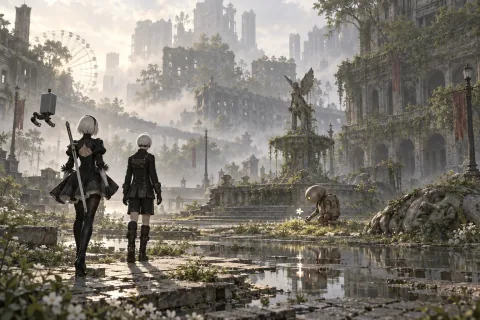
1. A guide carrying a white flag
A machine appears before 2B and 9S as they leave the amusement park. Instead of attacking first, it raises a white flag to signal peaceful intentions and offers to guide them to its village. The two have just fought a singer who used damaged android bodies, even turning those still alive but close to death into weapons. The offer by another machine lifeform to lead them safely into a community follows directly from that experience. They must see what the individual before them actually chooses to do.
2B and 9S follow the guide to the village. At the end of the path are homes at different heights, connecting walkways, and machines going about their lives. The scene differs from a military facility producing soldiers and preparing offensives under orders. Residents speak for themselves, ask for help, and form relationships with others. Rather than an automatic, identical copy of a human village, they see a community using its surroundings to suit its own bodies and lives.
Pascal, who represents the village, welcomes the soldiers and explains his desire for peace. Although a machine lifeform, he does not act on an obligation to attack any YoRHa unit he sees. He says the residents want to live apart from the war. For 9S, those words are not immediate proof that every precaution can be abandoned. They listen and look around at the residents to examine that claim for themselves.
The residents include children and adults, and relationships they call families. This is not a place where everyone, simply because they are machines, shares the same thoughts at once and performs one predetermined action. Someone wants to learn; someone worries about a neighbor. Starting from a mission to confront enemies, the soldiers have arrived at other beings' daily lives, which will continue even when the two briefly leave.
2. What must be learned after disconnecting
Pascal and the residents seek to live independently, apart from the machine network. Their wish to stay out of the war differs from a temporary agreement not to attack the two androids standing before them today. It takes the form of caring for one another, acquiring supplies, and continuing a community. Their peace is an attempt to create life beyond fighting, rather than a state in which force and danger are wholly unknown concepts.
When beings that once shared information through a network live separately, the conditions for automatically knowing one another's thoughts also change. To learn what a resident wants or why someone is angry, they must listen and watch. Children arguing with parents and sisters worrying about each other emerge within this setting. The possibility of failing to understand another mind appears, alongside relationships in which understanding can gradually be learned.
Pascal teaches the children knowledge and behavior left behind by humans and helps them live together. They are not introduced merely as the next production batch of combat weapons in smaller bodies. They play and make requests in the village, receive protection, and form relationships with other residents. Pascal's later determination to protect them at the risk of his own body has roots in the everyday community seen now.
But the village's choice of peace does not guarantee the same conduct from every machine nearby. Outside remain machines fighting the soldiers, along with dangers that can threaten residents. A request to find someone and bring them home therefore requires more than explaining the route. It also takes action to protect the returning individual along that path.
3. Pascal's filter and Anemone's oil
Pascal makes a request that can turn his words into practical exchange: deliver a Fuel Filter to Anemone of the Resistance. For the two soldiers, the object is a concrete proposal that machines and androids can coexist peacefully. Parts need not travel only to destroy the other side. A relationship begins through giving something the recipient needs to keep functioning and living.
When 2B and 9S return to camp with the filter, Anemone accepts the exchange with Pascal. His claim of peace is not treated as something nobody at camp has ever heard of. A basis for trade and contact already exists between androids living on the surface and the village's machines. Newly arrived YoRHa soldiers learn that locals have formed different relationships even within the broad category of the enemy.
Anemone sends Viscous Oil in return. This time, the two carry android supplies back to Pascal. On the first visit they cautiously followed the route offered by a strange machine. Now they travel the same way carrying an item for that community. Within a simple round trip to exchange goods lies an action that helps others sustain their own daily lives.
They need not keep going all the way back through the amusement park to make this exchange. Pushing aside the barricade on the path connected to the village entrance opens a shortcut to the City Ruins. First guided into a seemingly secluded village, the two now secure a direct route between village and camp. Pascal's proposal leaves a practical passage linking the communities, extending beyond words in a conversation window.
This exchange does not establish a comprehensive peace treaty between every android and every machine. Nevertheless, it is a present relationship that 2B and 9S verify directly. It becomes a small experience that prevents YoRHa's orders and the reality on the surface from remaining perfectly interchangeable. They have heard Pascal, seen the residents, and watched Anemone accept the item. Those facts accumulate for both soldiers.
After they deliver the oil, an urgent operator call arrives: Goliath-class machine lifeforms have appeared in the City Ruins. The soldiers have just been exchanging filters and oil, discovering how the other side lives, when combat orders return. The main story's next destination is the attack site. The sister and family stories below unfold as optional quests available while visiting the village around this period, with their separate progression kept intact.
4. A little sister lost while seeking parts
In the lower part of the village, the soldiers can accept a request from a big sister machine wearing a blue ribbon. She worries because her little sister has not returned from searching for parts needed to repair her. Their bond does not appear as command and obedience within a production facility. The younger one went to help her sister; the elder, setting aside her own need for repair, asks the soldiers to ensure the missing child's safety.
The little sister has gone to the desert. For 2B and 9S, this is already a place of many enemies and the birth of a new unit. Their purpose now is not to destroy an object of investigation or a weapon. They must find a small individual who needs to return to someone's home. On the same ground, the object of their protection changes. A structure recalling the Replicant protagonist fighting Shades to return to his family now appears around two machine sisters.
They find the little sister wearing a pink ribbon in the desert. She wanted to obtain parts and help her sister, and she also wants to go home. But she has lost her way and remains in a desert full of enemies. Her attempt to help placed her own body in danger, leading her sister to ask others for a rescue. The soldiers agree to accompany her to the desert entrance so she can get out.
Other machines attack on the return journey. The child they must protect is a machine, and so are the enemies threatening her. This quest could not work if the soldiers treated every member of the same kind as an enemy sharing one purpose. They fight some individuals to protect another, securing time for the little sister to move along the path. Combat ability becomes a means of helping someone return to a community.
During the escort, the little sister keeps asking questions. When she asks where babies come from, 9S, usually ready with explanations, becomes flustered. He tries to explain that machines and androids do not have children like humans, then seeks 2B's help. She does not smoothly supply the answer for him either. Unlike shooting or analyzing an enemy's structure, a curious child's question leaves both soldiers struggling to organize a response. The little sister is more than an escort target with a health bar: she keeps wondering about the world while they walk.
At the desert entrance, the little sister thanks them and heads back to the village. The player does not escort her body all the way to the village gate. On returning to Pascal's village and speaking to the big sister, the soldiers find the younger one home and finish the quest by confirming their reunion. The rewards include blue and pink ribbons like the ones the sisters wear. The original request to find someone leads to a final visit in which they see the two together again.
The elder's worry and the younger's effort to help can resume in the same place only once the latter returns safely. The soldiers witness more than the delivery of a part. There was someone waiting in the village and someone who went out to act for her. They experience how safely joining those two can become their own task.
5. A runaway child and a mother's incomplete understanding
Their relationship with the village continues on later visits. After the Goliath incident in the City Ruins, a quest opens about a child who argued with a parent and ran away. Near the village's outskirts, a mother machine worries about her child and asks the soldiers to bring him back from the city. All problems were not already solved within the peaceful scenery of their first day. As daily life continues, conflict develops too.
2B and 9S find the child near the City Ruins: Center access point. He is angry with his mother and feels unfairly treated. He is not presented simply as a malfunctioning device rebelling for no reason against an adult's order to return. Here is a child explaining, from his own position, why he left and wanting his feelings to be understood. While listening, the soldiers must also protect him from machines attacking the area.
The way back to the village requires an escort too. Being able to express anger at a parent does not equip a small body to survive outside battles alone. While the soldiers hold off enemies and secure the path, the child can return home. Listening to the reason for leaving and helping with the return belong to the same request. This differs from solving the problem by dismissing his unhappiness as unimportant.
After the reunion, there is a process of recognizing each other's mistakes and feelings. The mother reveals that, unlike when they were linked to the network, she cannot know every thought her child has. Even a machine family does not automatically share all its inner life merely because it calls itself a family. They can argue and misunderstand, then learn and be happy again. This is part of the everyday life that a village of separate beings must navigate.
The quest gives everyday scale to Pascal's idea of peace. It is not a motionless collection of identical individuals after a declaration that they will stop fighting. Beings with different feelings call a place home together, leave in anger, return, and try to maintain relationships. 2B and 9S have moved from judging whether machines merely replay human words to being the people who have helped those relationships through practical actions.
6. Beings with somewhere to return
Helping the residents leaves 2B and 9S with particular faces within the name machine lifeform. Among those grouped in military records as enemies to eliminate were a waiting elder sister, a runaway child, and a parent troubled by not understanding all her child's thoughts. They have not changed into human bodies to relate to the soldiers. They choose different actions in the same familiar round metal forms.
These experiences do not immediately change the whole battlefield. The two still take orders, investigate machines elsewhere, and fight. Pascal must also contend with outside dangers and supply needs to keep the village going. But the lives they have seen for themselves do not cease to have existed with the next order. They now know others who did not attack, and they have heard whom those others worry about.
For Pascal, the children's safe return means the continuation of his community. Even after the soldiers leave, he stays with them, teaches what he knows, and tends the village. When this place later faces danger, what he tries to save is not an anonymous production count of machines. It is the residents with whom he has lived and whom he has recovered by asking others for help. Their lives are the real shape of peace that 2B and 9S have seen.
Sources and scope of verification
The Fuel Filter goes from Pascal to Anemone, and Viscous Oil returns from the Resistance to Pascal before the urgent call about the city attack. In Lost Girl, the little sister is escorted to the desert entrance, then the reunion is confirmed separately in the village. Family Squabble opens after the city's Goliath incident. Neither optional quest is merged into a compulsory first day at the village. This is TroubleMaker's AI-assisted story commentary, without reproduction of original dialogue or lyrics. Checked on October 18, 2026, Bangkok time.
comments 0