
NieR Chronicles 7 — Thousands of Years and an Earth Without Humans
Chapters in this story
- Thousands of Years Between: Emil and an Earth Without Humans
- 1. Humanity's Disappearance and the Aliens' Arrival
- 2. A War Too Wide for Emil to Face Alone
- 3. Guilt Inherited by the Same Faces
- 4. The Position of Soldiers for Humanity
- 5. Why Bodies and Memories Do Not Always Return Together
- Sources and Scope
Thousands of Years Between: Emil and an Earth Without Humans
Spoiler notice: This installment discusses Replicant's endings and the truth about humanity in Automata. The long interval between the games is connected through what their records and associated timelines establish. No invented wars or character epilogues are inserted between documented events.
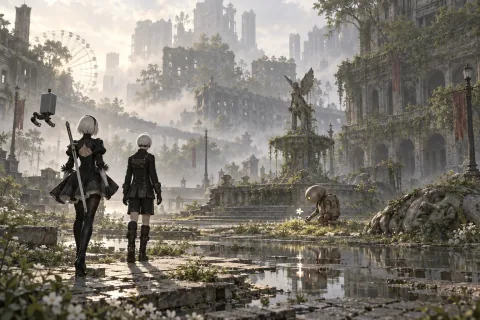
1. Humanity's Disappearance and the Aliens' Arrival
Replicant's protagonist recovered Yonah, and in E, following D, Kainé reunites with the erased protagonist. Yet that recovery does not revive the Shadowlord, the Original Gestalt. The plan to continue humanity by reuniting bodies and souls has lost its foundation. One restored Replicant meeting his companions again and preventing the collapse of all Gestalts were separate outcomes.
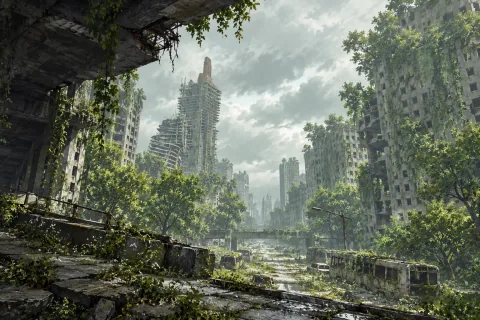
Time continues to pass. Every village does not empty simultaneously at the instant the last battle ends. The consequences of a system that can no longer be sustained unfold over a long period. The associated timeline records humanity's extinction in 4198. More years lie between the end of the boy's journey to return to his sister and the point at which a later age records humanity's absence. Those long consequences connect to Automata's world without humans.
Replicants could not produce children among themselves to sustain successive generations. Although the villagers lived as families and possessed selves of their own, the production and maintenance of their bodies depended on the system intended to restore humans. As Gestalts continued to relapse and reunification became impossible, those currently living could still have days ahead without being able to extend that life through future generations. This is why a brief return of peace to the protagonist's home after the Shadowlord's defeat can coexist with humanity's eventual disappearance.
The alien invasion is dated later, to 5012. These two events must therefore not be combined into a sequence in which aliens drive all living humans from Earth to the Moon and humanity subsequently disappears. Human extinction and the alien invasion are distinct events. The account Automata's soldiers initially learn is the cause they believe in and fight for, rather than a historical record accurately conveying the entire past the reader followed through Replicant.
The invading aliens use machine lifeforms as weapons of war. Human-made androids remain on Earth's side and resist. Even after humans, the creators of one side, have disappeared, their creations keep acting and fighting. Automata sends new soldiers into this world. Humanity's absence cannot automatically order the war to end: the remaining beings still have organizations, enemies and purposes they have been taught to defend.
2. A War Too Wide for Emil to Face Alone
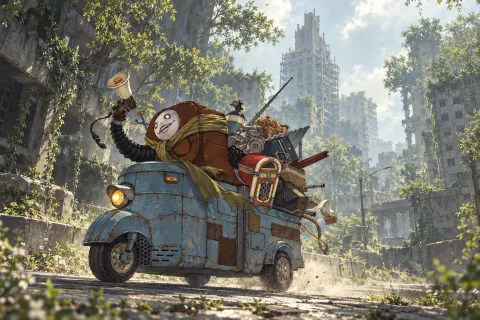
Emil survives to connect the two games. At the Shadowlord's castle he used his power to send his companions onward and survived even with only his head remaining. In E, he helped Kainé with a new body. Yet reuniting with companions does not guarantee a future in which the same people remain together forever. The long years ahead are not a time in which the friends who shared one adventure can always remain in the same place.
Emil is also involved in the fight against the aliens. Despite his immense power, the invasion is not one Shade whose defeat will end the war. There are machine lifeforms filling battlefields across Earth and a prolonged conflict. Emil responds by making copies of himself. Unable to defend many battlefields simultaneously with one body, he creates numerous beings resembling himself and continues the struggle.
Copying multiplies his strength, but it does not preserve his life perfectly unchanged. As duplication repeats and years of war accumulate, old memories fade. Some individuals struggle to hold clearly to whether they are the original and which experiences are their own. The Emil encountered in Automata does not struggle to remember someone simply because he has briefly forgotten a friend's name. After a long war and repeated duplication, he must recover the memories of those he wanted to protect.
Automata's traveling merchant Emil therefore cannot be treated as the same boy first met in Replicant driving the same body with every memory intact. Memories and relationships connect him to the original Emil, but he is also an individual who exists after the copying. The memories revealed through Lunar Tears, the underground home and the clones' battle later give this condition concrete form. Those events will receive a separate installment following the actual quests.
The boy whose eyes once made it difficult to face others becomes a name that has crossed an almost uncountable length of time. He changed his body to save a companion and increased his numbers to defend the world. Yet in the process he loses memories connected to why he wanted to defend that world. Greater combat power cannot preserve a person's relationships. Understanding Emil's long years gives his recollection of precious friends in Automata a weight beyond a quest reward.
3. Guilt Inherited by the Same Faces
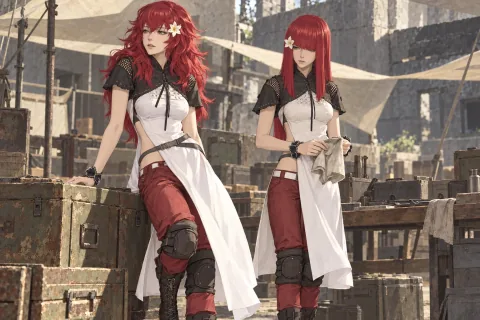
The names and faces of Devola and Popola also appear in Automata. This does not mean that the two individuals who died at the castle have revived to work in a ground camp as though nothing happened. These are two different androids of the same model. Because they share a model with the pair encountered in Replicant, an earlier failure they did not personally cause clings to their present circumstances.
After Project Gestalt failed, androids of the same model became targets of blame and disposal. Measures were also imposed on survivors to make them feel guilt. This is different from remembering an action through which one harmed someone and feeling remorse for it. They are excluded because of their model, and guilt itself is imposed through their systems.
Automata's pair live on the ground, carrying out duties such as supply and repairs. Their unequal treatment by other androids continues after the historical explanation ends. To understand why others respond uneasily to them, one must consider not only their present actions but also their names and appearance. Even after humans disappear, the stigma of having failed to protect humanity shapes relationships among other beings.
Their later choice to help 9S arises under these conditions. They do not simply return as the old administrators repeating the same plan. They are two present individuals choosing their own actions to be useful to someone. Recognizing an old name and distinguishing whom one is actually seeing are both necessary. Readers who remember Replicant's ending have particular reason not to merge the two pairs into the same individuals.
4. The Position of Soldiers for Humanity
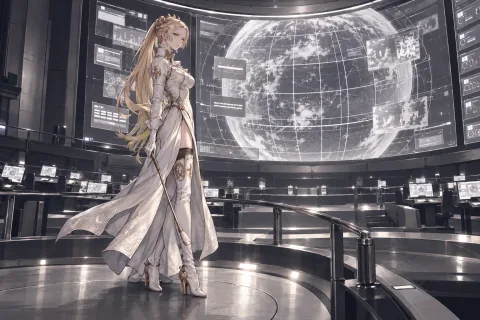
Not every android on Earth belongs to YoRHa. Automata has the Resistance, which has long fought and maintained bases on the ground, and YoRHa, which operates around the orbital Bunker. They can cooperate, but they are not one organization made up of identical units. The main story's relationships develop where those responsible for accumulated ground warfare and survival encounter soldiers from a new force descending from above.
YoRHa soldiers are given the purpose of reclaiming Earth for humanity. Messages and orders said to come from the Council of Humanity on the Moon repeatedly affirm that purpose. The account that their human creators remain alive on the Moon and must one day have Earth returned to them gives the war meaning. The reader has already followed human extinction, but the soldiers performing their first descent are not fighting with complete knowledge of this propaganda from the outset.
The lunar facility preserving humanity's records is also distinct from the Bunker where YoRHa lives and processes data. Both being above Earth does not make them the same building. The orbital base from which soldiers receive missions, descend to Earth and return houses the Commander and Operators. It is also the Bunker where 2B and 9S meet again after their first operation. The supposed voice of humanity from the Moon and the place where their colleagues actually work are different things.
YoRHa's battle and scanner types have different duties. 2B's missions center on direct combat, while 9S excels at investigation and hacking. Even on the same battlefield, their access to information and their means of resolving a fight differ. That difference gives them reasons to work together but also produces facts only one of them learns. It becomes crucial when investigating Earth's enemies turns into exploring their own organization's records.
5. Why Bodies and Memories Do Not Always Return Together
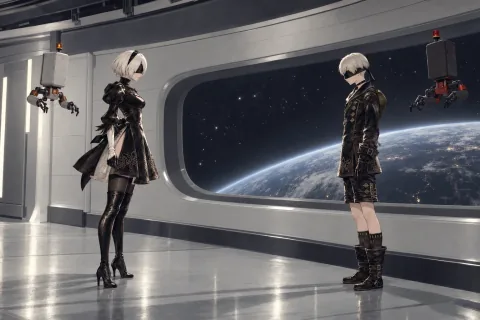
A YoRHa soldier can become active again through saved data and another body even after physical destruction. Yet treating this as perfect immortality without any memory loss would make the first operation's ending difficult to understand. If recent experiences were never transmitted, that span of time is missing from the restored body. Meeting a companion with the same appearance again does not guarantee that they remember shared moments in the same way.
This condition is distinct from the plan for bodies and souls in Replicant. A YoRHa soldier sending data to the Bunker is not a procedure that returns a human Gestalt to its corresponding Replicant body. The world's technologies and forms of bodies have changed, and these soldiers now face different problems. Still, the question returns of how memory and relationships, as well as a body, matter in recognizing someone as who they are.
Pods accompany the soldiers. These small support units analyze operational information and assist with ranged attacks and movement. 2B's Pod 042 and 9S's Pod 153 begin as relays for orders and information, but as the story proceeds, they keep witnessing the choices and memories of the androids linked to them. What to do with data remaining after someone's destruction will eventually also depend on their decisions.
The main story takes place in 11945. Into an Earth where an immense span of time has passed even since the alien arrival, 2B and 9S now descend. Their immediate task is to destroy a giant machine weapon. That first operation already reveals that losing a body and losing memories do not happen at the same pace. Beyond the era of the protagonist's name and the memory Kainé recovered, a reunion awaits in which the companion who fought beside someone no longer remembers them.
Sources and Scope
This account explains connections established by in-game records and associated timelines. It distinguishes Emil's clones from the original, the Devola and Popola individuals in the two games, androids generally from YoRHa, and the lunar archive from the Bunker. Scenes detailed only in concerts or novels have not been reenacted as events shown in the main game. This is an AI-assisted story commentary by TroubleMaker's editorial team without reproduction of original dialogue or song lyrics. Checked: October 18, 2026, Bangkok.
comments 0