
NieR Chronicles 27 — The Burning Village and Pascal’s Three Choices
Chapters in this story
- The Burning Village, the Children in the Factory, and Pascal’s Three Paths
- 1. Returning Along the Road Used to Bring Playthings
- 2. The Small Bodies Left Inside the Factory
- 3. A Pacifist Moves an Enormous Weapon
- 4. The Room They Return to After Victory
- 5. A Request to Erase the Cause of Pain
- 6. Killing, Erasing, or Leaving
- 7. The Shop That Appears After Memory Erasure
- Sources and Scope of Verification
The Burning Village, the Children in the Factory, and Pascal’s Three Paths
Spoiler notice: This chapter covers the late-game collapse of Pascal’s village, the defense of the factory, the children’s deaths, and the choices to kill Pascal, erase his memories, or leave. It includes suicide without describing methods in detail. The three choices are separate branches, not outcomes that occur one after another in a single timeline.
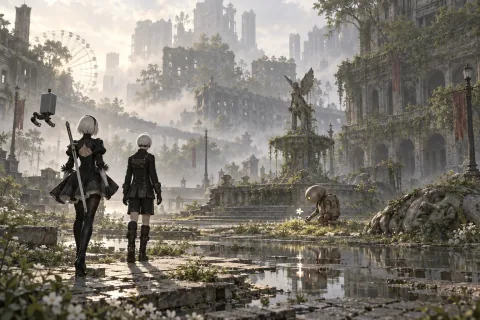
1. Returning Along the Road Used to Bring Playthings
After receiving the call that the village is in danger, A2 heads there. Until moments ago, this was a road she traveled to collect materials and prepare gifts. The children wanted something new to play with, and a resident wanted to find a book to please Pascal. A crisis has reached the place where those next promises were supposed to continue. This time, the village’s communications and transport cannot be relied upon in the usual way either.
The village she reaches is burning. Some residents have gone berserk, attacking other machines and even consuming fallen bodies. Small homes, paths, and a community that lived together are collapsing from within. The broad fact that machines live here remains the same, but the specific condition of who is alive and who is attacking other residents has changed. A2 sees the life she has only just come to know being destroyed.
She stops the attacking machines. Even for a fighter accustomed to killing machines, the purpose of this battle is not the same as before. To save living residents, she must eliminate the bodies attacking them. But defeating enemies cannot bring back homes already destroyed or residents already dead. The ability to remove an immediate threat does not restore the entire community’s time.
Pascal has fled with the children. When the village could no longer be defended as it was, he moved the remaining small bodies somewhere they might survive. Following his call, A2 goes to the abandoned factory. The place that 2B and Pascal once visited to seek reconciliation, only to flee the cult’s frenzy, now becomes a temporary refuge. Other children must be protected in the space where an earlier terror ended.
2. The Small Bodies Left Inside the Factory
A2 meets Pascal and the children at the factory. They have already lost their homes and many neighbors. What they need now is a small room where they can stay safely and adults who will protect them. To Pascal, the children’s survival is also the last possibility of continuing the village’s next day. Even if its homes are gone, as long as they live, relationships of caring and teaching remain.
But enemy attacks follow them to the factory. Pascal’s evacuation does not by itself establish a safe boundary. First, two machines enter the refuge and attack, and A2 deals with them. An alarm then warns that a larger enemy force is approaching the factory. If the incoming machines are not stopped outside, the interior where the children are staying will be attacked too. A2 goes out to defend it, while Pascal must somehow protect them as well.
Leaving the children inside is meant to separate them from combat and keep them safe. Those who can fight take responsibility for the outside so that small bodies do not stand directly before enemy bullets and enormous weapons. It resembles 2B and 9S escorting the village’s younger brother and child, making a path safe for someone weaker. This time, however, the adults cannot simultaneously see everything happening inside while they stop the danger outside.
3. A Pacifist Moves an Enormous Weapon
Outside the factory, A2 fights the incoming machines. Small and medium bipedal machines pour up the stairs, and after those groups are defeated, a gigantic tank is deployed. A2 defeats the tank too, but the enemies heading for the factory do not end with that one force. Rapidly cutting down nearby enemies with one person’s sword becomes insufficient to sustain the defense. Because she must stop attacks from reaching the building where the children hide, she cannot simply save her own body by fleeing far away.
Pascal takes control of an enormous Engels unit and joins the defense. The player controls that huge body too. Previously, 2B and 9S fought while avoiding its massive saw arms; now those arms and that body’s strength push back enemies coming toward the factory. The weapon’s size and firepower are the same, but whom it is being used to protect has changed.
Pascal does not merely say he wants peace and abandon the children. He tries to keep them alive even by using violence he never wanted. This does not make his earlier peace meaningless hypocrisy. A being who wanted to live without attacking others chooses protective action when the children’s bodies are already under attack. His judgment carries a far greater cost than he anticipated in peaceful daily life.
Another Engels appears, leading to a battle between giants. Its scale differs from a small android climbing a leg and cutting away weapons. Huge bodies exchange blows, block attacks, and bring the opponent down. The outside army that seemed too much for the pair is finally stopped. From the outside, the defensive battle to protect the children has succeeded.
4. The Room They Return to After Victory
A2 and Pascal return inside. Having fought outside and stopped the attack, they should now be able to meet the living children again. But the children in the room are already motionless. This is not the result of enemies breaking through the outer defense and killing them one by one. While the two adults fought, the children could not endure their terror and took their own lives.
Pascal struggles to accept why this happened. He recalls teaching them fear. He taught them the feeling that recognizes and avoids danger so that they would not be hurt through reckless behavior. Fear was part of an education intended to help them survive. But when their home collapsed and they came under attack, that feeling grew beyond what they could bear.
The children could not hold on by trusting in a future where they would be safe once the adults returned. What Pascal taught and the outcome of the feelings they actually experienced diverged. Fear learned for protection led instead toward choosing death. This cannot be expanded into a law that every machine with emotions must inevitably meet this fate. What Pascal confronts here is the loss of particular children whom his teaching and protection could not save.
For A2 too, this is a failure that cannot be understood through the number of enemies she destroyed. She handled all the threats outside, and Pascal even fought using an enormous weapon. Yet those they meant to save were already gone when that battle ended. There is no next enemy whose defeat with one more powerful attack could make the same children smile again. A loss that cannot be solved with a sword remains in the room.
5. A Request to Erase the Cause of Pain
Pascal cannot endure remembering the loss of the children he taught and cared for. He asks A2 to erase his memories. If she cannot, he asks her to kill him. The being who was fighting moments ago to protect the remaining children’s future now loses the desire to continue his own next moments.
A2 receives the request. 2B also entrusted her ending to A2 when the infection became severe, but the conditions are not identical. Pascal does not simply have a physical fault that can be repaired so his body can move again without knowing the children died. He is asking what to do with the memories causing his pain, and with the self that possesses those memories. The player must make a choice, or can leave the place.
None of the three paths brings the children in the room back to life. Even when the object of the choice narrows to Pascal’s current condition, the relationships he remembers remain events that have already happened. The pain does not vanish between a judgment that places all blame on him as if he had personally killed the children and the simple assertion that he has no reason to feel responsibility or grief.
6. Killing, Erasing, or Leaving
If the player chooses to kill Pascal, his body stops. After stopping berserk machines and defending the factory, A2 now directly ends the one who has asked her to do so. There is no scene that transforms this choice offscreen into complete salvation or a new life. The result is that he can no longer continue his memories and relationships through his own body.
If his memories are erased, his body survives. But the memories of knowing A2, leading the village, and teaching the children disappear. A remaining body being able to move is different from his continuing to live as Pascal with the same experiences. Helping him escape his current pain comes at the price of making him forget the things he loved as well.
The player can also leave without fulfilling either request. Pascal suffers at being left and tries to stop A2, but the game does not show all of his subsequent life after this choice. One cannot add a new epilogue claiming he certainly dies immediately or eventually comes to terms with every memory in a healthy way. What remains is the outcome that A2 did not perform either act, and the gap of not knowing what comes afterward.
These three outcomes do not follow one another. There is no single fixed ending in which his memories are erased first and Pascal is later killed while possessing those memories. The player sees different paths before the same loss and confronts the fact that none completely removes the preceding failure. Even viewing another choice does not return the children’s room to its earlier life.
7. The Shop That Appears After Memory Erasure
In the memory-erasure branch, Pascal can later be encountered again in the village. He does not recognize the player through their former relationship and sells remaining machine parts as merchandise. Among them are the children’s cores. Parts of bodies he once cherished and tried to protect above all else are kept as goods by a merchant who no longer knows their history.
The player knows where those objects came from and what they mean. Pascal does not. Because of that difference in information, the scene is difficult to read as a peaceful epilogue in which grief has simply been relieved and business is going well. The pain has been erased, but so have memories of what he should care about. Rather than becoming cruel again in personality, he has lost the relational context through which the cruelty could be recognized.
A2 must go on moving after all of this. Forming new relationships in the village did not make the world guarantee them. Yet the help she gave and the feelings she received do not disappear into a time when nothing happened. When she later tries to save 9S, she is someone continuing to hold another request even after experiencing the failure of fighting to protect others and still being unable to save them.
Meanwhile, 9S follows his own path after losing 2B. While A2 experiences new relationships and losses within a machine community, he tries to open the Tower built by machines and reach A2. Their pain has similarities, but they move in different directions. Without fully knowing each other’s time, their paths will cross again at the resource recovery units and the final Tower.
Sources and Scope of Verification
This account separately describes the game’s late collapse of Pascal’s village, the factory defense, the children’s deaths, and the three choices. It does not merge in the anime’s development in which other infected beings kill the children. The parts shop is an outcome of the memory-erasure branch; the offscreen fate after leaving is not declared certain. This is an AI-assisted editorial account, without reproduction of the original dialogue, lyrics, or novel text. Sources checked: 2026-10-18.
comments 0