
NieR Chronicles 21 — Hunting Betrayers and the Executioner Who Erased Her Memory
Chapters in this story
- Soldiers Hunting Betrayers and the Request of an Executioner Who Erased Her Memory
- 1. Headquarters Orders Them to Prevent Harm
- 2. 8B Sees Her Comrades’ Deaths
- 3. A Request to Find the Person Who Killed Her Friend
- 4. The Executioner Who Forgot Her Own Hand and Sought Another Killer
- 5. 11B’s Weapon Left at the Coastal Factory
- 6. When the Same Death Returns in Different Words
- 7. Gaps in Orders and the Erased Self
- Sources and Scope of Verification
Soldiers Hunting Betrayers and the Request of an Executioner Who Erased Her Memory
Spoiler notice: this chapter covers the optional quests YoRHa Betrayers, Amnesia, and 11B’s Memento, available before the main story’s all-out offensive. These are not mandatory missions newly occurring on a single day after Ending B. Each has its own availability and choices. They include clues connected to 2B’s role revealed later.
1. Headquarters Orders Them to Prevent Harm
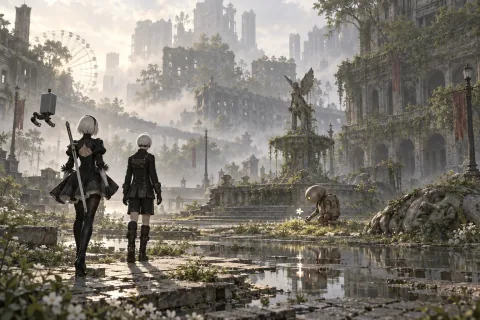
The two soldiers investigating the surface receive orders to track YoRHa deserters: 8B, 22B, and 64B. According to the briefing, they have not merely left their unit; they are threatening the Resistance camp and stealing supplies. To 2B and 9S, who have been helping the camp’s people, a mission against combatants from their own side is presented as an act of protecting those people.
The pair investigate the designated possible locations. Tall city buildings and the surroundings of fallen giant weapons become places to search for androids from the same army rather than analyze machines. As when they first identified A2 through wanted information, the reason to eliminate these targets is determined above before they can hear directly why they left.
Meeting 22B and 64B does not end in an arrest through conversation alone. The two androids resist, and 2B and 9S fight them. Their movements differ from battles spent avoiding the heavy weapons of machines. The soldiers close the distance quickly, dodge, and wield their weapons. Skills belonging to related types of combatants are used to hurt one another instead of protecting comrades.
The two targets escape from the first fight. 2B and 9S must locate them again and continue the pursuit. This is not one scene in which they immediately defeat everyone upon meeting them and hear the truth. Only after following the fugitives and fighting again do 22B and 64B fall. Possibilities of returning to dialogue diminish along the way, leaving destroyed bodies in place of living witnesses.
2. 8B Sees Her Comrades’ Deaths
8B appears afterward. She confronts the deaths of the two who had been traveling with her. To 2B and 9S she is the last of three targets on an order, but to her those two are more than names on a pursuit list. They were people on her side. Enraged over her fallen comrades, she fights the two soldiers.
Stronger resistance does not change the outcome. 2B and 9S defeat 8B as well. All the listed targets have been eliminated. They have achieved the military result of completing a mission, but the information they themselves have verified about why the deserters fled and what harm they actually caused the camp is not as sufficient as the initial orders implied.
9S cannot simply overlook that. They return to the camp and ask Anemone about supply theft and attacks. Since they acted in the name of helping victims, the person responsible for the camp should know about the alleged harm. Anemone, however, knows of no recent theft or attack reports matching their account. Only after carrying out the order does its stated justification fail to fit.
Attempts to check further with headquarters are blocked by restrictions on access to the case records. The route to investigating and conclusively establishing the background on site closes. What the game firmly reveals is that the original explanation contradicts Anemone’s answer, all three are already dead, and further inquiry is restricted. Those conversations do not establish exactly what secret the three deserters discovered.
3. A Request to Find the Person Who Killed Her Friend
In Route B, 9S can accept a request from a Resistance woman with memory loss. She says she was caught in a large explosion, cannot remember the surrounding events, and had a close friend who was murdered. Although her own memory is blank, a damaged Pod retains records of that friend’s final moments. She asks for help restoring them and finding the killer.
This is something 9S can help with through his abilities. The hacking he used to analyze machines and open blocked paths is now applied to someone’s personal loss. The client places herself not as the perpetrator, but as a bereaved victim who does not know the truth. 9S initially examines the materials on that basis too.
Reading the Pod’s records reveals a red-hooded figure as the killer. With a clue available, it seems they need only find that person next. As the investigation proceeds, however, the hood and the client become connected. The initial premise of a request requiring them to search the city for another murderer who escaped far away begins to shake. The records point to the very person standing before him asking for help.
Though anxious, she wants to learn more. Instead of denying everything or ending the search after the first clue, she asks 9S to restore deeper Pod records. Even if the fact she seeks might hurt her, the search already begun continues. Recovering memory begins to conflict with preserving her present self.
4. The Executioner Who Forgot Her Own Hand and Sought Another Killer
The deeper records show that she herself killed her friend. What returns is not the relief of identifying a culprit. It is the memory of what she did. With its restoration, the circumstances of her friend’s death and the cause of her amnesia differ from the original explanation.
She operated as a YoRHa execution model, a Type E. She carried out the disposal of deserters and those designated traitors, continuing her assignments while blending into the Resistance. The last person she had to kill was a close friend. When a familiar relationship and the designation of an ordered target attached to the same person, she obeyed the order and then could not bear remembering it.
Her erased memory was not simply the result of an external shock that made the killer unknowable. She forgot of her own accord because she could not endure what she had done. Yet even after forgetting, the loss of her friend remained. She became a client trying to solve an incident committed, as she believed, by someone else. Her present self constructed a new explanation in the gap where her own past actions had disappeared.
The returning memory does not stabilize her. Even with a quest-completion notice and reward, this is not a scene of accepting her friend’s murder and returning to peaceful daily life. 9S restores records for someone, then witnesses the truth break that person down. He experiences that a fact someone wants to know is not guaranteed to be an answer that sets them free.
The fall scene added in the anime is not attached to this game quest. What has been established here is the returned memory, the shaken client, and the Type E role. The existence of a model that must conceal its affiliation and execute someone close remains an important clue for later rereading the relationship between 2B and 9S.
5. 11B’s Weapon Left at the Coastal Factory
Another optional quest begins with 16D in the Bunker. In the hangar, she asks for the belongings of 11B, who was her instructor. 11B was among the soldiers who descended with 2B on the first operation. In that opening mission, comrades were shot down and scattered in succession. 2B survived and joined 9S, but the lives of those who vanished from the screen did not end without meaning to anyone else. In the Bunker, there are people who wait for and remember them.
2B returns to the abandoned factory and finds 11B’s body and weapon. The body also retains records of a plan to desert. She feared dying while continuing to fight and considered a way to leave the unit. A final period more complicated than the single sentence that a loyal soldier died in action emerges. The wish to preserve her own life and her death during an actual operation occupy the same record.
2B returns to 16D with this information. Handing over the weapon and telling her the escape plan are not the same choice. The player can disclose the plan or remain silent. The image of the dead person that 16D remembers changes with that choice. Whoever discovers a record now bears responsibility for deciding what to pass on to someone else.
6. When the Same Death Returns in Different Words
If the escape plan is withheld, 16D mourns 11B and reveals their close relationship. The weapon and memories return as mementos honoring someone she loved. She also expresses a wish to convert to a combat type and avenge 11B. The grief left behind does not stop at preserving memories; it leads to a resolve to change her own body and role. The additional records 2B found do not enter those words of mourning. That does not establish that everything said there was a lie within the game world. The information conveyed to 16D at that moment is different.
If the escape plan is revealed, her reaction changes sharply. She recalls 11B treating her harshly and calling her weak, and mocks the fact that this strict person was herself afraid and trying to flee. Laughter and anger overturn the mourning. Her wounds from the relationship and her feelings toward the dead emerge without resolving into a single emotion.
These reactions are different outcomes from the player giving different information. They cannot be combined into one fixed scene where she first confesses love and immediately delivers the whole second response in the same timeline. Nor does the change in words alone prove that she fabricated one particular feeling from beginning to end. There is room to read it as new information arriving in a relationship tangled with respect and affection, fear and resentment.
In this quest, memory is both evidence of an event and something that changes the survivor’s relationship. 11B had her reasons for wanting to escape alive; 16D had her own time experienced beside her. Reading one person’s records does not mean fully knowing another person’s heart. The short round trip in which 2B brings back a memento leads to a choice about how the dead will be remembered.
7. Gaps in Orders and the Erased Self
These three quests show different people acting without knowing different things. In hunting YoRHa deserters, 2B and 9S kill their targets before sufficiently confirming the basis of the orders. In Amnesia, the client seeks a killer while having forgotten her own past. In 11B’s Memento, 2B has read the records and chooses what to tell 16D, who has not.
Ignorance does not always arise from simple lack of information. Headquarters’ access restrictions can create it, as can memories erased to avoid one’s own pain. Facts not passed on can remain as a difference between two people. Rather than only finding who lied, we must trace who acted and who was hurt because of those differences in information to see the weight of the events.
Once 2B’s true role is revealed later, the circumstances of the Type E client who had to kill someone close become a more direct mirror. That does not allow us to move knowledge earlier and claim that 9S conclusively learned all of 2B’s assignments and the circumstances of their repetitions as soon as he saw this quest. What the game gives at this point is the existence of executioners and an example of a relationship painful enough to erase memory. Answers about the pair’s relationship reconnect those clues much later.
Sources and Scope of Verification
This commentary separates the game’s three optional quests and related records by incident. It does not invent and establish specific secrets of the YoRHa deserters or every motive of headquarters. The anime’s additional ending for the Type E client is not merged into the game, and 16D’s reactions are treated as outcomes of different player choices. This is AI-assisted editorial material and does not reproduce original dialogue, lyrics, or novel text. Sources checked: 2026-10-18.
comments 0