
NieR Chronicles 6 — Kainé and the Erased Name
Chapters in this story
- The Choice for Kainé and Ending E: Recovering an Erased Name
- 1. Yonah Returns, but a Companion Still Needs Help
- 2. C: Killing a Companion to End Her Suffering
- 3. D: A Sacrifice the Survivor Cannot Remember
- 4. Three Years Later: Kainé Follows a Loss Without a Name
- 5. The Keepers of Memory and Copies of Herself
- 6. Choosing to Recover the Erased Person
- 7. One Person's Return and Humanity's Future
- Sources and Version Notes
The Choice for Kainé and Ending E: Recovering an Erased Name
Spoiler notice: This installment covers Replicant's endings C and D and the ending E added in the 2021 version. C and D are alternative outcomes of the same choice; E takes place after D. Progression requirements are explained where they help make the narrative clear.
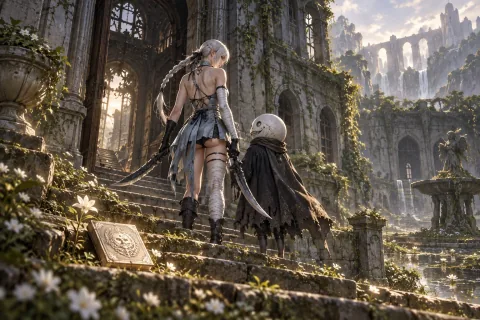
1. Yonah Returns, but a Companion Still Needs Help
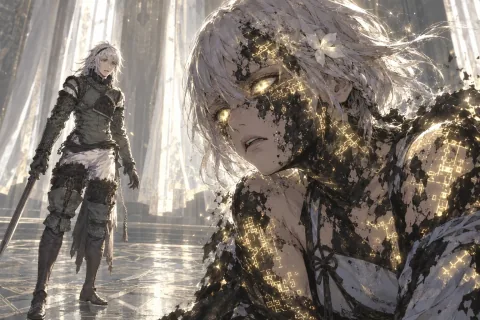
Defeating the Shadowlord brings the protagonist the reunion with Yonah that he has wanted for five years. Yet a problem remains for Kainé, who has traveled beside him. The Shade Tyrann inhabits her body, and killing the Shadowlord does not automatically resolve her relationship with him. At the very point when the group should be taking Yonah home, they face the possibility of losing someone else.
On the paths leading to C and D, Kainé's struggle against the Shade's power comes to the fore after the Shadowlord battle. The protagonist must now fight the companion who fought alongside him. As a boy, he joined her against a towering enemy; five years later, he and Emil freed her from stone. Now her own body becomes the site of another danger. He cannot simply leave her behind and assume that waiting will restore her to normal.
After that fight, Tyrann speaks to the protagonist. The Shade who has shared Kainé's body now presents him with a choice about her fate. Defeating the enemy has not made everyone on his side safe. Having rescued his sister, he must decide what he is willing to give up for his companion. The two outcomes of this decision are C and D.
This branch follows the adult protagonist's journey and the events leading to the Shadowlord's castle, then changes according to the final choice made before the same companion. The game requires a collection of weapons to reach it. After the protagonist defeats the Shadowlord again, Kainé collapses as she is about to leave, unable to contain the changes in her body. The crisis that had remained beneath the surface becomes visible. Subduing her leaves two possible paths that victory in combat alone cannot settle. They are alternatives, not two actions performed in succession within a world where the first outcome remains in effect.
2. C: Killing a Companion to End Her Suffering
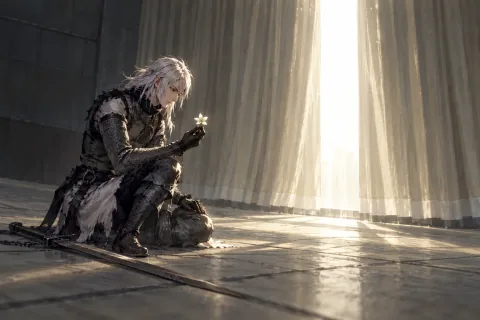
The first path is to end Kainé's life. The protagonist brings about her death himself so that she will no longer suffer as the Shade's power consumes her. The sword with which he cut down enemies beside her now turns toward her. The strength and experience he built while trying to save his sister cannot keep everyone he loves alive. A struggle over which threat to eliminate becomes a decision about how to let someone beside him go.
Kainé and the protagonist share a final kiss, and he kills her. They do not escape the crisis, acknowledge their feelings and then return home together. The act that expresses their bond coincides with the act that prevents them from continuing that bond in life. The hope that rescuing his family will allow him to resume an ordinary life with every companion is not fulfilled in this outcome.
The protagonist remains after Kainé dies. He must live with his relationship with Yonah and his memories of Kainé. Their meeting in the Aerie, their travels, her release from stone and the battles that followed do not disappear from the world. He is left with the pain of losing a companion and the knowledge that he chose her death to end her suffering.
A Lunar Tear remains where Kainé stood after her form disappears. The flower he once gave her when she returned from stone now marks a farewell from which they cannot walk away together. He picks it up. There is a final expression of gratitude from Kainé, and someone who remembers her survives. She herself can no longer speak to him at his side.
It would be too simple to describe C as abandoning Kainé because he has no wish to save her. The option presented to him is a way of ending her pain. That release, however, does not give them a living future together. The game separates choosing a companion's death from surrendering one's own existence. Care for the same person can lead to profoundly different endings according to the consequence one accepts.
3. D: A Sacrifice the Survivor Cannot Remember
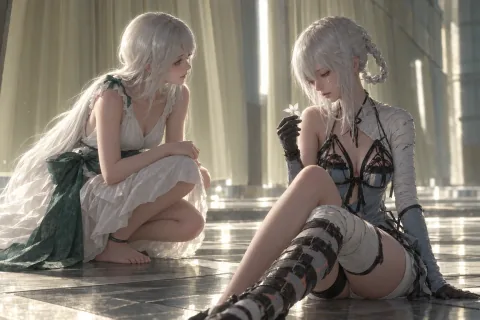
The other path is for the protagonist to give up his own existence to save Kainé. This is not a bargain in which he takes a minor injury or merely loses his magic. He disappears from the present world and from other people's memories. It differs even from a familiar heroic sacrifice, after which someone might tell others what he did and preserve his name. The condition is that the people left behind will no longer remember him either.
Yonah is part of what stands before this decision. The protagonist has traveled so far to recover his sister and has finally reached the point where they can be reunited. If he disappears, the person who would take her home and continue their life together disappears as well. D demands far more than handing over a weapon left unused after the victory over the Shadowlord. He gives up the life after their reunion, which until this moment has been the very purpose of the journey.
The player cannot observe this decision solely as an emotion taking place outside their own actions. The game asks them to confirm its meaning, then proceeds to erase the protagonist's name and the traces of his progress. The disappearance of someone from the world's memory becomes a loss of save records for the player who has been guiding him. These confirmations are not settings-menu operations unrelated to the story. They form part of experiencing the scale of what he gives away.
The protagonist disappears, and Kainé remains. Resolving the immediate problem of the Shade in her body does not restore the plan to reunite humanity. The change in Kainé's condition and the failure of Project Gestalt have different scopes. The Shadowlord is already dead, and the system sustained around him is not brought back in the same state. Saving a friend through one person's choice must not be confused with restoring the future of humanity as a whole.
Tyrann does not remain in Kainé's body after the bargain to control her again. He disappears along with the protagonist's existence, freeing her from sharing her body with a Shade. The being who repeatedly encouraged her anger and killing ultimately accepts a choice in which he too will cease to exist. Yet returning to life without Tyrann does not allow her to retain all the magic he supplied. That difference remains part of the conditions under which she fights in E.
For the surviving Kainé, something important is missing. This is not a loss she can mourn while clearly remembering the lost person's name and face. The one who saved her has been erased from memory. The reader knows what the protagonist chose, but those left behind do not possess that same explanation. D ends with this imbalance, and the 2021 version's E begins again from precisely that absence.
An image of the protagonist briefly passes through her memory, and a Lunar Tear falls from her hair. Kainé cries without being able to explain the reason fully. A recovered body does not mean that the emptiness in her heart has been filled. Even with his name forgotten, the feelings that connected her to him do not become a blank surface without a trace. The ending leaves open what might follow the protagonist's disappearance.
4. Three Years Later: Kainé Follows a Loss Without a Name
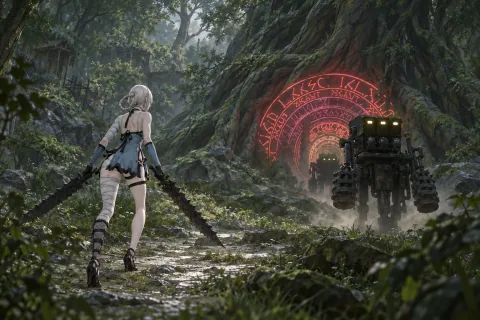
To reach E, the player starts a new game with a new name after seeing D. At first, the erased protagonist's name cannot be reused, and the early boyhood journey seems to be starting over. After the second fight with Hook in the Aerie, however, approaching Kainé changes the course of the story. Instead of following the boy along the same route back to the castle, the narrative moves to Kainé's life three years after D.
In dreams and daily life, Kainé carries the feeling that she has forgotten something important. She does not begin with a precise account of her relationship with the protagonist and then execute a plan to restore him. Nor can she conduct an ordinary search by asking other villagers to confirm the missing person's name. The absence of someone remains, but the records and memories that would readily establish that person's existence are out of reach.
Strange events in the forest and the movements of machines draw Kainé toward the Forest of Myth. A place where the protagonist and his companions once read memories and obtained a key fragment now reappears as a route toward an erased existence. What Kainé encounters is more than a new Shade lurking in the woods that she can kill before going home. A system handling Replicant memories and the world's records exists there.
Kainé enters and fights. The earlier journey centered on battles in which the protagonist moved ahead with Grimoire Weiss and Emil beside him; now her actions form the center of the story. Unlike the time when someone descended beneath the manor to resolve her condition, she is the one moving inward toward something she has lost. Even without remembering what her former companion did, she does not stop seeking the place he once occupied.
5. The Keepers of Memory and Copies of Herself
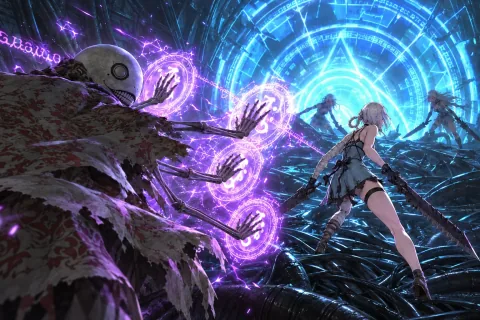
The space within the forest does not remain an ordinary natural landscape. A huge tree connects to structures handling records, and the system's administrators appear in the forms of a boy and a girl. These are not simply lost children. They have watched the records and repetitions of this world. Beneath the forest Kainé sees lies a realm of information that manages Replicants and the world beyond any single person's memories.
The administrators obstruct and seem to test Kainé, who must also fight enemies resembling herself. The repeated appearance of the same outward form exposes the difference between having a similar body and having lived the same experiences. The life that brought her here cannot be replaced by copying her appearance. She advances of her own will, breaking through the obstacles made before her.
She does not overcome every wall effortlessly on her own. When the gathering enemies and immense structures threaten to overwhelm her, Emil appears to help. A companion whose survival the reader saw in ending B after the castle explosion reenters these relationships with a new body. Even if he cannot guide her by simply remembering the protagonist's name, he can still choose to help Kainé.
Emil's new body has four arms. He fights enemies shaped like Kainé and helps break the barrier ahead. After coming to his companion's aid, he does not simply withdraw to rest in safety. He stays behind to secure her route inward. The bond between the boy who petrified Kainé and then transformed his own body beneath the manor to restore her continues at the doorway to this space of memory.
With Emil's help, Kainé heads toward the door farther within. His support continues the history in which she asked him to petrify her and he later changed his body to bring her back from stone. She does not remain merely someone others saved before she left the story. This time she uses the help she receives to move forward and confront the absence left by someone else's erasure.
6. Choosing to Recover the Erased Person
Farther inside, battles reproduce memories of enemies from the earlier journey, including Kalil and Gretel. As Kainé breaks through the cores, the administrators confront her with the consequences of killing the Original Gestalt and push her into deeper hidden memories. The final opponent to reappear is Hook. The memory of the creature that killed her grandmother and ruined her body blocks her path as a wound that revenge never erased.
Kainé is overwhelmed once during this battle. Confronting the old enemy without a companion's help or Tyrann's magic is no simple victory. Then Grimoire Weiss's voice recalls the reason she came, and she can fight with his power again within the remembered space. She faces Hook once more and defeats it. Weiss does not return in a complete physical body on an ordinary road so that everyone can set off on a new journey. Yet the record of a companion who fought beside her becomes a source of strength for Kainé now.
Rather than accept the outcome fixed by the management system, Kainé demands the return of what has disappeared. In D, the protagonist surrendered his existence to keep her alive. In E, the survivor acts because she will not accept that price as the final conclusion. Instead of commemorating forever the fact that someone vanished for her sake, she seeks to meet that person again.
The game asks the player to work with the erased protagonist's name again. The name that could not be used at the beginning becomes necessary in the final process of recovering the lost person. Here it means more than a string of characters displayed on a screen. Calling back the person the player accompanied overlaps with Kainé's action. The experience of losing save data in D connects to the experience of recovering that name and the traces of progress in E.
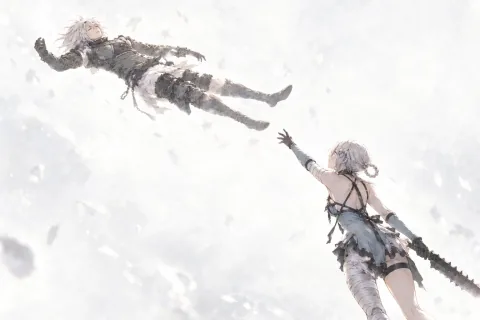
The administrators' system ultimately cannot confine Kainé's actions to its predetermined result. After the fighting through the immense tree and its information space, the protagonist returns. His body is not the adult form from the last battle, aged onward from that point. He appears as the boy from around the time he first met Kainé. That should not be reduced casually to the claim that he is an entirely new person who never experienced anything. Recovering the erased existence has been the subject of this ending throughout.
Where a giant Lunar Tear blooms, Kainé embraces the returned protagonist. At the beginning of his journey, Yonah searched for a Lunar Tear because she wanted to help her brother. Now the image of that flower frames the final reunion with someone who disappeared. His decision to vanish for Kainé and her journey to recover him meet here. Emil's help and Weiss's voice also remain part of the path to this restoration.
7. One Person's Return and Humanity's Future

E reveals more of what happens to Kainé after D, but it is not a timeline in which the same characters kill her in C and then perform D and E in succession. C is the outcome of a different choice. The absence and search in E exist because the protagonist disappeared in D. The order in which a player views multiple endings must be distinguished from the time the characters actually live through in a single world.
Nor does this ending resurrect the Shadowlord and restore his role as the Original Gestalt. The return of one Replicant protagonist does not put the entire plan to reunite souls and bodies back into its original condition. We also cannot append an unconfirmed lifetime of happiness or a new war for Yonah, Kainé and the protagonist as though it were the game's established ending. The relationship the final scene restores and the consequences remaining for the world have different scopes.
The 2010 game's main endings ran from A through D. The story corresponding to the later E first appeared as an epilogue in Grimoire NieR, and the 2021 version expanded it into a playable ending. The details of the two media should not all be merged into identical scenes. The account here follows Kainé's progress through the forest's management system and her recovery of the protagonist in the 2021 game.
As we move from Replicant to Automata, humanity's disappearance will no longer be just a sentence of background information. Before it came a journey to save a brother and sister, a choice that erased a name, and a surviving companion's efforts to recover the person missing from her life. Emil, too, carries the memory of that era's companions into a far longer span of time. This prepares us to distinguish what relationships the familiar faces and names in the next world inherit, and which of them belong to different individuals.
Sources and Version Notes
C and D branch from the same final choice; seeing C first is not a requirement for D. E continues after D in the 2021 version. This is an AI-assisted story commentary by TroubleMaker's editorial team, explaining events and choices without reproducing the original dialogue or song lyrics. Checked: October 18, 2026, Bangkok.
NieR Replicant ver.1.22474487139... — Steam
comments 0