
NieR Chronicles 11 — The Park Singer and Sartre’s Indifference
Chapters in this story
- The singer in the amusement park: the glance Beauvoir wanted
- 1. Through enemies that do not attack
- 2. The stage at the end of the roller coaster
- 3. Bodies used as decorations
- 4. Wanting Sartre to look at her
- 5. Sartre's melancholy: two soldiers carrying gifts
- 6. A guide approaches after the theater
- Sources and regional names
The singer in the amusement park: the glance Beauvoir wanted
Spoiler notice: this chapter covers the amusement park battle, Beauvoir's past revealed in Route B, and a related optional quest. Depending on the regional version, this machine is called Beauvoir or Simone, and the object of her affection is Sartre or Jean-Paul. This account uses Beauvoir and Sartre.
1. Through enemies that do not attack
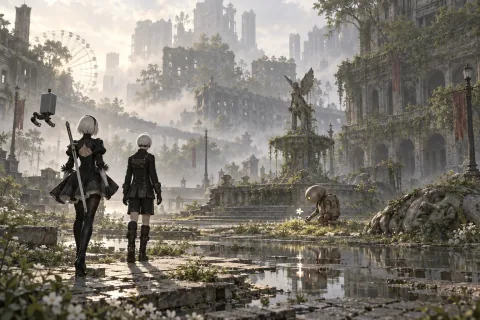
To investigate signals from missing YoRHa personnel, 2B and 9S pass through the city's sewers and climb a ladder into the amusement park. Rides once enjoyed by human visitors remain, along with a castle-like building and festive decorations. Machine lifeforms now fill the space in place of human audiences. Machines imitating clowns and parkgoers keep the celebration going. After the desert's repetitions of family and reproduction, play and festivity come into view.
Many machines at the entrance and in the square do not immediately attack when the soldiers approach. Some can be spoken to; others continue their festivities. This is a place where carrying weapons does not put every encounter into the same sequence of combat. Contact can differ from their familiar experience of meeting an enemy, being attacked, and fighting back. Attacking first can change the relationship, but killing all these machines is not a requirement for reaching the next area.
Farther inside, beyond the rides, stands a large tank. Its enormous weapon recalls the war machines they fought at the factory, but this tank is also not a compulsory target. They can take the next path without attacking it. Here, visible combat capabilities differ from the action a machine is actually choosing now. A large body alone does not prove an immediate intention to hurt them.
The park's celebration is not sustained by humans returning to applaud. Machines that have learned human amusements are using the space. The soldiers must pass among them in search of the next clue. The possibility of walking past peaceful individuals and the danger awaiting in the theater coexist in the same place. An outwardly cheerful festival does not establish the whole park as a safe community.
2. The stage at the end of the roller coaster
A moving roller coaster lies on the way to the theater. 2B and 9S ride it through the park's elevated areas. A ride once used by human visitors to enjoy the view now carries soldiers toward the next scene of their investigation. Fireworks and decorations are visible, but they must also fight machines attacking them along the way. The attitude shown by machines in the square does not extend to every individual here.
The theater beyond the coaster houses Beauvoir, a gigantic singing machine. She resembles a singer in an elaborate dress, but her decorations and weaponry incorporate captured android bodies. They cannot all be treated as corpses. Living androids close to death are also being used. Signals from still-functioning black boxes were both the clue that brought the soldiers here and a trap. The two have not simply come to watch a machine's performance.
Beauvoir attacks them. Her wide-reaching attacks and immense body turn the stage into a battlefield, forcing the soldiers to dodge and counter threats that accompany her singing. Her appearance as a singer does not mean the performance will end safely if they briefly stop fighting to talk. They fight while seeing bodies of androids like themselves being used by her. Even if she wants to become beautiful, the danger to those facing her is real.
Beauvoir deploys spreading shockwaves and ring-shaped projectiles. Contact with a ring forces the soldiers to respond to an intrusion into their systems, shifting the screen to a shooting-style hacking space where they must locate and destroy a core. Swinging a sword at her massive body is not enough to complete this battle. During it, damaged androids are called out to add similar attacks. 2B and 9S must overcome both the external barrage and threats entering their own systems.
3. Bodies used as decorations
The androids controlled by Beauvoir are not companions freely joining her performance. They have already been harmed and are used as weapons against their original will. When their bodies move to threaten the soldiers, 2B and 9S see their own side occupying the role of parts in an enemy's construction. Defeating Beauvoir also serves to stop this exploitation and these attacks. Learning her story later does not undo the existence of those she harmed.
In the first perspective, this external scene is what the soldiers and player encounter first. A huge, ornamented machine sings, attacks androids, and uses other beings' bodies as if they were parts of herself. The game does not first explain her entire past and then ask whether they wish to fight. The immediate need to survive comes first. Between the peaceful behavior at the park entrance and the violence onstage, the differences within the category of machine lifeforms grow wider.
The two ultimately defeat Beauvoir. Her attacks on the stage end, and the immediate threat stops. But when the player goes through this battle again from 9S's perspective in Route B, a different span of time accumulated inside that vast decoration becomes visible. Hacking offers more than a shortcut for destroying an enemy: it becomes a way into the reasons that brought her to this state.
The memories added later are not proof of innocence that cancels the violence of the same battle. They reveal both what Beauvoir wanted and whom she consumed in pursuit of it. The grotesque shape first encountered onstage now appears as the accumulated result of choices and failures. The individual who once hoped for something and the perpetrator she has become belong to one story.
4. Wanting Sartre to look at her
What Beauvoir wanted was the attention of another machine, Sartre. He spends his time discussing his ideas, and machines attracted to him are drawn to his words and manner. Beauvoir is one of those who watched him. She wants her feelings to reach him, but he does not look back at her in the same way. She begins searching her own appearance for the condition that might earn his gaze.
She comes to believe that becoming beautiful will make her loved. Records left by humans and information acquired from others become the basis of her education in beauty. She adds ornaments and decorations and changes her body. She was not originally made as the huge theater singer with no purpose beyond killing soldiers. Her desire to be chosen by someone gradually carries her toward that form.
Yet altering her body and adding adornments do not bring the response she wants. Beauvoir cannot simply accept these failures as reasons to stop. She keeps reaching for other means, believing she still lacks something that could make her more beautiful. She places hope in the claim that eating other machines will confer beauty and eventually uses android bodies as ornaments as well. Her endless search for a deficiency in her own body to explain his indifference spreads into harming other beings.
The decorations gathered this way produce the figure seen onstage. There is a profound gap between the goal of beauty and the result of taking and attaching other bodies. Sartre remains the judge who matters to her, yet he has never promised love in return for a transformed body. This was not a transaction in which performing tasks he specified would complete a relationship. The conditions Beauvoir set for herself simply kept growing.
The memories exposed through hacking end alongside the final battle. The fact that 9S and the player can see her circumstances does not substitute for being loved by the person whose affection she wanted. Nor does it restore the beings she consumed. For those who learn the wish behind the song and ornaments, destroying this enemy becomes more complicated, while the violence that had to be stopped remains real.
5. Sartre's melancholy: two soldiers carrying gifts
Speaking directly to Sartre and meeting the machines around him leads to an optional quest once Pascal's village becomes accessible. This cannot therefore be placed in the past as something 2B and 9S necessarily completed before entering the theater. It explores themes of Beauvoir's battle in another setting. The soldiers meet machines who admire Sartre and take on the task of conveying their feelings.
His three admirers are in different places. A machine wearing makeup in Pascal's village gives them a letter, a dreamer in the amusement park supplies Beautiful Glass, and a machine in love in the desert housing complex sends a Machine Fossil. The soldiers travel between village, park, and desert to deliver these objects. The price humans might assign to them differs from the value machines attach to them as expressions of affection. Along the way, the two hear what each admirer sees in Sartre.
Delivering the gifts does not bring the gratitude and affectionate answers the admirers hope for. Sartre shows little interest in the objects. He does not receive his admirers' feelings in the way they wish. The soldiers must return to those who asked them and report his responses. Carrying an item to its destination does not complete a simple exchange of gift and thanks.
Some admirers, however, interpret even a disappointing response as part of the manner that attracts them. Whatever Sartre does can be read as fresh proof of his specialness. Alongside Beauvoir's response to his indifference as a reason to modify her body further, this shows desire taking different directions within similarly one-sided relationships.
After reporting to each admirer, the soldiers return to the village and find Sartre gone. Speaking to the round machine nearby gives them the letter he left and concludes the quest. It does not change Sartre into someone who loves Beauvoir, nor unite all his admirers into a mutually understanding family. The soldiers see that machines also experience reciprocal relationships and one-sided expectations, and that the strength of one person's feelings cannot determine another's heart.
6. A guide approaches after the theater
As the two leave the park battle behind, another machine approaches carrying a white flag. It does not attack first, and offers to guide them to its village. In the theater, a machine used android bodies as weapons and decorations. Now one wants to bring two armed soldiers into its own community. These successive contacts make it harder to see all machines as a single group with one attitude.
2B and 9S follow the guide. This is not a transformation in which they lay down every weapon and declare there are no enemies before checking whether a stranger's words are trustworthy. They remain cautious but go to see the village themselves. Another possibility opens: the objects of their investigation may include more than factory weapons and the enormous threat born in the desert.
At the end of that path are Pascal and the children. If the park's machines have learned expressions of play and love, Pascal's village tries to turn them into rules for living together and caring for others. Having passed through the story of Beauvoir's desire growing toward the attachment of other beings to her body, the soldiers now encounter machines trying to protect one another. The relationships formed there will give them a basis for understanding later loss.
Sources and regional names
Beauvoir and Simone, and Sartre and Jean-Paul, are names used in different regional versions. Beauvoir's past is tied to Route B's added perspective, while carrying gifts to Sartre is a separate optional quest. Destroying every peaceful machine and the tank in the park is not treated as mandatory story progression. This is TroubleMaker's AI-assisted story commentary, without reproduction of original dialogue or lyrics. Checked on October 18, 2026, Bangkok time.
Jean-Paul / Sartre — NieR Wiki
Letter for Jean-Paul — NieR Wiki
comments 0