
StarCraft Chronicle Episode 3: Those Who Lost Their Earth to Return To
Chapters in this story
- Awakening Inside a Drifting Cage
- The Crash Landing and the First Steps on a Strange Land
- Deformed Expansion Beyond Survival
- The Tyrannical Rule of the Terran Confederacy
- Divided Humanity and the Clash of Factions
- The Rebellion of Korhal and the Fiery Pillars of Apocalypse
- Hatred Blooming from the Ashes
- Sons of Korhal, Oath of Blood
- Verified Sources
This is a fan narrative newly written based on the events of the original work. The characters' emotions, dialogue, and scene atmospheres have been reconstructed, and it includes major endings.
Awakening Inside a Drifting Cage
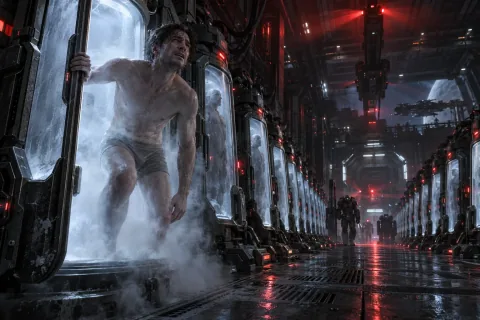
A cryogenic chill, piercing like a needle to the spine, forcibly awakened a paralyzed neural network. A nameless exile stared blankly at a dim, blinking red emergency light through the frozen glass of a stasis pod. Inside the massive supercarrier launched by the United Earth Directorate, only an ominous, mechanical warning sound echoed incessantly.
His muscles were stiff as stone, and the air rushing into his lungs was as sharp as a blade. Suppressing a wave of nausea with trembling hands, he pushed open the heavy door of the stasis pod. The painful groans of those waking from decades of long slumber began to rise like ghostly wails from every corner of the massive ship's interior.
This was not the originally planned orbit of Gantris VI. As the navigation system of the ATLAS supercomputer completely collapsed, the four massive colony ships had lost their destination and drifted through space. With the warp engines' residual power depleted, they were ruthlessly cast away into an unknown star system whose very name they did not know.
The exile stumbled toward the central observation window. Beyond the pitch-black void of space, the light of an unfamiliar star cast bizarre, colossal shadows. The blue light of Earth had long since become a distant legend, faded from memory. They were completely abandoned in this cold universe.
The Sarengo, the Reagan, the Argo, and the Nagglfar. These massive iron cages, packed with prisoners, dissidents, and those branded as mutants, were now falling out of control, tracing their own chaotic orbits. Only chilling mechanical static flowed from the communication channels, confirming their despair.
The ship's artificial gravity generator fluctuated, and the floor began to tilt terrifyingly. People screamed, desperately clinging to fixed iron pillars or the handles of stasis pods. The exile held his breath, which had risen to the back of his throat, as he watched a strange planet with a massive, red atmosphere approach at a terrifying speed outside the window.
The friction of atmospheric entry heated the ship's thick outer hull to a glowing red, unleashing a deafening, tearing roar. The internal temperature rose rapidly, and emergency sprinklers activated, but they were far from enough to drown out the desperate screams of the terrified passengers. This was not a safe landing, but a ruthless plunge toward a predestined doom.
A powerful shockwave slammed through the entire ship, instantly cutting all power and plunging everything into pitch-black darkness. As the exile's vision was sucked into the void, only the horrific sound of the massive metal hull crashing into the alien soil filled his final moments of consciousness, stripping away all sensation.
The Crash Landing and the First Steps on a Strange Land
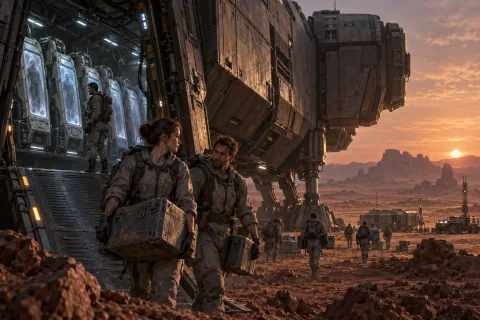
In the year 2259, the remnants of humanity were ruthlessly scattered across an unknown star system that would later be named the Koprulu Sector. The Sarengo, which crashed onto the planet Umoja, met a tragic end as its hull shattered into pieces during atmospheric entry, killing everyone on board. It was a horrific and futile demise, offering not even the slightest chance of survival.
On the other hand, the survivors of the Nagglfar, which crash-landed on Tarsonis, crawled out through the acrid smoke. A nameless colonist wiped his bloodied forehead and gripped the coarse soil of the alien land. While the gravity and atmospheric composition were similar to Earth's, the bizarre color of the sky and the dry scent of the wind felt alien to the bone.
The situation of the Argo, which reached the planet Moria, was not much different. On a desolate land whipped by red dust storms, the survivors had to huddle together, using the wreckage of the collapsed hull as a shield. All they were given was a harsh and primal mandate: to survive in this barren environment.
Amidst the painful groans of the injured, the colonists frantically rummaged through the wreckage to find usable supplies. Emergency rations and medical kits were severely lacking, and as night fell, the harsh cold of the alien planet cut to their bones. The relief of survival quickly turned into dread of the impending hunger and cold.
The ATLAS supercomputer aboard the Nagglfar was the sole beacon of hope and lifeline for the survivors of Tarsonis. By restoring ATLAS's vast database, they analyzed the surrounding environment and found ways to secure drinking water. The cold computational power of the machine was precariously extending fragile human lives.
People began tearing away the ship's massive outer plating to build temporary shelters to escape the harsh nights. The dazzling sparks of heavy laser cutters slicing through metal embroidered the alien night sky. It was the first scar of survival, carved by those abandoned by Earth to force their existence upon this unforgiving universe.
Physical labor was endless, and many collapsed from exhaustion and unknown alien diseases. A colonist buried the cold corpse of a companion in the barren earth, his calloused hands trembling. The despair of never being able to return home gradually transformed into a venomous instinct to survive on this dreadful land at all costs.
As the years slowly passed, the horrific scars of the crash landing began to be covered by massive metal structures. The humble temporary camps of survival were soon packed with massive, smoke-belching factories and rugged concrete buildings. It was a historic moment as a new alien species called humanity took deep, stubborn root in the Koprulu Sector.
Deformed Expansion Beyond Survival
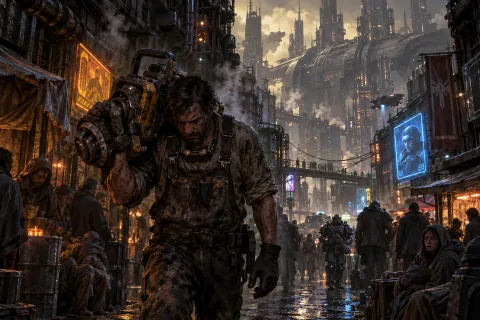
Decades of arduous years completely transformed the barren settlement into a colossal human industrial city. The sky of Tarsonis was always hazy with thick smoke spewing from massive factory chimneys, and in every narrow back alley, the smell of machine oil and the stale sweat of people clung together, emitting a suffocating stench.
Supplies remained severely scarce, suffocating the lives of the people. A nameless laborer slung rusty mining equipment over his heavy shoulders and took heavy steps down into the pitch-black underground mines. After sixteen hours of grueling labor, all that was given was a miserable ration of food, yet no one dared to utter a complaint.
In the heart of the city, skyscrapers built using the massive wreckage of the old ships as skeletons flaunted their imposing grandeur. The few powerful elites who had led the initial settlement enjoyed safe and affluent lives atop those high towers. Meanwhile, the lower class had to eke out a living like beasts in damp underground sectors where even sunlight could not reach.
The fierce struggle for survival ruthlessly trampled upon human dignity. Desperate riots broke out daily in front of food distribution centers, and those whose heads were cracked by the ruthless batons of private mercenaries rolled on the cold streets. Laborers averted their eyes from the blood-stained ground, silently hurrying to their workplaces.
Monopolizing the overwhelming technology of the ATLAS supercomputer, Tarsonis rebuilt its civilization at a much faster pace than the other planets. They constructed orbital shipyards and began building new vessels to sail the cosmos. The roar of engines tearing through the sky was an object of awe for the lower class, yet simultaneously a symbol of inescapable oppression.
As the city expanded recklessly, the surrounding natural environment was thoroughly destroyed and polluted. Toxic wastewater dyed the rivers red, and mutated creatures exposed to radiation prowled the outskirts. The colonists were repeating, on this alien planet, the exact same destructive nature that had gotten them exiled from Earth in the first place.
A laborer sat in the corner of a dingy, smelly tavern, wetting his tired throat with cheap synthetic alcohol. On the television screen, the leaders of Tarsonis delivered grand, deceptive speeches proclaiming the colonization of new worlds. Yet, beneath that splendid blueprint lay nothing but endless greed for more resources and slaves.
As night deepened, the city's neon signs flashed bizarrely and dreamily through the thick smog. Rather than the warm light of civilization, it resembled the flashing eyes of a colossal monster struggling for survival. Humanity in Koprulu continued its deformed expansion and growth without pause, eating away at its own soul.
The Tyrannical Rule of the Terran Confederacy
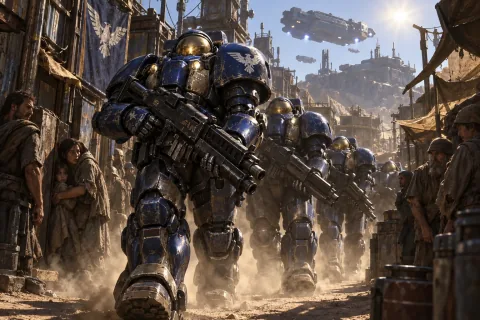
The greedy ruling class of Tarsonis finally proclaimed a massive political entity known as the 'Terran Confederacy' to the cosmos. The privileged class, known as the 'Old Families,' began to assert absolute hegemony over the entire Koprulu Sector, backed by ATLAS's technology and formidable military power. Their arrogance seemed ready to pierce the very orbit.
Whenever Confederate Marines marched through the colony streets in their bulky, massive armored suits, people trembled in fear and quickly made way. Under the plausible pretext of maintaining public order, the Confederacy crushed dissidents with ruthless violence and levied exorbitant taxes to build the skyscrapers of Tarsonis even higher and more luxurious.
The residents of the fringe colonies suffered under the Confederacy's endless exploitation, harboring deep resentment in their hearts. An old farmer on a frontier planet collapsed in despair after having most of the crops he harvested with blood and sweat seized by armed Confederate tax collectors. To them, the Confederate flag was not a symbol of protection, but a death warrant sentencing them to starvation.
The nobles of the Old Families enjoyed luxurious banquets every night on Tarsonis's splendid orbital stations. Sipping the finest wine from crystal glasses, they treated the fringe colonists as uncivilized, filthy savages. In their arrogant eyes, the lower class was nothing more than cogs to be silently consumed for the prosperity of the Confederacy.
The Confederacy's political machinations were as cunning as a serpent and as brutal as a beast. They bribed colonial leaders with vast wealth and power to sow internal division, and sent dark assassins to those who refused to submit. Secret, bloody purges were the most effective and reliable means of maintaining the Confederacy's reign of terror.
The press was thoroughly controlled, blinding and deafening the public. Every day, the news networks parroted disgusting propaganda broadcasts praising the greatness of the Confederacy and the benevolence of the Old Families. A handful of conscientious journalists who tried to speak the truth were branded as 'traitors' and dragged to secret prison camps, never to see the light of day again.
The Confederacy's military power grew bloated by the day, threatening neighboring planets. Massive Battlecruisers patrolled the orbit of Tarsonis, flaunting overwhelming military might. Whenever the shadows of those colossal steel vessels fell heavily upon the soil of the colony planets, the people realized with bitter clarity that they could never escape this massive oppression.
Yet, as the oppression intensified, the embers of resistance burned secretly and fiercely. In underground taverns and abandoned factory districts on the outskirts, voices enraged by the Confederacy's tyranny began to gather cautiously. Contrary to its outward appearance, the splendid golden age of the Terran Confederacy was slowly rotting from its very foundations, showing signs of collapse.
Divided Humanity and the Clash of Factions
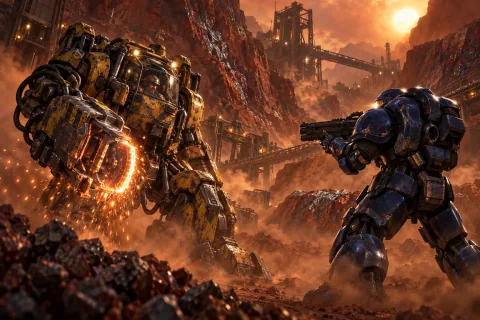
Not every planet meekly bowed its head and submitted to the brutal dictatorship of the Terran Confederacy. The rugged mining guilds of the planet Moria formed a coalition to resist the Confederacy's blatant resource plunder, establishing the 'Kel-Morian Coalition.' Rallying tough miners and money-hungry mercenaries, they defended their mines from the Confederacy's greedy clutches.
The Kel-Morian stronghold was a massive industrial complex where red dust and sharp mechanical noise never ceased all day long. Coalition executives, with expensive cigars in their mouths, ruthlessly commanded localized skirmishes against Confederate forces over holographic tactical maps. To them, what mattered was not noble ideology or a grand cause, but solely the ownership of resources and massive profits.
The Coalition's laborers preferred to be expendable assets of the Coalition rather than miserable slaves of the Confederacy. Wearing illegally modified mining power suits, they engaged in blood-spattering firefights with regular Confederate Marines. This grueling struggle for resources, known as the 'Guild Wars,' left indelible scars and deep-seated resentment on both sides.
On the other hand, the people of the planet Umoja carefully chose a completely different path from armed conflict. Extremely wary of the Confederacy's bellicose expansionism, they quietly established an independent self-governing body called the 'Umojan Protectorate.' Rather than all-out war, Umoja's leaders sought to protect their territory through advanced technological development and strict control of information.
The cities of Umoja had an atmosphere entirely different from the smoke-filled skyscrapers of Tarsonis or the rugged factory zones of Moria. Atop calm, orderly white streets, advanced defense systems operated silently. They thoroughly rooted out spies sent by the Confederacy, while conversely planting their own capable informants deep within the heart of Tarsonis.
Umojan scientists actively welcomed brilliant intellectuals who had escaped the Confederacy's oppressive regime, building up their technological prowess. They secretly studied individuals with psionic potential and covertly sought ways to counter the Confederacy's inhumane neural-resocialization technology. Behind the peaceful veil of the Protectorate, a cold and fierce war of intellect was being waged.
The Terran Confederacy, the Kel-Morian Coalition, and the Umojan Protectorate. Humanity in the Koprulu Sector was thus split into three major factions, maintaining a precarious and fragile balance. Deep distrust and hostility toward one another filled the void of space with taut tension, making this star system resemble a massive powder keg that could explode at any moment from a single spark.
In the border regions of each faction, minor and major armed clashes and covert struggles occurred without end every day. Nameless smugglers took advantage of this chaotic situation, trading illegal weapons and rare resources in a life-or-death tightrope walk. Even after leaving Earth, humanity had ultimately failed to escape the dreadful cycle of pointing blades at one another's throats and shedding blood.
The Rebellion of Korhal and the Fiery Pillars of Apocalypse
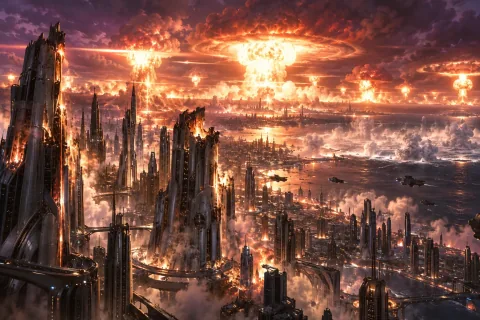
The planet Korhal IV, once one of Tarsonis's most vital and prosperous colonies, was the first to bravely rebel against the Confederacy's tyranny. Angus Mengsk, a senator of Korhal, fiercely denounced the Confederacy's corruption and endless exploitation, declaring complete independence. The citizens of Korhal, galvanized by his passionate speeches, poured into the streets, tearing down and burning the Confederate flag.
The hot flames of rebellion spread uncontrollably across the entire planet in an instant. Despite their poor armament and lack of training, Korhal's militia pushed back the Confederate garrison with overwhelming momentum, driven solely by their yearning for freedom. The name of Angus Mengsk was deeply engraved as a symbol of hope in the hearts of all colonists who yearned for liberty.
However, the Old Families of the Terran Confederacy had no intention of tolerating this rebellion that challenged their authority. They first sought to nip the rebellion in the bud by assassinating Angus Mengsk and his family. Yet, when his son Arcturus, fueled by rage, organized a rebel force and pushed back the Confederate military, they opted for an extreme solution. To fundamentally prevent Arcturus's resistance force from threatening the Confederacy, a thousand Apocalypse-class nuclear missiles were launched simultaneously from the orbit of Tarsonis toward Korhal.
The peaceful sunset that had dyed Korhal's beautiful sky red was instantly and completely engulfed by an eerie, blinding white light. Citizens who had been cheering and celebrating their victory in the streets screamed in horror as they watched the rain of death pour from the heavens. There was not even time for evacuation sirens to sound. Colossal pillars of fire ruthlessly pierced and erupted from the planet's surface.
The ultra-high-temperature nuclear firestorm swallowed everything without mercy. Splendid skyscrapers melted instantly into ashes, and countless people vaporized on the spot before they could even register the pain. The once-fertile land melted under the horrific heat, glazing over like glass, while the oceans across the entire planet boiled furiously, spewing steam of death.
Radioactive fallout poured down continuously like black snowflakes, piercing through thick dark clouds. Korhal, once the most beautiful and prosperous planet in the Koprulu Sector, was reduced in a single day to a horrific radioactive wasteland where no living thing could survive. Before the Confederacy's ruthless and overwhelming power, the freedom Korhal had dreamed of was thus brutally trampled and extinguished.
The controlled news network of Tarsonis shamelessly reported the complete destruction of Korhal as a "just and merciful punishment for foolish rebels." As the horrific spectacle of Korhal, turned to ash, played across television screens, all the colony planets fell into a deathly silence. It was a tragic moment where overwhelming terror completely replaced hope.
Inside their secure bunkers, Confederate leaders clinked their finest wine glasses, arrogantly celebrating their steadfast power. They did not doubt for a second that the destruction of Korhal had served as a perfect example to any who dared dream of rebellion. Yet, they remained entirely unaware that from those horrific ashes, the most dangerous monster—one that would choke the life out of the Confederacy—was awakening.
Hatred Blooming from the Ashes
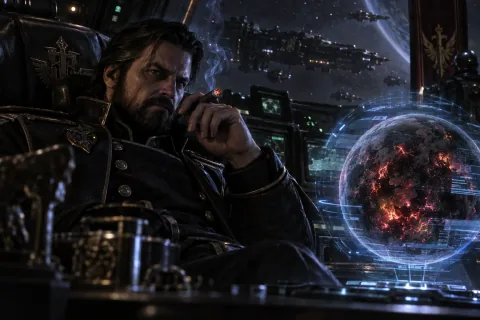
Arcturus Mengsk had already abandoned his life as a cynical businessman when he received news aboard a frontier prospecting vessel that his father Angus and his entire family had been brutally assassinated by Confederate Ghosts. He had led a rebellion to exact vengeance upon the Confederacy that had slit his family's throats, but while negotiating an alliance on Umoja, he received word that his homeland of Korhal had been completely destroyed by a thousand nuclear missiles, reduced to a gray sphere, and he froze like stone once more. From the deepest recesses of his heart, a cold and fierce hatred began to surge like boiling lava.
Unable to turn off the flickering holographic screen, he sank deep into his cockpit chair. The blue smoke rising from the cigar held between his fingers drifted away futilely through his tightly closed lips. Weak emotions like sorrow or despair were luxuries. From the deepest recesses of his chest, a cold and fierce hatred began to surge like boiling lava.
In the past, Arcturus had often distanced himself from his father, mocking him as a foolish idealist who did not understand reality. He had thought it a meaningless, suicidal act to throw eggs at a colossal monster like the Confederacy. However, the blind violence of the family assassination committed by the Confederacy shattered his long-held cynicism and summoned him to the battlefield. And now, the unprecedented nuclear bombardment unleashed by the Confederacy had ruthlessly taken even the innocent citizens of Korhal, erasing the very source of his existence from the cosmos.
He reached out with a hand trembling faintly with rage, gripping the metal plating of the cockpit as if to crush it. As he closed his eyes, horrific auditory hallucinations of Korhal's citizens screaming as their flesh melted in radioactive flames swirled dizzily in his ears. Those hallucinations gradually became a distinct voice, whispering of bloody vengeance. A cold, sharp madness flashed in Arcturus's dark eyes.
"The old beasts of the Confederacy have absolutely no idea what they have just done," he muttered in a low, dry, raspy voice. The arrogant nobles of the Old Families believed they could control everything forever through overwhelming terror, but they failed to calculate just how destructive a storm the pure wrath of a man with nothing left to lose would bring.
Arcturus slowly stood up and took heavy steps toward the ship's cramped armory. Picking up a worn, cold pistol, he stroked the cool barrel with his fingers. He was no longer a prospector drifting through space in search of profit. His heart now began to beat, pumping red blood solely for the thorough and horrific destruction of the Terran Confederacy.
He skillfully operated the communications console to open an encrypted secret channel to evade Confederate surveillance. He transmitted a covert and resolute message to the few survivors who had miraculously escaped the catastrophe of Korhal, and to the underground organizations harboring resentment against the Confederacy's tyranny. It was not a lamentation for the victims, but a declaration of a bloody war. There was not a single tremor or hesitation in Arcturus's voice.
Beyond the observation window, the pitch-black darkness of the endless universe stretched out silently. In that darkness, Arcturus clearly saw a blood-red future where the skyscrapers of Tarsonis burned. He swore that he would complete the revolution his father had failed to achieve, and that he would not shrink from any cruel means in the process. To tear the monster apart and kill it, he had willingly resolved to become an even larger, more horrific monster.
Sons of Korhal, Oath of Blood
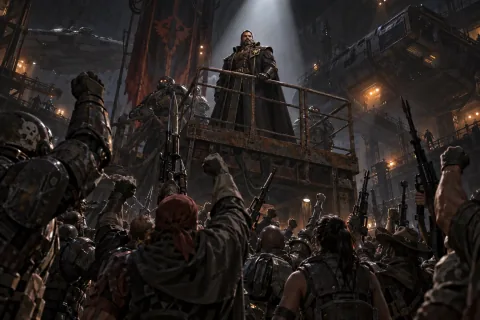
In an abandoned asteroid base hidden on the outskirts of the Umojan Protectorate, dozens of people gathered cautiously in a dark, damp hangar. They were survivors who had escaped the devastation of Korhal, soldiers who had deserted after disobeying the Confederate military's massacre orders, and those who had lost their beloved families to the endless tyranny of the Old Families. In their hollow eyes, deep fatigue and suppressed rage lingered dangerously.
Arcturus Mengsk walked up onto a rusty iron platform with heavy boot steps. His long black coat cast a thick, massive shadow under the sharp floodlights. He stared deeply into each of the scarred faces of the gathered crowd. In that suffocating moment of silence, a tension so taut hung in the hangar that not even a single breath could be heard.
"Our beautiful home has burned," Arcturus's voice echoed heavily, striking the walls of the empty hangar. "The Confederacy has ruthlessly turned our families to ash and calls it peace. They want us to be paralyzed by overwhelming fear and kneel forever. But we will never bow our heads to their will."
From the enraged crowd, the sound of someone clenching their fist so hard their knuckles turned white could be heard. Arcturus leaned forward, gripping the platform firmly. "My father, Angus Mengsk, died like a beast while crying out for freedom. I inherit his blood, and I intend to finish this horrific struggle he left behind. We will pierce the rotten heart of the Confederacy with our rage, once and for all."
His eyes burned with a fierce desire for vengeance. "We will no longer flee into the darkness. We will not weep in silence. We are the avatars of vengeance born from the ashes of Korhal, the flames of wrath that will completely purify this rotten universe. We are the 'Sons of Korhal'!"
As soon as Arcturus's blood-boiling declaration ended, the hangar filled with an explosive roar of cheers. People raised their rusty bayonets and fists, frantically chanting the name of the Sons of Korhal. On their faces, instead of the crushed despair, a mad hope and murderous intent bloomed. Arcturus looked down at the enthusiastic response, a cold and calculating smile playing in his mind.
He calculated precisely how excellent and sharp a weapon this blindly enraged crowd would become. The sweet and noble causes of justice and freedom were the perfect shackles to make them willingly throw away their lives. Arcturus raised his hand to quiet the cheers and began to coolly direct their first armed operation to strike a Confederate supply depot.
At this very moment of the birth of the Sons of Korhal, the massive, bloody cogs grinding toward the downfall of the Terran Confederacy began to turn with a roar. Still entirely unaware of the horrific threat harbored by the unknown alien races yet to come, humanity was injecting the most lethal poison of its own making into its own veins. The true age of blood that would swallow the cosmos had finally raised its curtain.
Verified Sources
Blizzard Official StarCraft Chronicle
StarCraft and Brood War Official Game Introduction
Official Story Presentation and Reference Images from Remastered
The Past of Mengsk and Kerrigan as Explained by the Developers
comments 0