
SANABI Story 6 · Her Mother’s Song and the Final Salute
Chapters in this story
This is an original narrative commentary following the events of the main game. This installment includes the true ending and epilogue, followed by a separately identified bad ending. The two conclusions result from different choices and are not consecutive events on one timeline.
1. Climbing the City Again
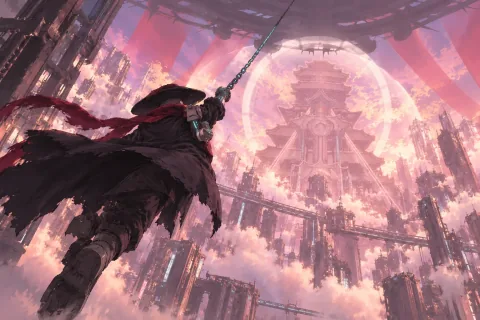
From the lowest district to the highest level, the General climbed again. Neither routes nor enemies had disappeared. The city where he destroyed Writ of Execution, fought Justice, and fled the Overseer still stood before him. But his body without the components restricting it, and his heart that knew what he was traveling for, differed from the first journey.
The name that forced revenge on him again through the memory of an explosion whenever he was stopped was recovering another meaning. The journey to save Mari required no enemy’s face assigned by Mago. He needed only to know where the girl was: the one he had tried to send away, who returned and saved him.
Mari remained before the reactor. She blamed him for failing to follow the plan, leaving them too late. Now, she said, the only way was for her to enter the core and dismantle it herself. The knowledge that no human could return alive from inside gave that resolve its weight. She intended to end with her own life the tragedy she believed began with her father’s death and her own talent.
When the General called her name, Mari became angry. She threw her headphones and told him not to call her by name. She did not want a machine imitating her father to take even the grief she shared with him. It was the anger of someone who repeatedly hoped and was disappointed. A desperate refusal: if he was not her father, he should not try to fill that place.
Her words returned what the General had said about Mufin. A machine imitating a person. He now knew how deeply those words hurt his daughter. A lengthy explanation of who he was could not reach her. He took out the harmonica, the instrument he first said he could not play and then sounded only a single note upon.
2. The Song That Came from Her Mother
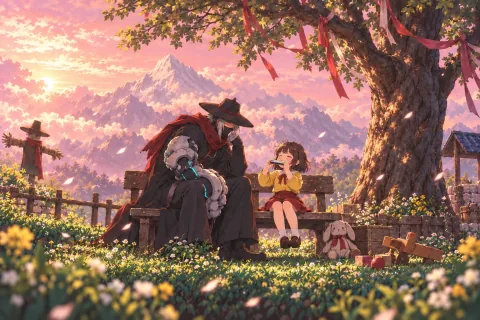
The mountain memory returned. After her mother’s death, his daughter taught him to play the harmonica. He thought he merely had to play through to the end. But neither pitch nor rhythm was right. She told him that arriving at the end was not the only thing that mattered. The conversation whose answer was missing at the beginning reached this small time of music.
Her father felt he was not doing enough for her. Her mother’s empty place was enormous. Hearing his feelings, his daughter returned the comfort she had learned. When their cat Mufin died, she explained, her mother had played the song and spoken about meetings and partings. This cat and the present drone are not the same being. The drone’s name carried onward an earlier family memory.
Whoever one meets, the time spent together is never infinite. That makes the time together precious. Instead of trying to erase her child’s sadness over losing the cat, her mother taught her the meaning of the time they shared. Now the daughter conveyed that feeling to her father, who had lost his wife: the moments playing with him had made her happy, and she was grateful that he still played with her.
His daughter also had adventures she wanted to share. She wanted to become a soldier like him and go to a great castle where villains lived. She wanted to defeat a giant worm man, take a photograph with Justice, run from an unbeatable monster, and ride a train that flew through the sky. There was also a promise to play her mother’s song again if she became sad later.
Their shared experiences in Mago City overlapped with that promise. The enormous shredder and Justice, the Overseer they could not defeat in battle, and the flying train. The adventure had not unfolded as safe play exactly like childhood. Yet within the actions Mari followed in hopes he would remember remained the child’s wish to share an adventure.
Sanabi had not first come into existence as an enemy’s name. It was the song passed from mother to daughter and from daughter to father. Before Mago’s altered memories, a feeling had connected this family. What endured despite erasure and distortion was the trace of that feeling, rather than a password or command.
3. The Moment She Can Call Him Father
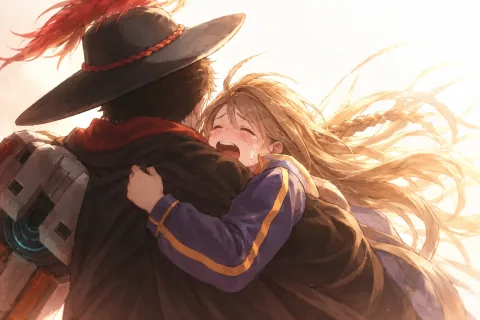
The General played Sanabi. This time, he did not push through notes merely to reach the end. He properly followed the flow of the song his daughter taught him. For Mari before him, the music answered who he was. The harmonica she repeatedly offered finally crossed the barrier where words could not pass and connected them.
Mari burst into tears and embraced him. She no longer had to call him a stranger and test him. The time of questioning whether he was her father and pushing him away again as a machine fell apart. At last she could call the person she awaited Father.
He acknowledged how much his daughter had suffered. At first Mari tried to say she had been fine, then admitted that she had struggled for a long time. Her father’s death did not feel real, and she thought he might answer from somewhere if she called. Yet as time passed, the father in her dreams faded while the reality without him became clearer. Even falling asleep to dream again frightened her.
For ten years, memories she held for fear they would disappear grew more indistinct the harder she clung. The place Mari tried to return to through cheerful speech, drawings, and harmonica was more than a past scene. It was a life with a father who would recognize and answer her. Only in his arms could she reveal the grief she concealed to endure those years.
Mari apologized. She believed her creation of the data caused his death and everything afterward. She also confessed guilt for repeatedly failing to believe in him and trying to give up. The General saw that she stayed beside him to the last. His daughter had returned to save him despite fear and offered the harmonica despite knowing there was no chance.
What he sought to leave her was shared time and gratitude, rather than a list of faults. A child’s good intention being stolen and used by criminals for tragedy did not mean the child must bear all responsibility. He wanted to carry their memories together rather than her apologies. Her father did not repeat the judgment Mari had long imposed upon herself.
4. The Last Commander
Even after their reunion, the reactor did not stop. It had already passed its limit. Mari clung to him and asked to leave together. She said she would try to repair him. If technology could hold the time she had gained once again, she would do anything. But the General reminded her of the parting her mother had spoken about.
Mari did not want to accept it. She had no confidence she could endure a world without him again. After living ten years in his absence and only just returning to his arms, another ending was no less painful for being understood. The General conveyed his love for her. Then he returned the meaning that, if endings come to everyone, what truly matters is how one lives toward that end.
At first, he believed that taking revenge to the end was enough. Now he chose what he must do so his daughter could go on living. Even when Mari held him and pleaded to die together, his choice did not change. He wanted to conclude with his own hands what he felt had begun because of him, and above all he could not let her enter the core.
He handed Mari the iron identification token. She had left it as a child, Song had preserved it, and it had passed through her father to return to her. That handover carried his request that she remember him and his gratitude that she had grown this way. Their adventure together, however brief, was precious to him.
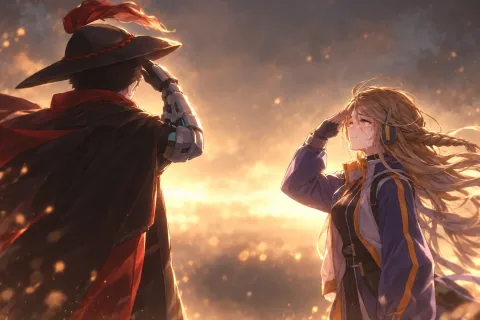
Mari called her father to a stop once more. After a pause, she saluted. Her tears had not stopped, nor had parting become bearable. Nevertheless, she could send her final greeting. The General returned the salute. Their game, in which the child became commander and her father obeyed her orders, became the form of a greeting that could truly be their last.
He entered the core. Mari sank down, holding the token to her chest. Taking the radiation upon himself, the General dismantled the core and sacrificed himself to save the city and his daughter. Reunion was not an ending that kept him alive forever. But Mari could now know what he had traveled his last road for.
5. The Days Those Left Behind Live On
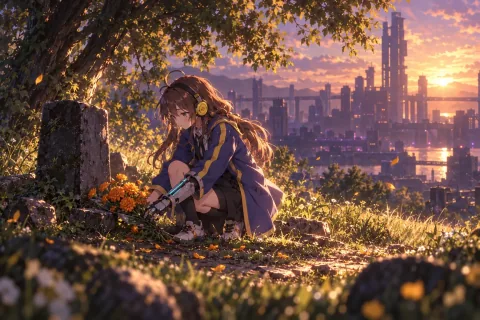
After time passed, Mari laid flowers at a grave where marigolds bloomed. She missed her father. She could go forward without that longing disappearing. She had become able to move while carrying his memory. Wearing a wire gauntlet resembling his chain arm, she set out again.
Baek and Song took Mari to the old training ground. Her wish to become a soldier like her father continued into a new time there. Song immersed herself in training, and Mari was astonished by the severely damaged training ground. The General’s last advice remained in the time his junior spent continuing to strengthen herself. They had returned to daily life while remembering their superior.
Other people’s time returned to the city. In the lowest district, an inspector examining the destroyed Writ of Execution was astonished by equipment far beyond national safety standards. Workers said they had been following orders from above. Watching the news, commercial-district citizens spoke as if the court had staged the incident to seize the city. Not everyone knew the truth the General and Mari had seen.
Firefighters could not enter the factory because the Overseer continued its destruction and fires still burned. Residents of the highest level left for other cities. A gap remained between the crisis they witnessed and the actual crimes behind it. The city’s survival did not turn the ending into one where every Mago record was intact and everyone understood the truth.
Robbers targeting the commercial district were subdued by Justice. This showed that Mago’s mass-produced units fought earlier were not the entirety of the being called Justice. Even if the corporation used Mari’s childhood admiration as a weapon, it had not erased every other life connected to that name.
Mari put in order the home where she had long shut herself away. On the refrigerator was a childhood drawing. A happy moment placing a paper hat on her father and being together. She did not depart leaving the drawing behind. She took it with her. It was a final image of being able to enter a new day with memory, rather than having to forget her father to live.
6. A Separate Branch — Choosing to Descend
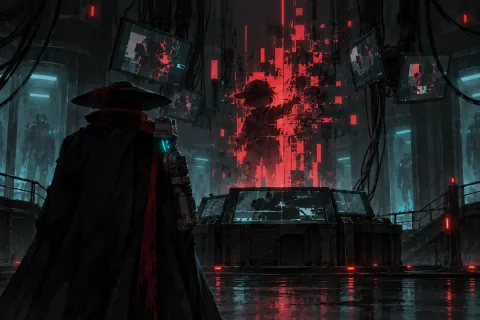
What follows does not happen after the true ending above. It is the bad ending reached by descending from the headquarters stairs to the basement where Sanabi supposedly waits, instead of returning to Mari. The results of the two choices are kept on separate timelines.
In the basement were Mago employees attempting to overload the nuclear power plant and explode the city. The General regarded them as the enemy he sought and attacked. The final survivor tried to explain that Sanabi did not exist, but he did not hear the explanation through. Eliminating the assigned objective took precedence over hearing the truth.
After the employees died, the image of his daughter in his memory glitched. Messages announced target elimination and project termination. The revenge he clung to closed as completion of a task set by Mago. Mari’s wish to reach her father, and his choice to return to her, did not continue.
This branch does not continue into the true ending’s reunion, final salute, or subsequent life. It adds no answer where the screen does not establish who issued the final command or what they felt. What can be confirmed is that reaching revenge’s end did not let father and daughter recover one another. The question Sanabi had posed from the beginning becomes clearer in that contrast. Simply reaching the end does not complete a person’s life.
Sources and Scope of Verification
Focusing on established events in the original main game, we compared the official introduction, developer interview, publicly available gameplay screenshots, and character and plot materials. The atmosphere and descriptions of emotion interpret the characters’ actions and dialogue. The early manipulated memories, actual past, present events, and different ending branches are distinguished; uncertain motives and subsequent events are not added as facts. Illustrations are AI reconstructions based on actual game scenes and designs verified through searches, rather than official images or exact cutscene copies. Codex directly wrote and compared the Korean text and 13 translations; Gemini was not used. Sources checked: October 9, 2026.
Official SANABI Steam page — introduction, supported languages, and purchase
Public SANABI main-game playthrough — view the events and scenes
Wonder Potion developer interview — family story and direction
https://news.denfaminicogamer.jp/english/240719a_en
SANABI plot cross-check — research records, family past, and both endings
https://m.namu.moe/w/%EC%82%B0%EB%82%98%EB%B9%84/%EC%A4%84%EA%B1%B0%EB%A6%AC
Cross-check of Mari Gold’s actions and background
https://sanabi.fandom.com/wiki/Mari_Gold
Cross-check of the General and Worker 17287’s background
https://sanabi.fandom.com/wiki/Protagonist
Cross-check of Major Song’s background and reunion
https://sanabi.fandom.com/wiki/Major_Song
Visual reference for the main game’s reunion illustration
https://steamcommunity.com/sharedfiles/filedetails/?id=3082015222
comments 1
준장과 마리의 마지막 경례 장면은 정말 잊을 수가 없네요. 하모니카 소리가 아직도 들리는 것 같아요. 😭