
SANABI Story 5 · Worker 17287, a Daughter Who Waited Ten Years
Chapters in this story
This is an original narrative commentary following the events of the main game. This installment covers the truth of the Sanabi Project and the actual past of Mari’s family. It contains spoilers for the main game’s central revelation.
1. The People Who Made the Memories
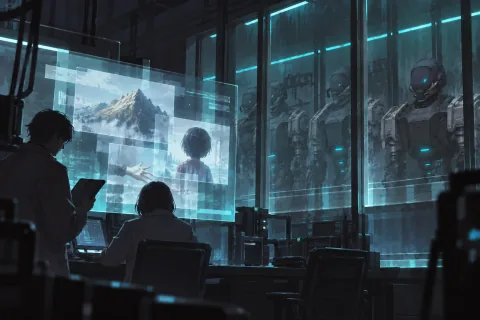
On the transport, Song discovered complex cognitive restrictions. The program prevented recognition of and communication with humans. Only certain key people remained exceptions. Forcing him awake from outside also risked overload that would reset the personality data. Security levels could be adjusted, but he would have to overcome the internal restrictions himself.
Baek decided to wait. He believed that, if this truly was his old superior, he could do it. He now guarded the one he had just knocked down with his mechanical prosthetic, instead of waking him recklessly. Certainty had not arrived. Yet he could not simply discard that fighting style and the voice calling their names.
The mountain landscape and his daughter appeared again in the General’s consciousness. This time, their forms wavered. The background began revealing the program’s structure. Research records that had not been erased remained inside. The concealed process unfolded: who had changed his memories, and why.
Mago had obtained a soldier’s completed personality data. The board wanted to use that personality as a weapon. The researchers could not refuse. The project began under a threat of immediate death for disobedience. People deprived of choice were made to develop technology that deprived someone else of it.
Choi Gyeon, chief executive of Mago’s trading company, wanted a program that obeyed direct commands. The researchers explained that this was no simple artificial intelligence. A personality copying a human mind would not move as desired merely because commands were entered. They therefore had to intervene in memories and emotions, leading it into actions it believed it wanted itself. The issue exposed by the mass-produced Justices reappeared within the explanation of this research.
The emotion they chose was hatred. They tried to use the soldier’s revenge after losing his wife, but he had not insisted on revenge to the end. He had chosen to return to his daughter. To remove that support, Mago’s researchers twisted the memories. The actual victim of the bombing had been his wife, but in the memories accepted by the personality, his daughter had died instead.
The method rearranged memories and concealed portions of them, rather than making memories from nothing. His daughter’s words on his birthday were joined to the discovery of a bomb. Conversations with comrades that led to retirement became meetings for his return to service. Past resentment toward Baek was overlaid with resentment over missing the new target. The early scenes were implanted memories, rather than events all repeated in the actual present.
2. The Sanabi They Could Not Erase
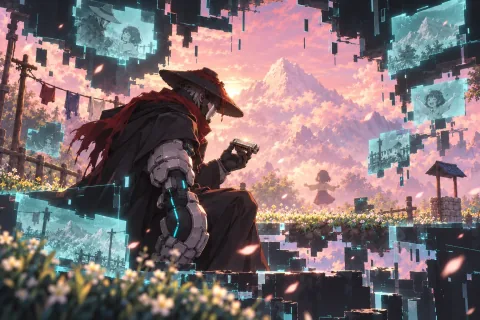
Even making him perceive his daughter as dead did not perfect the project. The concept of Sanabi remained deep within him. The feeling that reaching the end was not all that mattered opposed the blindness of revenge. The researchers tried to identify the concept, but some relevant memories were already missing.
That deletion preceded Mago’s acquisition of the data. Mari, who first created the personality, had removed the pain connected to her mother’s death. Even without memories explaining what it was, the emotions left by those recollections lived deep within. Mago could not find a way to restore them. Mari too had erased her traces and vanished, so they could not locate her.
The researchers therefore changed Sanabi itself into an enemy’s name. They made him believe it was the fictional terrorist organization that killed his daughter. The name of the feeling that stopped him became the objective that drove him to the end. Unable to erase a trace of love, they imposed the role of hatred upon it.
The cognitive filter maintained that control too. It blocked his recognition of humans so others could neither reveal the truth nor correct his mistaken beliefs. At the same time, it made him believe in the enormous anomaly that millions of people had disappeared from the city. Accepting that major contradiction made the smaller ones around him less conspicuous. The citizens’ disappearance was an explanation produced by his cognitive restrictions, rather than the actual disappearance of the entire city’s population.
Choi Gyeon was wary that certain key people remained exceptions. Meeting those people could break the control. The researchers replied that encountering those few among so many was nearly impossible. Yet on his journey the General had encountered them all: Mari, Song, and Baek. The relationships Mago had dismissed through numbers returned in reality.
After long research, the combat software was completed. For the researchers who devoted themselves to the project to survive, completion did not mean safety. After the final report, the research leader was murdered by the security team’s chief. The other researchers were purged too. Mago treated even the people who created the technology as evidence that would remain alongside it.
Workers were known as multipurpose labor robots. Yet one arm had the same structure as the chain arm. Putting the personality into innumerable bodies would create an army behind the appearance of labor robots. Mago’s objective was a coup. The Final Resolution Protocol was a mechanism prepared to erase every record, person, and the city itself if that plan was exposed.
3. Ten Years Left in the Mirror
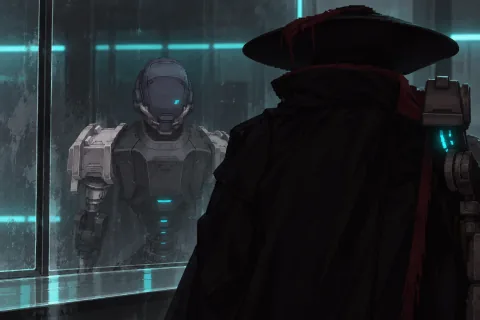
The General woke and looked in a mirror. The human form he knew was absent. A Worker was reflected there. Even the appearance he had understood as his own, a soldier with an old chain arm, had been part of his perception. Mari speaking to another Worker in the factory and Keeper’s designation Worker 17287 now converged on the same answer.
Baek spoke the first half of the unit’s motto. The General answered with its second half. Both juniors saluted. Before the entity they had tried to explain through data and programs stood someone they had known, loved, and respected. When he asked how long he had been dead, the answer was ten years.
It was not seventeen days since his daughter’s death. It was ten years since his own. His daughter had lived and grown during that time, seeking her father beside a machine that did not recognize her. Mari on the highest level was his daughter herself, rather than a girl trying to fill someone else’s place. Only belatedly could he understand what his words of rejection had meant to her.
The city now faced the nuclear power plant’s explosion. The royal court intended to annihilate it first. The General had to reach Mari. Song stopped him, asking whether he was going straight back to die again after returning in ten years. These were the words of someone who had not yet had time even to hold on to the joy of reunion.
Baek offered to take him there together. The General pointed out that helping him could itself become treason. His existence was a product of forbidden technology. He told Baek, now a commander, to make the right judgment. He would not turn his juniors’ loyalty toward dying alongside him.
His military hat and iron identification token returned. The hat Baek had kept, the trace of the child that Song had preserved. The token was worn and cracked with age. Time that seemed near in his memory carried ten years’ weight upon the object. His juniors had kept their longing through his absence as well as his equipment.
The General conveyed to Baek that he had let go of his resentment over his wife’s death. It was forgiveness he had not sufficiently expressed while alive. Baek had carried responsibility and guilt for a long time. This farewell sought to let him put them down before it was too late.
To Song he left a half-joking admonition that her punches were weak and she should exercise more. Rather than blame her for striking him, he returned to the way an old superior addressed a junior. She choked up, unable to finish her salute. Baek comforted her beside him. Attacking him because she failed to recognize him and having to let him leave again overlapped within the same brief reunion.
4. The Grief His Daughter Tried to Remove
The General descended through the city. Passing the central factory and commercial district, he returned to the lowest level. He donned his cloak and pulled out his limiter components himself. Revenge no longer drove him. To reach Mari and keep his promise, he began using the strength he possessed.
As he climbed the city again, Mari’s actual memories continued. Her mother had died. Remnants of a terrorist organization her father had suppressed carried out a retaliatory bombing. Her father evacuated Mari to a safe house and issued Operation Zero. The anger that violently destroyed criminal organizations had genuinely existed then. Yet for his daughter, he stopped his revenge and retired.
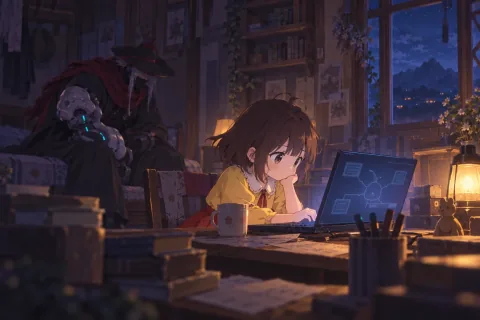
Returning home did not erase grief. He endured his wife’s empty place and the weight of responsibility for his daughter. He tried to conceal it from her, but Mari saw him crying at night. Her strong father was hurting in a place without any enemy. She wanted to fix it with the talent she possessed.
At eight years old, Mari created her father’s personality data. She removed the memories connected with the pain her mother’s death had caused her father. She believed that taking them out would stop him from being sad. The child could not yet comprehend the meaning of technology that erased another person’s mind, or what desires might make that data their target.
For the first time, her father became truly angry. Even researching that forbidden technology carried the ultimate punishment. To protect his daughter, he tried to destroy the data. But a backdoor had already been planted in the computer. Someone already knew about the created personality. Armed intruders attacked the house, killed her unarmed father, and took the data.
The General’s death was investigated. But all the attackers were found dead in a warehouse, and evidence identifying them disappeared as well. The party behind them was concealed. Though the case concluded as a criminal organization’s retaliation, Mari’s life did not end there. The guilt that she had killed her father remained and grew. Distanced from school and daily life, her life became bound to investigating the people who killed him.
5. The Daughter Who Called Her Father Back
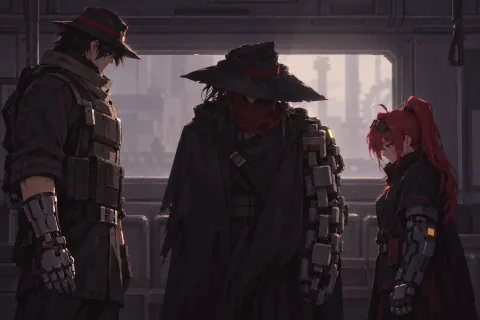
Mari eventually discovered that Mago was behind it. The data she made for her father had become a weapon avenging a daughter it believed lost. It was an outcome far from her first wish to ease his grief. The Sanabi Project secured by her hacker acquaintance was the substance of that crime, but discovery of the leak prompted Mago to begin the city’s destruction.
The lives of 2.97 million citizens were at risk. What Mari had left was a stolen copy of the project. She put it into Worker 17287, set its objective to meet her and stop the city’s explosion by dismantling the core beneath headquarters, designating that task as Sanabi, and waited inside the city. The scenes the General remembered, including his initial military return and helicopter journey, were memories joined together to make him move here.
Mari wanted to save the city. At the same time, she wanted to see her father. She knew better than anyone that the irreversibly reprogrammed personality could not return to its original state. Still, she could not abandon the hope that, if she showed him the words and actions of her childhood, her father might recognize her somewhere within it.
Her bright expression and excessive chatter at their first meeting, explaining operations through drawings, and repeatedly offering the harmonica were connected to that hope. Even when she left in fear, she returned. The refusal to lose her father again and the despair that expecting a father who would not return might be self-deception held her in turn.
When Mufin was lost, the General’s statement that it was merely a machine reached that final hope. So did his insistence that he was not her father. Mari was no stranger asking him for something he could not understand. She was a daughter, repeatedly presenting her childhood self to someone she still could not call Father after waiting ten years.
The General was now traveling toward the end of that time. The fact that he was a machine carrying the data of someone who had already died did not change. Yet that fact alone did not determine his choices. The weapon Mago sought to create moved because his daughter was dead. He now moved because she was alive.
Sources and Scope of Verification
Focusing on established events in the original main game, we compared the official introduction, developer interview, publicly available gameplay screenshots, and character and plot materials. The atmosphere and descriptions of emotion interpret the characters’ actions and dialogue. The early manipulated memories, actual past, present events, and different ending branches are distinguished; uncertain motives and subsequent events are not added as facts. Illustrations are AI reconstructions based on actual game scenes and designs verified through searches, rather than official images or exact cutscene copies. Codex directly wrote and compared the Korean text and 13 translations; Gemini was not used. Sources checked: October 9, 2026.
Official SANABI Steam page — introduction, supported languages, and purchase
Public SANABI main-game playthrough — view the events and scenes
Wonder Potion developer interview — family story and direction
https://news.denfaminicogamer.jp/english/240719a_en
SANABI plot cross-check — research records, family past, and both endings
https://m.namu.moe/w/%EC%82%B0%EB%82%98%EB%B9%84/%EC%A4%84%EA%B1%B0%EB%A6%AC
Cross-check of the General and Worker 17287’s background
https://sanabi.fandom.com/wiki/Protagonist
Cross-check of Mari Gold’s actions and background
https://sanabi.fandom.com/wiki/Mari_Gold
Cross-check of Colonel Baek’s background and reunion
https://sanabi.fandom.com/wiki/Colonel_Baek
Cross-check of Major Song’s background and reunion
https://sanabi.fandom.com/wiki/Major_Song
comments 1
십 년이라는 시간이 마냥 길게만 느껴졌는데, 글을 읽으니 그 무게가 더 아프게 다가오네요. 마리가 아버지를 기다리며 보냈을 시간과 준장이 마주한 진실까지… 다시 게임 켜서 사슬팔을 휘둘러야겠어요. 😢