
ព័ត៌មានសំខាន់
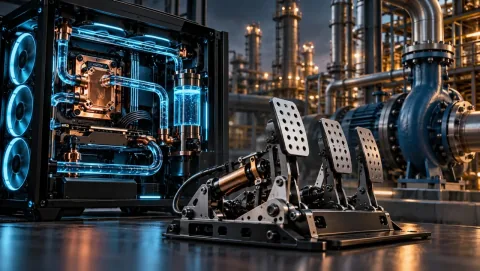
Water-cooled PCs, hydraulic sim racing pedals, and refinery pumps all rely on fluid behavior. While a refinery pump moves large volumes against heavy resistance, a PC loop handles smaller restrictions, and a hydraulic brake pedal displaces minimal fluid to build pressure.
Flow rate measures volume over time, whereas pressure difference drives movement against resistance. Pumps operate where their performance curve meets system resistance. Maximum flow figures measured with little restriction do not reflect crowded cooling loops.
Fluids can exhibit laminar flow, turbulent flow, or a transition region. Mixing in turbulent flow aids heat transfer in CPU blocks, while refinery piping frequently sees turbulence. Conversely, brake circuits require consistent pressure transmission with minimal movement.
When temperatures disappoint, builders should inspect for kinks or clogs before buying stronger pumps, as extra speed can increase noise without improving temperatures. Similarly, industrial engineers must evaluate suction conditions to prevent vapor bubble damage.
Sim pedals replicate real brake responses using load cells, springs, elastomers, or hydraulic pressure. Compatibility checks, such as matching fittings and ensuring secure mounting, prevent costly mistakes before hardware installation.


