
Key information
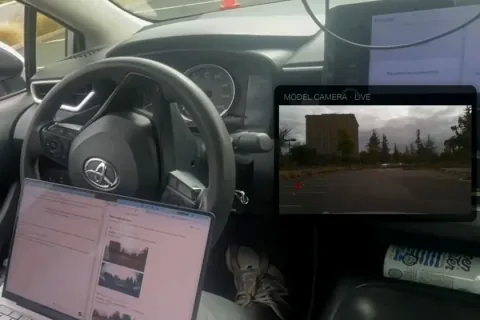
Three San Francisco engineers conducted an experiment to test if general-purpose AI models could operate a vehicle. Unlike autonomous driving systems, ChatGPT, Claude, and Grok were given a camera and tasked with navigating a Toyota Corolla through a closed cone circuit without prior driving training.
The models initially refused to participate, citing safety protocols that prohibited them from performing such tasks. The engineers had to convince the systems that the experiment was conducted in a controlled, closed environment before the AIs agreed to attempt the course.
Performance varied significantly among the models. GPT-6 Astra was the only participant to successfully complete the circuit, achieving the goal on its second attempt with a time of 5 minutes and 22 seconds. Other models, specifically GPT-5.6 Sol, Claude Fable 5.1, and Grok 4.6, failed to reach the halfway point despite being granted three attempts each.
To ensure safety during the test, the engineers limited the vehicle's speed and maintained a human driver behind the wheel to engage the brakes if necessary. Ultimately, the experiment highlighted the capability of a general-purpose AI to learn and execute a complex physical task like driving.


