重點資訊
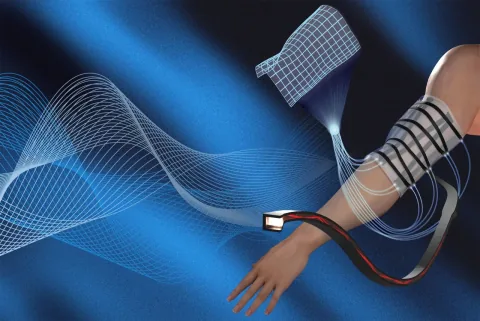
MIT engineers have developed a soft, wearable sheet capable of tracking its own 3D shape and movement. This technology, which utilizes optical fibers to monitor bending, could eventually support applications in virtual reality, gaming, and physical therapy. Lab tests indicate the device maintains a tracking error of less than half a centimeter.
The sensing surface consists of 14 flexible rubber waveguides embedded within a 16 x 16 x 0.5 cm silicone sheet. By roughening one side of the fibers, the team enabled bi-directional sensing, allowing the system to detect bending in different directions. An external circuit board processes the data, with a MATLAB algorithm reconstructing the 3D shape approximately three times per second.
While the technology is resilient to damage, allowing for shape reconstruction even if some fibers are disconnected, it faces current limitations. The 1 mm thick fibers are considered bulkier than ideal for clothing, and the sheet does not stretch, which can interfere with the algorithm when applied to joints like wrists or elbows. Additionally, the force-sensing capabilities currently lack calibrated readings.
Future development aims to refine the technology by utilizing thinner fibers, potentially reaching the scale of human hair, to enable the creation of smart garments. Researchers also plan to implement faster solvers to improve processing speeds and explore designs that allow for simultaneous force and shape detection.