Key information
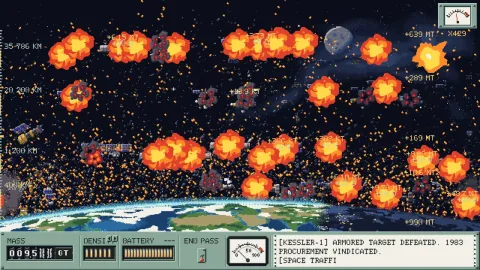
Swiss two-person independent studio Periapsis Works has announced that their retro-style space incremental adventure game, KESSLER: Orbital Incremental, is scheduled for release on November 6 with Traditional Chinese language support. The game draws inspiration from the real-world hypothesis formulated by NASA scientist Donald J. Kessler in 1978, which suggests that high orbital object density could lead to a cascading cycle of collisions rendering certain orbits unusable.
Players take control of the KESSLER-1, a top-secret Soviet satellite launched in 1983 with orders to blockade the sky that was forgotten after the war ended. Awakening in 2041 amidst a crowded sky with only a single gun, a small battery, and thousands of targets, players will trigger the Kessler syndrome by destroying satellites and watching the debris tear through the orbital paths.
During gameplay, KESSLER-1 can be modified in maintenance bays between orbital passes with dozens of upgrade directions, including chain lightning and burning debris modules. Players will ascend from 400 km up to the geostationary orbit and reach the Concorde space station, while interacting with characters such as the space traffic control center and a former engineer, with the complete version offering a playtime of approximately 4 hours and two endings.