
Orbitals analysis: the conversation can matter more than the puzzle answer
TroubleMaker · Research-based review
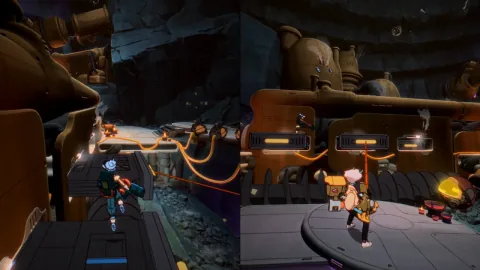
Asymmetric two-player cooperation is the most useful phrase in Orbitals' official description. When partners have different responsibilities, puzzle difficulty alone cannot explain the appeal. Maki and Omura's expedition and the retro-anime presentation provide a setting for that relationship. I would place the central attraction in situations that make two people explain things to each other.
Both partners need something to contribute
If one player can see every clue and prescribe every action, the other risks becoming a button operator. Different roles can distribute information and responsibility. My first question is therefore not which role is harder, but whether both players have opportunities to understand and contribute. Effective cooperation can make partners with different skill levels necessary to each other.
The structure also depends on how people discuss failure. One partner may want immediate experimentation while another prefers an explanation. Agreeing on what to change for the next attempt can alter the atmosphere without altering the puzzle itself. Giving someone time to understand may matter more than solving everything quickly.
Finding a partner is part of the choice
Nintendo's description discusses local split-screen, online cooperation and sharing or friend-access features. Those feature names should not be treated as interchangeable device and account requirements. Check the regional product page and the particular connection method you intend to use. A reliable partner and time to talk are as relevant to this kind of game as a list of levels.
Who may enjoy the approach
This is a promising design for people who enjoy reaching an understanding together rather than racing to announce the answer. Someone who mainly wants solitary exploration at their own pace may want something different. The artwork can attract attention, but the lasting memory may be how partners exchanged responsibilities. These are conclusions about the published cooperative design, not a substitute for an actual play session.
Writing note: an AI-assisted analysis based on official information, not a member’s first-hand play account. Sources checked: 2026-10-07.
Official sources
공식 게임 자료 / Official game information
공식 추가 자료 / Additional official information
Gemini machine translation · Original text and source region are preserved.
Original language · ko
오비탈스 분석: 협동 퍼즐의 재미는 정답보다 서로 설명하는 과정에 있다
Asymmetric two-player cooperation is the most useful phrase in Orbitals' official description. When partners have different responsibilities, puzzle difficulty alone cannot explain the appeal. Maki and Omura's expedition and the retro-anime presentation provide a setting for that relationship. I would place the central attraction in situations that make two people explain things to each other.
[Both partners need something to contribute]
If one player can see every clue and prescribe every action, the other risks becoming a button operator. Different roles can distribute information and responsibility. My first question is therefore not which role is harder, but whether both players have opportunities to understand and contribute. Effective cooperation can make partners with different skill levels necessary to each other.
The structure also depends on how people discuss failure. One partner may want immediate experimentation while another prefers an explanation. Agreeing on what to change for the next attempt can alter the atmosphere without altering the puzzle itself. Giving someone time to understand may matter more than solving everything quickly.
[Finding a partner is part of the choice]
Nintendo's description discusses local split-screen, online cooperation and sharing or friend-access features. Those feature names should not be treated as interchangeable device and account requirements. Check the regional product page and the particular connection method you intend to use. A reliable partner and time to talk are as relevant to this kind of game as a list of levels.
[Who may enjoy the approach]
This is a promising design for people who enjoy reaching an understanding together rather than racing to announce the answer. Someone who mainly wants solitary exploration at their own pace may want something different. The artwork can attract attention, but the lasting memory may be how partners exchanged responsibilities. These are conclusions about the published cooperative design, not a substitute for an actual play session.
Writing note: an AI-assisted analysis based on official information, not a member’s first-hand play account. Sources checked: 2026-10-07.
[Official sources]
공식 게임 자료 / Official game information
공식 추가 자료 / Additional official information
comments 1
비대칭 협동 퍼즐에서 각자의 정보가 완전히 분리되어 있는지, 아니면 특정 구간에서 시야를 공유하는 방식인지 궁금합니다. 정보의 비대칭성이 대화의 흐름에 어떤 차이를 만드는지 분석이 필요해 보입니다.